

Welcome to Shia Rights Watch

spot_imgspot_imgspot_imgspot_img
Home Blog Page 56

Guess Which Countries are Spending Most on Arm Forces and Weapons?

SIPRI, Stockholm International Peace Research Institute, one of the reliable research institutes that researches into the arm control published a scary report on the increase spending on arms by countries with most human rights violations. According to the report China, Russia and Saudi Arabia are among the 23 countries around the world that have more than doubled their military expenditure since 2004. While developing countries are springing more on weapons, western countries such as US is spending less on arm forces and weapons.
Saudi Arabia’s spending increased by 14 per cent and reached $67 billion,

Bahrain’s spending increased 26 per cent,

Iraq’s spending is up to 27 per cent,

The report highlights that eight states bordering the Gulf—Bahrain, Iran, Iraq, Kuwait, Oman, Qatar, Saudi Arabia and the United Arab Emirates (UAE) are countries that invest most in arm forces and weapons.

Such report raises the important question of why such countries are inverting so much on weapons. And where do they buy these weapons from?

History reveals that all these countries have been involved in human rights violations, arm conflicts and unrest. Number of these countries, such as Saudi Arabia and Qatar, are well known for arming different terrorist groups. Some others, such as Bahrain, are well known for oppressing peaceful pro-democracy native protestors.

It is interesting how money and economic priorities result in killings of many activists and pro-freedom civilians. The fact that all mentioned countries buy the weapons to mainly confront their own citizen is crystal clear to all yet no company or government stopped selling weapons to those countries. Except Korea that stated they stopped selling to Bahrain, no other country claimed such rightful decision.

If and only IF, international committees and nations would stop selling arms to countries that are famous for their human rights violations, there would be a hope for the peace in the future of the Middle East….

Too bad….

Every nation needs money and guest who has it?

Oil reached companies of Middle East…..

So it’s OK if they are killing people with it, as long as they pay CASH for the weapons….

by Hawraa Zakery, Human Rights Reseracher                      on    April, 15,2014
Signs of Bahraini Government’s Weakness

Nineteen people were arrested today, April 14th, in different areas of Bahrain; 17 were arrested during a home raid without a warrant from the court, and 7 others arrested on the street.

Yesterday, six children between the ages twelve and fourteen were arrested at one of the check points in the Daih area. The children arrested are reported below:

Muhammad Shakir, 12 years old

Ja’afar Hani, 14 years old

Hussian Mashi’a, 12 years old

Ahmad Hani, 12 years old

Ali Shamloh, 13 years old and

Wadi’a Wadiee (age not reported)

According to activists many children are held in detention centers in Bahrain, many of whom need medical attention after torture and maltreatment.

Increasing arrests and torture are a sign of the Bahraini government’s weakness. SRW believes that violence and human rights abuses are the reaction of a weak and fearful government.

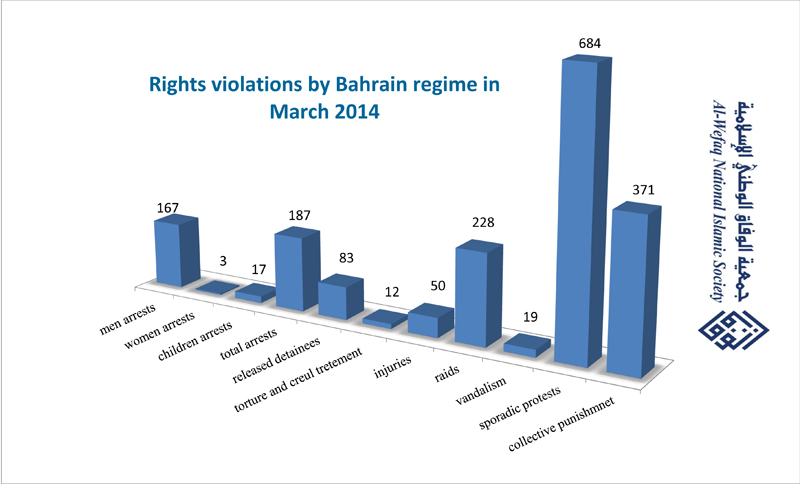
Bahrain in March 2014

1The Liberties and Human Rights Department (LHRD) in Al Wefaq National Islamic Society reported the Shia rights violation in Bahrain during the month of April.

In its report, the organization reported as many as 228 home raids during the month of April that involved confiscation of personal belongings by the governmental forces. Tear-gas was used in most cases on family members and children.

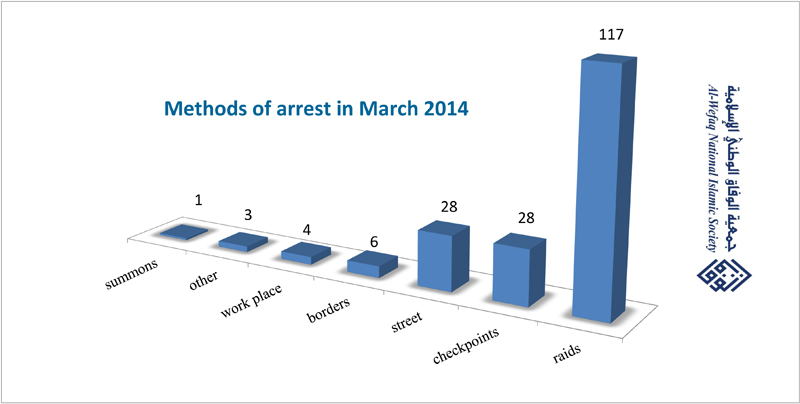
Also in this month, 187 arrests were documented 17 years or less. According to the organization, “117 of the total arrests took place during home raids, while 28 were arrested from streets, 28 from checkpoints, 6 at the borders and 4 from workplaces”.

During the month, 12 cases of torture and mistreatment were reported to the LHRD.

Human rights violation towards the Shia majority is taking place in Bahrain everyday yet the international committees have failed to pressure the kingdom.

SRW has been following with news in Bahrain and has used all its influence to report the violations.

2

Torture Routine in Syria

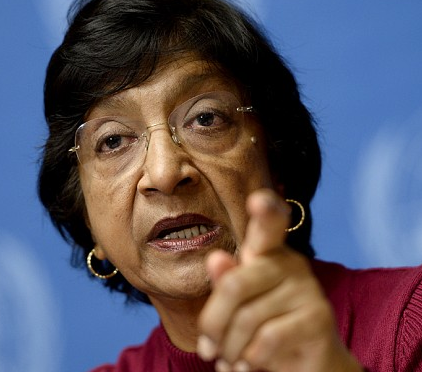
UN High Commissioner for Human Rights, Navi Pillay, said torture was routinely used in Syria while condemning the violence in Syria in a paper released by the High Commissioner’s office.

While government forces, opposition forces, and various other armed groups blame each other for ongoing violence that so far has claimed 150,000 lives, many, including women and children, are being tortured.

Unrest in Syria has created a safe haven for many terrorist groups to carry out inhumane acts. It takes a great deal of either ignorance or apathy from the international community to allow torture to become routine. All who engage in torture, violence and targeted killings must be punished. It will take an international effort in the case of Syria since fighters from 70 countries are present.

SWR commends Navi Pillay for her statement and hopes more leaders will take action and talk about the extreme violence in Syria.

Office of Imam Shirazi Representative Vandalized in Possible Hate Crime

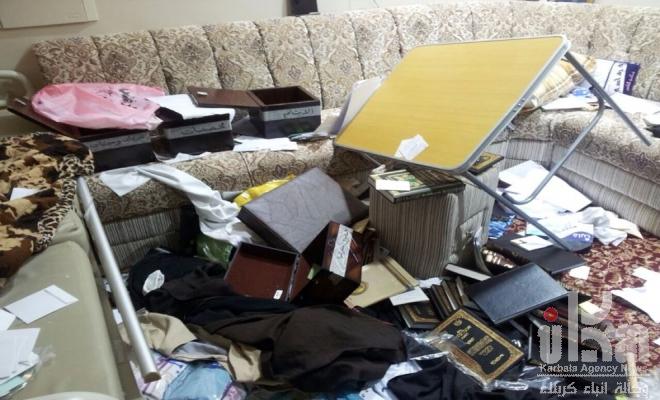
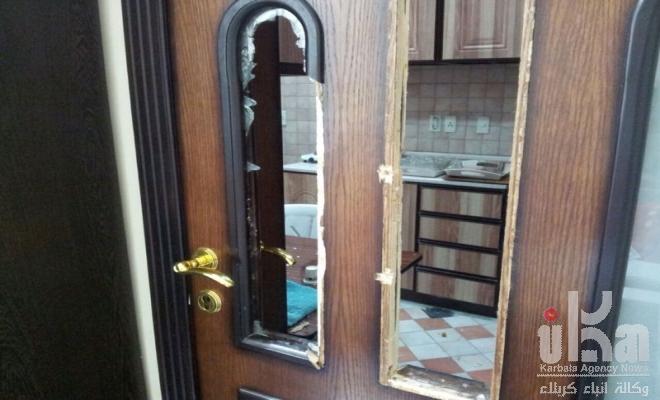
shirazThe office of the Imam Shirazi’s representative in Saudi Arabia was vandalized today as witnesses describe the incident as a hate crime. According to the witnesses the office of Seyed Tahir Shamimi, the representative of the Imam Shirazi, in Al-Awamiyah was attacked by unknown masked men. As the result windows were defaced, and a glass door was shattered.

Imam Shirazi is a well-known Shia scholar whose followers have been attacked in different countries for their critiques towards oppressor governments.

Saudi Shia have been attacked by government forever, however recent attacks are carried out by unknown people. Last week an attack to Shia Muharram commemoration resulted in death of a teenager and 7 adults. Saudi authorities have always oppressed this population and spread hate speeches against them.

SRW urges Saudi government to investigate increasing crime against Shia Muslims and recognize this population as rightful citizens.

shirazz

Pakistan in March 2014

Shia targeted killings in Pakistan claimed 21 lives during the month of March. As activists reported following members of the Shia community were killed last month in this country.

      Sahid Ali killed in Karachi on 03-03-2014

      Samar Alam killed in Karachi on 03-04-2014

      Raza killed in Karachi on 03-04-2014

      Manzoor Hussain Raza killed in Karachi on 03-05-2014

      Abn al Hassan Ali killed in Karachi on 03-05-2014

      Muhammad Ali killed in Karachi on 03-07-2014

      Iftihar Hussain Peshawar on 03-09-2014

      Ikhtar Hussain, Naeem Jafri, Fazal Abbas killed in Karachi on 03-11-2014

      Shukat Hussain killed in Dera Ismail Khan on 03-15-2014

      Khuram Abdi Ali killed in Karachi on 03-16-2014

      Iftikhar Hussain killed in Karachi on 03-18-2014

      Dr.Babar Ali killed in Attock on 03-19-2014

      Manzoor Talpor killed in Khair Pur on 03-20-2014

      Ghulam Nabi, Anwar Jafri killed in Hala Naka on 03-20-2014

      Shujaat Hussain, Shujaat Hussain Jafri, Agha Jamil killed in Karachi on 03-22-2014

      Zulfikar Ali killed in Karachi on 03-24-2014

      Haidar Zulfikar killed in Karachi on 03-31-2014

Shia population of Pakistan has been target of anti-Shia terrorist groups for centuries, yet the government failed to protect them. SRW have been using all its power to advocate for this minority in west and urges all to take it upon themselves to stand up for the rights of Pakistani Shia.

Commemoration of 1991 Shia Massacre in Iraq

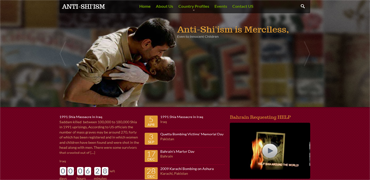
Anti_shiismOn April 5th, along with the commemoration of the memory of the victims of  1991 Shia massacre in Iraq, Shia Rights Watch department of research on Anti Shiism  begins its operation to gather data on history of violations, abuse and discrimination against Shia Muslims around the world.

End of dictatorship in Iraq was a happy news but revealed many sad stories that were hidden until then. After the fall of Saddam regime in 2003, the post war investigation of Iraqi and U.S. experts revealed at least 270 mass graves to exist across Iraq. According to a Congressional Research Service report most of the bodies found in the mass graves belonged to Shia Muslims, whom were killed after the 1991 uprising (Katzman, 2009). Bodies of many children and women were found at al-Mahawil mass grave near the Shia populated city of Hilla, 56 miles south of Baghdad. Matching the bodies to the names is a difficult task as the relatives of the victims have to identify their loved ones from their accessories like glasses and personal effects, according to Daily Mail 15,000 bodies found in four mass graves around Hilla alone, the total number bodies found in all mass graves can rise to at least 300,000.

In months following the 1991 uprising, about 17,000 people including Shia clerics and students were reported as disappeared, and thousands displaced, detained, tortured and killed. Many of the families still don’t know the fate of their relatives. Following the event, the Ba’ath regime began massive attacks on Shia faith and rituals, by destroying mosques, Islamic Centers, burning down libraries, desecration of holy sites, closing religious schools, censoring publications and forcing the Shia clerical establishment to endorse and praise the regime.

AntiShiism.org is a new hope to shed lights on the oppression that Shia have been through and welcome every humanitarian effort to demand a change that stops these tragic targeted violations from happening again.
Shia Rights Watch commemorates the victims of April 1991 Shia Massacre in Iraq and simultaneously launches AntiShiism.org in order to establish a well-documented informative network about the Shia rights violation. This organization welcomes every individual to take action and pledge to make the world free of prejudice, hatred and discrimination against minorities.

Please join us at www.AntiShiism.org.

Four Car Bombs Attacks in Iraq

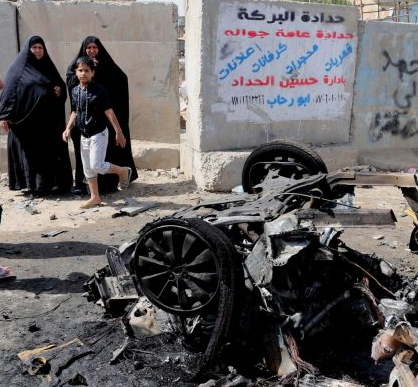
newsToday, 30 were killed and 46 wounded in a series of bomb attacks in Shia populated areas of the Baghdad according to local sources. Four cars exploded: one in Sadr City district, one in Kazimiyah, one in Shaab and one in the Shammaiya neighborhood.

Iraqis lost about 9000 people to terrorist attacks in 2013 and 2014 has been another deadly year so far. Most bombings target Shia populated areas killing many civilians, and injuring even more.

Some claim the attacks are a sign of discontent from the Sunni population towards the Shia government. However civilians are the main target of the attacks says SRW. If the opposition is carrying out the bombings it makes more sense for them to attack the government forces and bases, yet the attacks have been carried out against civilians. SRW believes the attacks that target civilians are a form of anti-Shi’ism and not an anti-government expression.

Water Cut Off in Iraq: Inhumane Treatment Suggested by Deilami

Taha Deilami, an Iraqi cleric, called on Al Anbar Province residence to cut off water to Shia populated cities, especially in south Iraq.

According to him, residence of Al Anbar Province that is equivalent of one third of the area of ​​Iraq are Sunni and the area must be free from any Shia. Historically, the province was known as the Brigade Dulaimi before 1961. The province borders Salahuddin and Nineveh on the north, Syria on north-west, Jordan on the West, Baghdad on the east, Saudi Arabia on the South and Karbala and Najaf on south-east.

Deilami claimed, in his TV show on Wesal channel, if the Sunni cut off the flow of Euphrates river water many people would die.

As a result, on April 7th, ISIS blocked flow of Euphrates river water from the central and southern Iraq leaving many farmers and residents of the area with no water.

Anti-Shia clerics and influential public figures have been using their popularity to encourage sectarian violence and spread hatred among people in Middle East. Taha Deilami, Youssef al-Qaradawi, Saad al-Durihim, A’ajami and many other are enablers whose speeches resulted in many killings and human rights violations. Such people must be held responsible for the crimes they encouraged and be investigated by international criminal courts, says SRW.

Iraqis who live under the poverty line, lost many family members, lack security and freedom now are facing water cut off thanks to the Taha Deilami and ISIS.

Shia Rights Watch strongly condemns such inhumane act of ISIS and urges Iraqi government to hold Deilami responsible for the water cut off and restore the water flew immediately.

Universal Empathy: Promising Solution

Need to develop universal human rights respect and empathy can be a promising solution to the growing oppression around the world.

Historically many oppressor governments and regimes used foreigners as soldiers to implement so called security rules, to torture in prisons, to investigate antigovernment movements and more. Moreover, they use foreigners as labor forces, as it is usual in most Gulf countries, for examples:

  • Bahraini inmates have always complained that their guards do not speak and understand Arabic and therefore could not response to their needs,
  • In the unrest of Iran during 2009/10 election , protestors stated the government used Lebanese soldiers to suppress them,
  • Pakistani forces are used in Saudi Arabia and Bahrain to fight with pro-democracy protestors,
  • In the conflict of Syria people from all nationalities are fighting pro and against government.

And the list goes on and on.

Relying on forces from outside is a politically important strategy by countries with most human rights violations. This strategy factors out the important element of mercy and empathy among people who share same ethnicity or nationality. Soldiers who do not understand the language of the protestors do not understand the rationale behind the protest, cannot understand the prisoner when he/she is starting to be innocent, cannot respond to the medical need of the inmate after torture and so on. Besides using foreigners as forces, these governments use foreigners as labor force in order to avoid labor unrest that could impact the economy of the country.

Countries with dependency on foreign labor and political forces such as Bahrain lessen their natives’ role in political and structure of their country which is a clear violation to the basic rights of the people.

Now that governments “use/abuse” people against their fellow human beings, it is up to us, as citizens of one world, to stand up and develop universal empathy toward each other especially when we do not share same background, ethnicity and faith.

The belief that governments and authorities are the most powerful forces to change the world is a myth, at least to me as a human rights activist. Most of the times, in order to spread peace and freedom we do not need to follow governments because they have their own political agendas, but we need to follow our hearts. After all we are all citizen on one world and we all have empathy towards each other.

When we empathize we become the most powerful force that can spread peace and freedom.

 Hawraa Zakery, Human Rights Researcher           on April 8/2014

UN Complaint