

Welcome to Shia Rights Watch

spot_imgspot_imgspot_imgspot_img
Home Blog Page 26

Incidents of Anti-Shiism in September, 2016

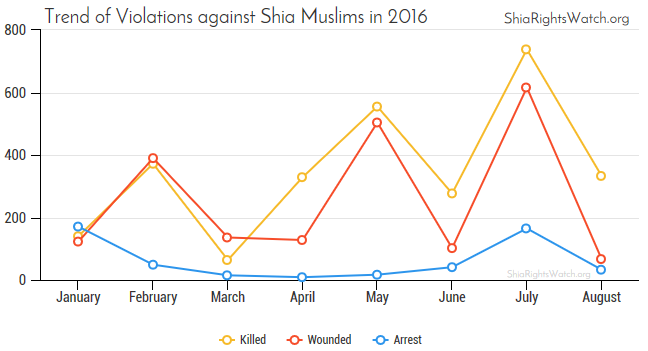
Shia Rights Watch_Trend of Violations against Shia Muslims in 2016

Iraq


Death count in Iraqi Shia has totaled 372 in the month of September. Baghdad topped the charts with the majority number of Shia killed, with Madain following second. Targeting of Shia Muslims in Madain has been on a particular rise in the year 2016. The majority of deaths has been due to IED’s, suicide bombings and gunfire.

As the number of injured exceeds the casualty count, one can understand that the aim of Shia targeting is not only elimination of this population but also induction of fear. The majority of attacks, 99%, were targeted at not religious centers, but at everyday destinations, such as cafe’s or marketplaces and shopping centers.

Incidents of particular concern have been a chain of explosions in densely populated areas of Baghdad, particularly the neighborhoods of Hurriya, Husainiya, Diyala bridge, and Abu-Dashir . Attacks were claimed by ISIS. ISIS targeting of Shia-populated areas have been ongoing since their reign and little attention has been given to them. Anti-Shiism sentiment adopted by ISIS has held a long history in Wahhabi extremism.


Saudi Arabia

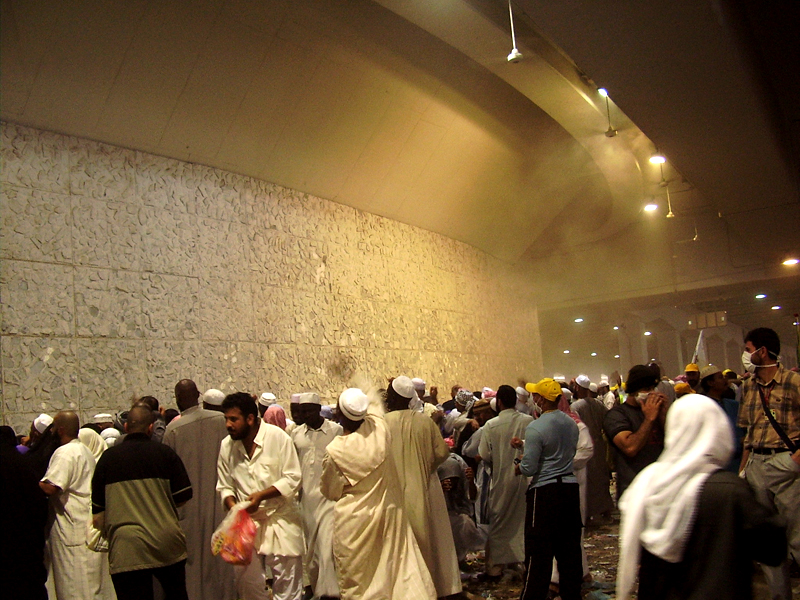
This year, September began in unison with the Muslim Hajj season. In light of last years targeted abuse of Shia Muslims in the Hajj processions and in efforts to reduce anti-Shiism, Shia Rights Watch issued a travel advisory warning Shia Muslims of possible tensions and encouraging reports of human rights violation. Total transparency on the part of Saudi Arabian forces and Shia pilgrims was also encouraged.

However, Shia rights abuse continued to persist as a total of 17 Shia Muslims were detained unjustly. In addition, many Shia report having to undergo extra process in entering the Kingdom. Thirteen of the 17 arrested were Bahraini citizens, which raises concern as hajj processions are a religious rituals with the aim of creating unity among the global Muslim community and spreading peace. With their arrests, Saudi forces have disrupted the peace and have used hajj as a means of political control in the region.

Ala Taha, an Iraqi scholar was also arrested in this years Hajj procession. In mid-September, Taha was sentenced to three-month incarceration and a total of 300 flagellations. With the efforts of Shia Rights Watch legal and advocacy team, and the Iraqi Embassy, Taha was released before the end of hajj processions.

Three other Shia scholars Sayed Zainedin, Sayed Jafar Mosavi and Abo-Hamed Yousofi were also detained upon their entrance to the Medina airport.

Anti-Shiism in the Kingdom of Saudi Arabia is systemic as scholars and religious leaders in the nation have encouraged hatred. One example of this is the twitter post of Mufti A’eth al-Gharni, in which he denounced 80 million Shia earlier this month.


Pakistan

On the eighth of September, punjabi police forces raised a women’s seminary in Hussainabad, sahiwal, without warrant. Anti-Shiism sentiment has been on the rise in southeast Asia, specifically Pakistan. In the past, anti-Shia actions were carried out by extremist groups such as LeJ or SeS in forms of targeted bombings or shooting of Shia in prominent social classes. The recent rise in unwarranted raids of Shia Islamic seminaries is a sign of escalating anti-Shiism tension in Pakistan. Shia Rights Watch has and continues to warn the rise of such sectarian hatred as little justice has been displayed. Justice must be served and recognition of wrong doing must be announced by responsible parties in order to reduce sectarian conflicts in not only Pakistan, but also the region.


Bahrain

Conditions in Bahrain continue to be striving for Shia citizens. Abbas Abdul-Nabi, an activist has been placed in solitary confinement. Abdul-nabi has been critically ill as result of police brutality on peaceful protest. Abdul-Nabi has been denied medical attention.

If not detained, numerous activist have been denied leaving the nation, one such being Sharaf al-Mousawi. Ahmed Reda, a journalist, has also been restricted from traveling outside of Bahrain- no reasons have been announced for said restrictions.

Upon the return of Hajj, many Bahraini travelers have had their passports withheld.


Mauritania


A prominent Mufti in Mauritania has called for action against the growth of the Shia religion in this country. This outright denouncement of Shia community is a display of an expansion of anti-Shiism in this country, and more importantly in the region. Shia Rights Watch strongly condemns any isolation of minority communities in Mauritania and urges peaceful action against hatred.
Letter to Embassies for Muharram 2016: “Make Brotherhood and Non-Violence your New Year’s Resolutions”

shia-rights-watch_moharam2016

As Muharram is approaching, Shia Rights Watch writes to embassies to ask for protection of Shia Muslims during their Ashura gatherings. Muharram is the first month of Islamic year when many celebrate New Year and many others postpone their celebrations in order to commemorate the death of a peacekeeper, Husain.

The letter is as follows:


Dear Honorable Ambassador,

On the occasion of the Hijra New Year, it’s our honor to extend to you our greetings and sincere wishes. We at Shia Rights Watch hope for this year to be prosperous for you and the people of your country.

As you are celebrating the New Year, Shia Muslims in your community are commemorating the death of a man who stood for justice and the rights of others, Husain. Husain ibn Ali is the Prophet Muhammad’s grandson. During this important time, it is important to model the spirit of acceptance and respect by taking actions to prevent any violations and hatred towards this minority. During past years, Shia minority faced forms of violation and pressure during the month of Muharram, and it would add to the sincerity of the government to protect Shia Muslims this year, so they perform their rituals under the safety provided by their government.

We encourage you to make respect, brotherhood and non-violence part of your New Year’s resolutions.

At SRW we believe that respect and protection of religious freedom are the keys to peaceful coexistence and mutual respect. We call upon all governments to respect the rights of their citizens and protect their lives and property. Please keep in mind that Muharram rituals are not the political movement, but rather religious and spiritual gathering that advocate for peace and brotherhood.

Sincerely,

Mustafa Akhwand

Director of SRW

Peace Day Youth Summit at the United Nations Headquarters

Shia rights watch_peaceday

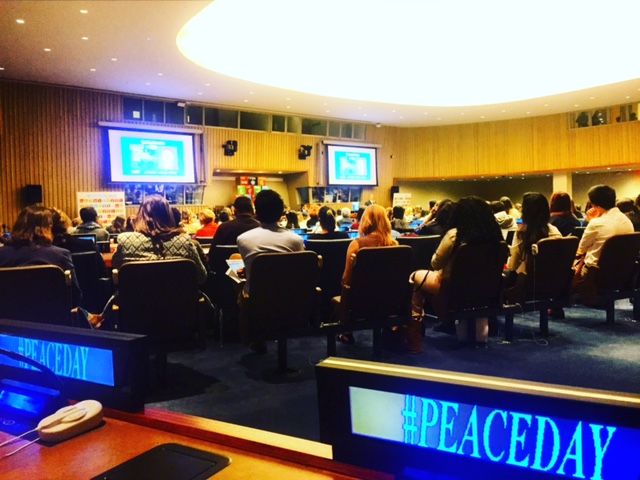
Representative of Shia Rights Watch attended an event sponsored by UNDPI, titled Peace Day. The Peace Day Youth Summit focuses on Youth engagement for peace. Today %50 of the world population is under 30 and 1.8 billion are ages of 11-24. We currently have the largest Youth population in history. Youth Summit event places a global spotlight on sustainable peace and the SDGs and the role of youth in achieving tangible results in eradicating poverty globally and also taking steps forward towards restoring Peace.

Update: Shia Scholar sentenced to 3-month incarceration and 300 flagellation, during HAJJ 2016

Shia Rights Watch_Hajj2016

Update:

Thanks for all the effort and follow up with our team and Iraqi Embassy in Saudi Arabia, Shia Scholar “Ala Taha” got released today.


BREAKING: Saudi Arabia authorities arrested Iraqi Shia #Scholar “Sheikh Taha” in Mina during Hajj pilgrimage sentencing him to 3-month incarceration and 300 flagellations for an unknown reason. Shia Rights Watch during the beginning of the Hajj season has warned the Shia Muslims toward Anti-Shia threats that they might face during the Hajj. Saudi Arabia authorities are known for their act of violence toward Shia and in many cases preventing Shia Muslims from practicing their faith in public. Many cases of beating and arresting were reported to Shia Rights Watch, and we are working with Iraqi Authorities to release Hajj pilgrims from detention.


Read:

Hajj 2016 Travel Advisory


أيلول / سبتمبر

13/9 مفتي موريتانيا يدعو إلى وقف المد الشيعي في البلاد: اطلق مفتي الدولة الموريتانية تصريحات تحريضية تدعو الى كراهية الشيعة.

ودعا مفتي موريتانيا أحمدو ولد لمرابط الرئيس الموريتاني إلى اتخاذ إجراءات عاجلة لوقف ما زعمه بالمد الشيعي في البلاد.

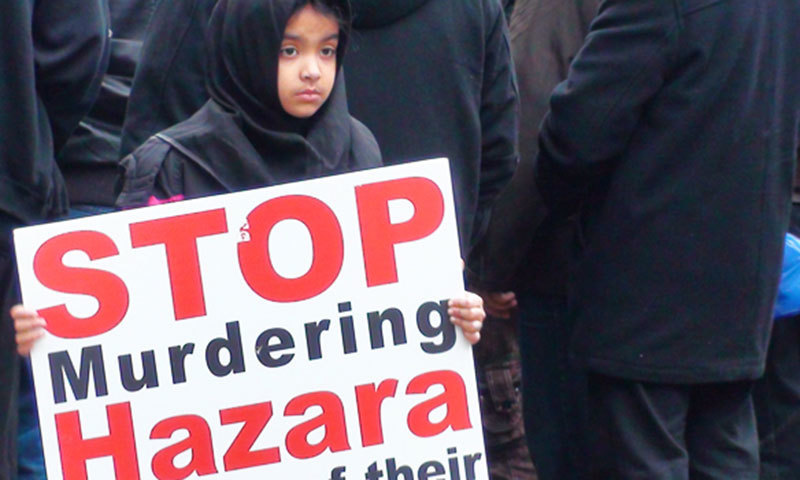
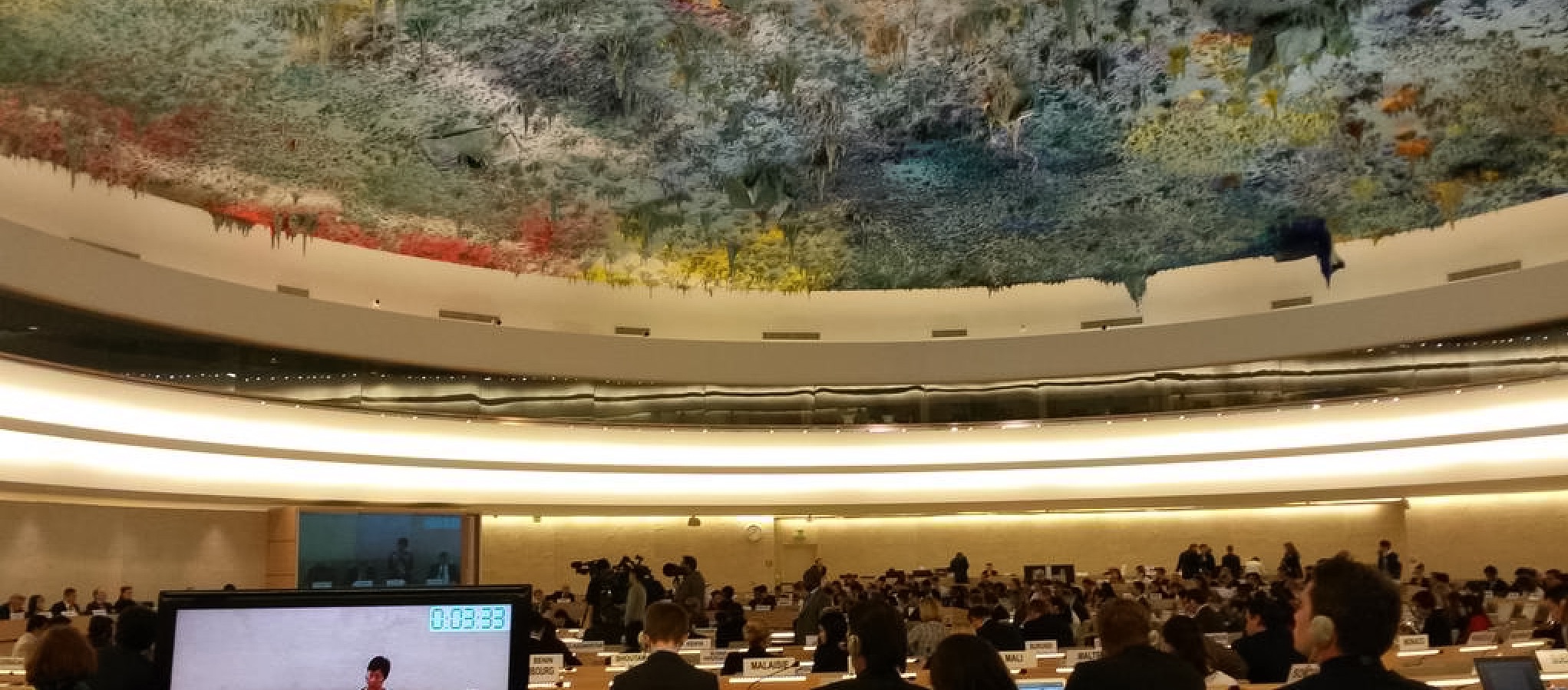
Advocacy for Hazara Minority at the 33rd Session of the Human Rights Council in Geneva

Shia rights watch_Hazara #HRC33
www.dawn.com

In advocacy effort for Hazara minority, the following statement was presented by SRW at the 33rd Session of the Human Rights Council in Geneva

Dear esteemed colleagues and member states,

The protection of ethnic minorities is a priority for Shia Rights Watch. The Afghan Hazara minorities who are frequently persecuted as a result of anti-Shia extremism are of high concern.  A recent Kabul bombing during a peaceful protest that resulted in the death of 80 innocent lives lost and wounded 260 is a key example of such discrimination and the lack of attention the international community gives to this minority group.  This incident reversed the progress made by current Hazara reformists, mostly targeting young leaders who hoped to lead future generations.

Hazara have face very harsh and inhumane treatment throughout the history. An estimated 60% of thier population was exterminated during the 1890’s genocide of Hazaras in Afghanistan. During and after the genocide, Hazaras lands were confiscated and distributed , and tens of thousands of Hazaras men, women, and children were sold as slave. It was also reported that tens of thousands of Hazara captives were sold during the same time to pay the expenses incurred in supporting revolt.  As the result of past degradation , this population is still considered as second class citizen with no protection.

Once the largest ethnic group in the country, only make up 9 percent of the Afghan population today. The increasing ethnic tensions in the country, under extremists and terrorist organizations such as the Taliban and ISIS have added great fear to  Hazara. Currently this underrepresented population face great threat of ethnic and heritage cleansing that must be prevented.

Shia Rights Watch has noted the Constitution of Afghanistan has several clauses which provide protection to minorities, including the Shia Hazara. SRW would like to reiterate that according to article twenty-two,  “any kind of discrimination and distinction between citizens of Afghanistan shall be forbidden. The citizens of Afghanistan, man and woman, have equal rights and duties before the law. Governments are responsible for protection and safety for all, but Hazara dense areas are not protected enough resulting in genocide. Also, Afghan government needs to preserve rich heritage and culture of Hazara by promoting them, and giving them freedom to share and express their belief. Hazara should be recognized under law and their children should have the right to study their own educational materials at their schools.

Hazara are among Afghanistan’s well educated people who have positive impact on the peaceful future of this country.  “The Hazaras are producing the most enthusiastic, educated, forward-looking youth” according to Michael Semple,  the deputy to the special representative of the European Union in Afghanistan.

Besides claims of genocide, there are claims of forced expulsions of ethnic Hazaras and Tajiks from areas controlled or conquered by the Taliban, as well as harassment of these minorities throughout Taliban-controlled areas. Noteable number of Afghan refugees belong to Hazara community who are leaving ancestral homeland to find peace.

Such group are deprived from their rights to dignity, life, security, education, and many more based on International Bill of Human Rights.

Shia Rights Watch believes Hazara are actively and positively contributing to the well being of the Afghan diverse  community and their rights should be recognized and respected. To ensure such, SRW  urges the Afghan government to abide by its constitution in protecting the rights of minorities and encourage its citizens to appreciate its rich diversity.


Sincerely,

Shia Rights Watch


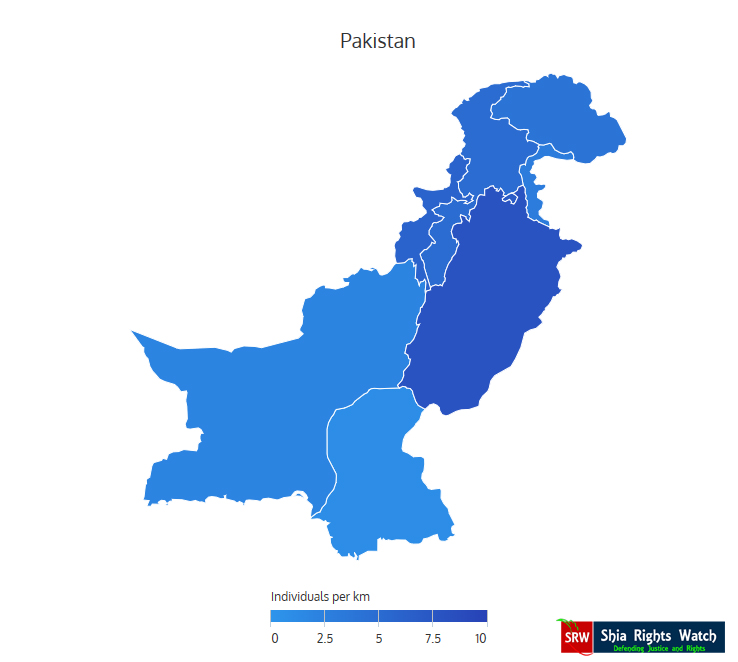
SRW Written Statement for 33rd Session of the Human Rights Council in Geneva: Case of Pakistani Shia

Shia Rights Watch_Pakistan

Greetings esteemed colleagues and member states,

On behalf of Shia Muslims around the world it is a pleasure to be able to present this address to the commission. Today Shia Rights Watch would like to highlight the body’s attention towards acts of anti-Shi’ism and terror in Pakistan. The country has great variety in its cultural and religious heritage it should embrace. However too many hate crimes against the Shia minority are caused by terrorist organizations and individuals which condemn the Shia as infidels, or are  seen in the lack of protection. The Shia currently constitute up a marginalized group that equates to about 20% of Pakistan’s total population based on government repost. This number does not include those who hide their faith in fear of anti-Shia sentiments. In fact, such sentiments are so strong that the recent years of 2012 to 2015 resulted in over 1,900 Shias killed in bomb blasts or targeted gun attacks.

So far in the year 2016, 15 people have been killed, 35 wounded, and 9 arrested. In 2015, Pakistan ranked third in the world for its number of anti-Shia incidents with a total of 285 killed, 275 wounded, and six kidnapped. One key Shia target of extremist anti-Shia groups is prominent human rights leaders and clerics, those vital to progressing rights and equality for the Shia community. This is due to the opinion that the Shia hold more power and recognition than deserved. Several examples from this past year include cleric Syed Shahid Abbas Shirazi, human rights activist Syed Khurram Zaki,  lawyer Syed Raza Shah, educational professional Abid Raza,  and Shia leader Malik Iftikhar Ali Haideri. The actors which committed these killings are pro-ISIS groups, terrorists of Ahle-e-Sunnat-Wal-Jamaat, or unidentified acts of hate crime.

Current laws in Pakistan make it easy for courts to send Shia to jail for a variety of reasons that are just typical parts of their religious practice.   A particular hate crime law, the Prevention of Electronic Crimes (PEC) Act issued in 2015 was used to prevent cyber-terrorism and hate speech, but Shia are threated under this law. Earlier in 2016 the act led to the 13 year long sentence of a man from Lahore. He was sentenced for liking a Facebook post that preached Shia beliefs, or as the court stated, religiously offensive content.  Other anti-Shia rhetorical and speak is also still widely acceptable across Pakistan.  The systematic oppression of Shia can take additional forms. The current educational system for example, has removed references to Shia schools of thought. Pakistani seminaries also have a lack of accountability for their teachings; this typically results in anti-Shia extremism.  While much of this occurs from seminaries, hate speech beyond their walls is a result of social norms. The anti-Shia literature published by seminaries accounts for about 12 percent of recruitment. The media refuses to cover anti-Shia atrocities or alters stories to be non-religious or accidental.

As it stands, the Shia perceive radicalism as a major threat, especially the prevalent anti-Shi’ism of Deobandi groups and the Ahle-Hadith sub-sect. Shia Rights Watch would also like to issue thanks to current activists in Pakistan urging for greater action of state bodies to create a safe environment for Shia. Shia Rights Watch hopes for a future in Pakistan without violence, where every individual can fully exercise their right to exist and practice religion peacefully.

Sincerely,

Shia Rights Watch


Presenting the Case of Malaysian Shia- Statement to United Nations

Shia Rights Watch #HRC33 Malaysia

Greetings esteemed colleagues and member states,

On behalf of Shia Muslims around the world it is a pleasure to present this address to the commission. Today I am here to draw your attention to the ongoing threats to Shia Muslims in Malaysia.  Although this country grants freedom for most of its diverse groups, Shia are greatly restricted in the nation, as its laws declare the Shia sect illegal to practice. There are also active bodies in Malaysia established to instill systematic oppression onto the Shia such as the anti-Shia task force, which has made statements that Shia are infidels, and deviants in the eyes of Islam.

The government has banned all Shia related publications and raided their commemorations as a means to prevent them from practicing their faith. In April additional considerations to forbid marriage between Shia and non-Shia are also underway despite previous Shia coexistence throughout the nation’s history.  Other suggestions have also been in contention of whether Shia prepared food is Halal for Muslims of other faiths.

Similarly to many other countries throughout the Middle East, anti-Shia seminaries are spreading their ideology throughout the country, evoking violence on a variety of fronts.  Shia Rights Watch is concerned with the level of discrimination and inequality for the right of practicing religion. Other denominations can practice freely, unlike the Shia.

In fact, specific articles 3(a) and 11 of the Malaysian Constitution, Shia Muslims are not given official state recognition as a religious entity. This discrimination received religious legitimacy in 1996 when the Fatwa Committee for Religious Affairs issued statement that branded Shia Islam as deviants. In doing so, it prohibited Shia from spreading their beliefs and distributing any electronic or print resources that espoused Shi‘i principles. Interestingly, this opinion overturned a 1984 decision from the same committee that deemed Shi‘ism acceptable in Malaysia. Under the country’s federal system, such a decision required agreement on the part of the individual states in order for it to have any effect. Unfortunately for the community, 10 of the 14 states initially agreed to implement the fatwa. There is no way for Shia to have protected rights in cases of terrorist attacks, and no legal way to address their human rights violations.

This basis for anti-Shi’ism is found through the 1960 Internal Security Act (ISA) to silence religious dissent, and while significant limits were placed on this act in 2012 there are still many issues.  The ISA was used on several occasions to target Shia in Malaysia. Ten Shia were arrested in 1997 under the ISA and another six suffered the same fate in October 2000.  In December 2010, 200 Shi‘a were arrested by the Selangor Islamic Religious Department and four years later, 114 Shia were arrested by the Perak Islamic Religious Affairs Department with assistance from the Malaysian police. A recent statement from the Prime Minister’s Department Jamil Khir Baharom clearly stated in his remarks that Shi’ites in Malaysia have no rights; “we have rules, we practise the teachings of Ahli Sunnah Wal Jamaah under the Shafie School, so we do not allow proselytising of Muslims. So, there is no issue of human rights violation here”

To reiterate statements made from the Middle East Institute, “Regardless of the historical antecedents of the faith, the primacy of ethnic Malays (and by association their adherence to Sunni Islam) has meant that Shi‘i Islam is considered a “deviant” sect in the country.

Unfair treatment of Malay-Shia is clear violation to at least 13 Articles under the International Bill of Human Rights such as:

Article 1. All human beings are born free and equal in dignity and rights.

Article 2. Everyone is entitled to all the rights and freedoms set forth in this Declaration, without distinction of any kind, such as race, colour, sex, language, religion, political or other opinion, national or social origin, property, birth or other status

Article 3. Everyone has the right to life, liberty and security of person

Article 7. All are equal before the law and are entitled without any discrimination to equal protection of the law

Article 9. No one shall be subjected to arbitrary arrest, detention or exile.

Article 10. Everyone is entitled in full equality to a fair and public hearing by an independent and impartial tribunal, in the determination of his rights and obligations and of any criminal charge against him.

Article 11.  (1) Everyone charged with a penal offence has the right to be presumed innocent until proved guilty according to law in a public trial at which he has had all the guarantees necessary for his defence.

(2) No one shall be held guilty of any penal offence on account of any act or omission which did not constitute a penal offence, under national or international law, at the time when it was committed. Nor shall a heavier penalty be imposed than the one that was applicable at the time the penal offence was committed.

Article 12. No one shall be subjected to arbitrary interference with his privacy, family, home or correspondence, nor to attacks upon his honour and reputation. Everyone has the right to the protection of the law against such interference or attacks.

Article 13. (1) Everyone has the right to freedom of movement and residence within the borders of each state.

Article 16.  (1) Men and women of full age, without any limitation due to race, nationality or religion, have the right to marry and to found a family. They are entitled to equal rights as to marriage, during marriage and at its dissolution

Article 18. Everyone has the right to freedom of thought, conscience and religion; this right includes freedom to change his religion or belief, and freedom, either alone or in community with others and in public or private, to manifest his religion or belief in teaching, practice, worship and observance.

Article 19. Everyone has the right to freedom of opinion and expression; this right includes freedom to hold opinions without interference and to seek, receive and impart information and ideas through any media and regardless of frontiers.

Article 20. (1) Everyone has the right to freedom of peaceful assembly and association. (2) No one may be compelled to belong to an association.

Article 27. (1) Everyone has the right freely to participate in the cultural life of the community, to enjoy the arts and to share in scientific advancement and its benefits. (2) Everyone has the right to the protection of the moral and material interests resulting from any scientific, literary or artistic production of which he is the author.


The Malaysian state aspires to be a moderate nation that embraces globalization, therefore it should refrain from oppressing and vilifying Shia who figure from among its own indigenous Malay-Muslim citizenry. Instead, it should engage them intellectually, socially and perhaps even religiously as part of dakwah, in sync with the lofty spirit of Malaysia as championed by Prime Minister Najib Razak”.

Shia Rights Watch encourages the Malaysian government to appreciate its rich diversity and provide fair and equal rights to its Shia population.

Sincerely,

Shia Rights Watch


Azerbaijani Shia and their Struggles- Presented at UN 33 Session of Human Rights #HRC33

Greetings esteemed colleagues and member states,

On behalf of Shia Muslims around the world it is a pleasure to be able to present this address to the commission. Today I am here to draw your attention to the increasing oppression of Shia Muslims in Azerbaijan. Thus far in 2016, Azerbaijan has bared witness to several acts of anti-Shi’ism violating the fundamental human right of freedom of religion. While the Shia represent 65% to 80% of Azerbaijani population, they face many discrimination such as unlawful arrests or prevention of practice through the country.

2015 saw the death of 9 Shia and the detainment of 35. In these past six months of 2016 authorities have banned 732 religious books with unjust reason.  Azerbaijani forces also destroyed a Shia Religious under the pretext of expanding the street. In recent years, Azerbaijan authorities have been limiting Shia Muslim activities although this country is majority populated country. More than 150 Shia activists including 18 clerics are in prisons of Azerbaijan.

Activists believe during the past few years the Wahhabists have grown notably in Azerbaijan, especially in areas of the country sharing borders with Russia. This is of particular worry for Shia Rights Watch as human rights organizations in Azerbaijan are currently not allowed to investigate these matters. Azerbaijan currently ranks 127th of 177 on Transparency International’s corruption perceptions index and over the years has frozen assists on bank accounts of NGOs and jailed some of the country’s most prominent human rights activists.  In April large numbers of Shia leaders were arrested unfairly. Police raided the homes of clerics and activists, including Karbalayi Qismat, and Syed Nazem and Seyed Waqar. As of today, there exists over 150 Shia activist and 18 Shia scholars imprisoned on basis of religious expression and identity.

Other concerns regarding freedom of speech for NGOs and Shia are related to recent arrests of journalists and in the 2015, Azerbaijan’s parliament debated a law to ban the display of flags honoring the killed Shia Imam (Hussein) on streets and also prohibiting those Azerbaijanis who have received religious education at international Shia seminars abroad from performing religious ceremonies. These violations of freedom of religion and expression are in violation of the current Azerbaijani constitution, which grants Azerbaijani citizens the right for life, freedom, safety, culture and religious practice, the presumption of innocence, and the right to equality regardless of denomination. Without the right to freedom of practice, radicalism becomes a greater threat, undermining prospects for a peaceful society where individuals can reach their full potential.

Shia Rights Watch hopes for a fairer governmental system that encourages and celebrates diversity and equal rights for all denominations

Sincerely,

Shia Rights Watch

Shia News Wire # 82

August 26th to September 2nd/2016

Iraq

Baghadad and Madaen continue to have the highest Shia fatality rate as 37 Shia were killed due to IED and 5 bodies found.

The deadliest suicide bombing of the week killed 23 in Ain al- Tamur, a town 40 kilometers west of the city of Karbala on August 30th. According to sources four suicide bombers had planned to explode their vest in different areas of the city; however officials arrested three of them after one bomb exploded.

Also, thousands of bodies found in more than 72 mass graves throughout Iraq on August 31st. Graves are located in different areas such as isolated mountains. Human rights activists believe ISIS is only group capable of such crime and victims belong to minority groups such as Shia Muslims
Afghanistan

A mass arrest happened on August 31st, as authorities arrested 12 to 15 activists and journalist from Hazara community during a protest about a major power transmission line during a visit to the area by Afghan President Ashraf Ghani. Witnesses report forces assaulted reports and arbitrarily detained them for 24 hours.
Saudi Arabia

On August 31st, two Shia clerics were arrested in Qatif, Saudi Arabia. Mohammad Zain Alhdon and Jaafar Alawi were arrested, no explanation is given yet.
Bahrain

Taiba Ismail, 36 year old female blogger, was sentenced on 31st  for tweets she had written that were critical of the monarchy. She had already spent 65 days in prison in relation to the case.
Madagascar

Another Shia man, Eric Daya, was kidnapped on August 30th. There is no update on his case.

Shia community has lost members due to kidnapping previously. Oun Alac, another Shia man, was kidnapped last year and war never found. His family believes he is dead.


UN Complaint