Welcome to Shia Rights Watch

spot_imgspot_imgspot_imgspot_img
Home Blog Page 39

Shia Weekly News #35

Week of October 4, 2015

Shia Rights Watch Alert: Global Rally for Humanity

For Immediate Release- 09 October 2015- Shia Rights Watch would like to issue an alert for American Muslims during the nationwide mosque protests that are a part of the Global Rally for Humanity. As freedom of speech is oppositions’ rights, freedom of religion is ours.

At SRW, we invite all Muslims to express the spirit of acceptance and respect that during these hard times and urge them to not get involved in any violence. Mosque leaders are advised to seek police help if needed and prioritize safety of their community as well as the oppositions.

Iraq

Deadly attacks have continued against Shia Muslims in Iraq this week. On October 5th at least 51 people were killed and 120 were injured by a series of car bombs that detonated around the country according to Iraqi police.

The first attack occurred in the Shia majority town of Khalis which is roughly 50 miles northeast of Baghdad. According to the local police captain, the assailant requested from police that he park his vehicle in front of a crowded market in order that he may buy medication from a nearby pharmacy. When granted permission, the assailant left the car and it would detonate five minutes later. The exact casualty figures from this explosion are not known.

A second explosion would occur in the town of Al-Zubair which is 9 miles southwest of the southern town of Basra. Like the first, this car bombing took place outside of a crowded market. In this attack ten people were killed and 30 were injured.

The final bombing this day occurred in the Hussainiya district of northern Baghdad. While not much is known about the situation surrounding the bombing, it is known that at least 11 people were killed and 30 were injured.

In addition to these bombings, attacks such as these occur every day in Shia neighborhoods around Iraq. Some are reported and some, unfortunately, are not. While no group has taken responsibility for the wave of attacks this week in Iraq, many suspect it is the work of ISIS which has taken responsibility for scores of similar attacks in recent months.

Saudi Arabia

In what has become an unfortunate series of monthly news coming out of Saudi Arabia, yet another death sentence was handed down the by courts to a Shia human rights activist. On October 8th, the British advocacy group Reprieve revealed that a Saudi courted upheld the death sentence for Dawoud Hussain al-Marhoon for his connection to protests in the country’s eastern province in 2012. Arrested at the age of 17, Al-Marhoon has been subjected to unfair legal proceedings and now a cruel sentence for exercising a right of his.

In Reprieve’s statement, they noted that the trial of Al-Marhood was filled with irregularities as he “was sentenced after a number of secret hearings took place without the presence of his lawyer, who was also blocked from receiving information about appeal hearings”.

Shia Rights Watch condemns this trial and sentence as illegitimate due to its gross violations of due process and its disproportionate punishment. These proceedings violate Article 10 of the Universal Declaration of Human Rights which states “everyone is entitled in full equality to a fair and public hearing by an independent and impartial tribunal, in the determination of his rights and obligations of any criminal charge against him”. This declaration, which Saudi Arabia is a party to, has been recognized by many as obtaining the status of customary international law, meaning it is binding upon all states.

Saudi Arabia continues to blatantly violate international human rights norms in the face of the international community with impunity. It is time that the Kingdom be held accountable for its action. Dawoud Hussain al-Marhoon must be released along with the remaining prisoners of conscience in the country.

Yemen

While mosque bombings have been regular occurrences in countries such as Pakistan and Iraq, it seems as if this trend has reached Yemen. This time ISIS has detonated a suicide bomb inside of the al-Nour Mosque in the northern Nahda district of the country.

In this attack the assailant, wearing a suicide vest, walked into the mosque and detonated himself, killing seven people.

ISIS has declared itself to be fighting the Houthi militia group in Yemen but has been regularly bombing Shia mosques in the area stating that this is because they are Houthi strongholds. This reasoning rests on faulty logic because it essentially equates all Shia in the country with the Houthis, which is far from the truth. Seondly, civilian targets should be avoided at all costs during armed conflict by all parties.

Shia Rights Watch condemns these horrific attacks by ISIS in the country and calls for the immediate peaceful settlement of the conflict raging in the area.

30 Article of the International Bill of Human Rights

30 Article of the International Bill of Human Rights

Article 1.

  • All human beings are born free and equal in dignity and rights. They are endowed with reason and conscience and should act towards one another in a spirit of brotherhood.

Article 2.

  • Everyone is entitled to all the rights and freedoms set forth in this Declaration, without distinction of any kind, such as race, colour, sex, language, religion, political or other opinion, national or social origin, property, birth or other status. Furthermore, no distinction shall be made on the basis of the political, jurisdictional or international status of the country or territory to which a person belongs, whether it be independent, trust, non-self-governing or under any other limitation of sovereignty.

Article 3.

  • Everyone has the right to life, liberty and security of person.

Article 4.

  • No one shall be held in slavery or servitude; slavery and the slave trade shall be prohibited in all their forms.

Article 5.

  • No one shall be subjected to torture or to cruel, inhuman or degrading treatment or punishment.

Article 6.

  • Everyone has the right to recognition everywhere as a person before the law.

Article 7.

  • All are equal before the law and are entitled without any discrimination to equal protection of the law. All are entitled to equal protection against any discrimination in violation of this Declaration and against any incitement to such discrimination.

Article 8.

  • Everyone has the right to an effective remedy by the competent national tribunals for acts violating the fundamental rights granted him by the constitution or by law.

Article 9.

  • No one shall be subjected to arbitrary arrest, detention or exile.

Article 10.

  • Everyone is entitled in full equality to a fair and public hearing by an independent and impartial tribunal, in the determination of his rights and obligations and of any criminal charge against him.

Article 11.

  • (1) Everyone charged with a penal offence has the right to be presumed innocent until proved guilty according to law in a public trial at which he has had all the guarantees necessary for his defence.
  • (2) No one shall be held guilty of any penal offence on account of any act or omission which did not constitute a penal offence, under national or international law, at the time when it was committed. Nor shall a heavier penalty be imposed than the one that was applicable at the time the penal offence was committed.

Article 12.

  • No one shall be subjected to arbitrary interference with his privacy, family, home or correspondence, nor to attacks upon his honour and reputation. Everyone has the right to the protection of the law against such interference or attacks.

Article 13.

  • (1) Everyone has the right to freedom of movement and residence within the borders of each state.
  • (2) Everyone has the right to leave any country, including his own, and to return to his country.

Article 14.

  • (1) Everyone has the right to seek and to enjoy in other countries asylum from persecution.
  • (2) This right may not be invoked in the case of prosecutions genuinely arising from non-political crimes or from acts contrary to the purposes and principles of the United Nations.

Article 15.

  • (1) Everyone has the right to a nationality.
  • (2) No one shall be arbitrarily deprived of his nationality nor denied the right to change his nationality.

Article 16.

  • (1) Men and women of full age, without any limitation due to race, nationality or religion, have the right to marry and to found a family. They are entitled to equal rights as to marriage, during marriage and at its dissolution.
  • (2) Marriage shall be entered into only with the free and full consent of the intending spouses.
  • (3) The family is the natural and fundamental group unit of society and is entitled to protection by society and the State.

Article 17.

  • (1) Everyone has the right to own property alone as well as in association with others.
  • (2) No one shall be arbitrarily deprived of his property.

Article 18.

  • Everyone has the right to freedom of thought, conscience and religion; this right includes freedom to change his religion or belief, and freedom, either alone or in community with others and in public or private, to manifest his religion or belief in teaching, practice, worship and observance.

Article 19.

  • Everyone has the right to freedom of opinion and expression; this right includes freedom to hold opinions without interference and to seek, receive and impart information and ideas through any media and regardless of frontiers.

Article 20.

  • (1) Everyone has the right to freedom of peaceful assembly and association.
  • (2) No one may be compelled to belong to an association.

Article 21.

  • (1) Everyone has the right to take part in the government of his country, directly or through freely chosen representatives.
  • (2) Everyone has the right of equal access to public service in his country.
  • (3) The will of the people shall be the basis of the authority of government; this will shall be expressed in periodic and genuine elections which shall be by universal and equal suffrage and shall be held by secret vote or by equivalent free voting procedures.

Article 22.

  • Everyone, as a member of society, has the right to social security and is entitled to realization, through national effort and international co-operation and in accordance with the organization and resources of each State, of the economic, social and cultural rights indispensable for his dignity and the free development of his personality.

 Article 23.

  • (1) Everyone has the right to work, to free choice of employment, to just and favourable conditions of work and to protection against unemployment.
  • (2) Everyone, without any discrimination, has the right to equal pay for equal work.
  • (3) Everyone who works has the right to just and favourable remuneration ensuring for himself and his family an existence worthy of human dignity, and supplemented, if necessary, by other means of social protection.
  • (4) Everyone has the right to form and to join trade unions for the protection of his interests.

Article 24.

  • Everyone has the right to rest and leisure, including reasonable limitation of working hours and periodic holidays with pay.

Article 25.

  • (1) Everyone has the right to a standard of living adequate for the health and well-being of himself and of his family, including food, clothing, housing and medical care and necessary social services, and the right to security in the event of unemployment, sickness, disability, widowhood, old age or other lack of livelihood in circumstances beyond his control.
  • (2) Motherhood and childhood are entitled to special care and assistance. All children, whether born in or out of wedlock, shall enjoy the same social protection.

Article 26.

  • (1) Everyone has the right to education. Education shall be free, at least in the elementary and fundamental stages. Elementary education shall be compulsory. Technical and professional education shall be made generally available and higher education shall be equally accessible to all on the basis of merit.
  • (2) Education shall be directed to the full development of the human personality and to the strengthening of respect for human rights and fundamental freedoms. It shall promote understanding, tolerance and friendship among all nations, racial or religious groups, and shall further the activities of the United Nations for the maintenance of peace.
  • (3) Parents have a prior right to choose the kind of education that shall be given to their children.

Article 27.

  • (1) Everyone has the right freely to participate in the cultural life of the community, to enjoy the arts and to share in scientific advancement and its benefits.
  • (2) Everyone has the right to the protection of the moral and material interests resulting from any scientific, literary or artistic production of which he is the author.

Article 28.

  • Everyone is entitled to a social and international order in which the rights and freedoms set forth in this Declaration can be fully realized.

Article 29.

  • (1) Everyone has duties to the community in which alone the free and full development of his personality is possible.
  • (2) In the exercise of his rights and freedoms, everyone shall be subject only to such limitations as are determined by law solely for the purpose of securing due recognition and respect for the rights and freedoms of others and of meeting the just requirements of morality, public order and the general welfare in a democratic society.
  • (3) These rights and freedoms may in no case be exercised contrary to the purposes and principles of the United Nations.

Article 30.

  • Nothing in this Declaration may be interpreted as implying for any State, group or person any right to engage in any activity or to perform any act aimed at the destruction of any of the rights and freedoms set forth herein.


UN Women for Peace

[highlight color=”yellow”]United Nation, NYC[/highlight][padding right=”80%” left=”0%”][/padding]

[highlight color=”yellow”]10/06/2015[/highlight]

On Tuesday October 6th, Shia Rights Watch attended a United Nations Meeting of delegates and NGOs on the plight of Yezidi women under ISIS. This event, held by the UN Women for Peace Alliance, discussed the current condition of Yezidi women in ISIS-held territories. The speakers at this event included an Iraqi professor and journalist who used his connections in the country to help coordinate the escape of Yezidi women, a group of filmmakers who recently concluded a documentary on Yezidi abductees, and a Yezidi woman who was a former captive of ISIS.

Each of the speakers at the event mentioned three requests of the Yezidi community to the international community. These requests were the safe return of captured Yezidi women, the provision of services to escaped Yezidi women, and the ability to return to their homeland and live in safety away from the threat of ISIS.

Shia Rights Watch joins the community of human rights activists gathered at the UN on Tuesday to condemn the actions of ISIS and further declare their actions against ethnic and religious minorities as genocide.

Mandela Rules on the Treatment of Prisoners

[highlight color=”yellow”]United Nation, NYC[/highlight][padding right=”80%” left=”0%”][/padding]

[highlight color=”yellow”]10/07/2015[/highlight]

On October 7th Shia Rights Watch attended a high-level UN event on the implementation of the Mandela Rules on the Treatment of Prisoners. The Mandela Rules are a revision of the 1955 Standard Minimum Rules for the Treatment of Prisoners. These non-binding guidelines for how states treat their prisoners had not been updated since it implementation by the United Nations Congress on the Prevention of Crime and the Treatment of Offenders.

Some important revisions to the Standard Minimum Rules are provisions for the prohibition of torture, and the improvement of health conditions for detainees. UN officials stated that one of the purposes of these revised rules was to ensure that despite the fact that people lose their liberty when they enter prison, they should not lose their dignity. For example, despite the fact that one may be detained, the Mandela Rules state that prisoners are entitled to the same state of health care as people in the community. This is especially true for diseases such as HIV and Tuberculosis.

The revision on the Standard Minimum Rules is an important milestone for criminal justice reform. In many places around the world, prison conditions fall well below the standards set before the 1955 standard minimum rules. This applies to Shia Muslims in Bahrain who have been arbitrarily arrested and are forced to endure well horrible prison conditions for years. Shia Rights Watch will continue to advocate for the improvement of prison conditions around the world while continuing to call for the release of prisoners of conscience detained under oppressive regimes.

Shia Weekly News #34

2015-10-05

Bahrain

In Bahrain, the government has been accused of working to erase the culture and heritage of Bahraini Shia by denying may of them access to a Shia religious education. This week Sayed Ahmed Al-Wadaei, the director of advocacy for the Bahrain Institute for Rights and Democracy (BIRD), in a statement to the UN Human Rights Council stated “the Bahraini government has worked on erasing the culture and history of the indigenous Bahrainis”.

The Bahraini government has be accused of pursuing this policy through its lack of promotion for Bahraini heritage sites and its educational bias against Shia Islam. Al-Wadaei stated that the Bahraini government has refused to upgrade its religious education system to include teachings that are different from those adhered to by the royal family. This is particularly troubling since Shia Muslims constitute the majority of Bahrain’s population yet they are kept from studying their beliefs in religious school.

Iraq

Violent attacks against Shia Muslims have continued throughout the weeks as bombings ravaged Shia neighborhoods throughout the country. In the final week of September at least 43 Shia Muslims were killed in a mixture of bombings, and shootings. The largest casualties came on September 28th when 19 people were killed in a series of Improvised Explosive Devices (IEDs) in Shia neighborhoods in Baghdad. Shia Rights Watch continues to lobby the international community for a call to protect Shia Muslims who have been greatly affected by the bombing tactics of terrorist groups such as ISIS and Al-Qaeda. The international community cannot continue to ignore the violent deaths of this vulnerable religious minority.

Unfortunately an additional 24 Shia Muslims were killed in the first weekend of October as bombs were detonated in Baghdad’s main Shia neighborhood. On October 24th, three suicide bombers tried to breach the checkpoint at Adan Square in the Kadhimiyah neighborhood and after being denied access two of them detonated themselves. This busy checkpoint is one of the main access points for the Shia shrine of Kadhimiyah, which attracts many visitors on Saturdays. Updated casualty figures have at least 24 people killed and 61 wounded. The Baghdad Province of ISIS has claimed responsibility for this attack on twitter by tweeting out the names of the bombers shortly after the attack occurred.

The continued violation of the religious freedom of Shia Muslims in Iraq by ISIS is unacceptable and the Iraqi government, in conjunction with the international community needs to do its part to protect places of worship, work, and rest for Shia Muslims.

United Kingdom

In the first of the United Kingdom’s Conservative Party’s annual conference in the city of Manchester, Prime Minister David Cameron urged Saudi Arabia not to execute Ali El-Nimr. Ali El-Nimr was arrested in 2012 at the age of 17 for “chanting anti-state slogans in illegal protests and inciting others to demonstrate” was recently sentence to death by execution. This draconian punishment for exercising one’s innate rights has enraged the international community as call have come in from many groups to halt this execution. This latest condemnation comes from one of Saudi Arabia’s biggest European allies, who has contributed millions of dollars in security and technical assistance to their government. Despite their close national security relationship, Prime Minister Cameron stated “we never stint in telling them that we don’t agree with them on this human rights issue”. While this condemnation is a far cry in addressing the numerous human rights abuses that are present in Saudi Arabia against Shia Muslims, we recognize the weight that this statement carries in the international community in getting the Saudi government to improve its human rights practices.

Incidents of Anti-Shiism in September 2015

Nine Months of Anti-Shiism

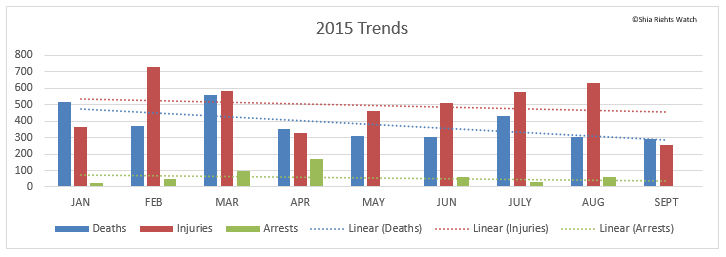
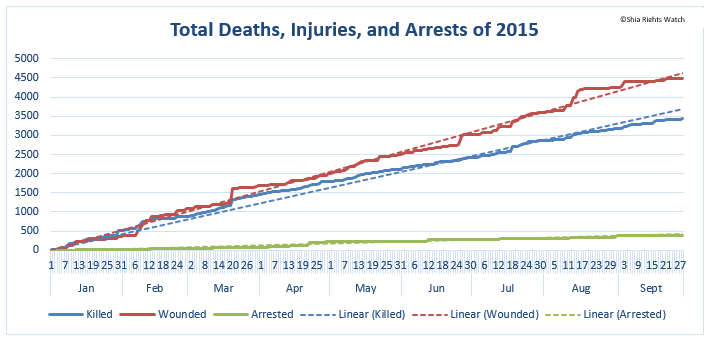
The year is nearly finished, but violence and persecution of Shias does not appear to end. The current trend for the year shows a decrease overall, but that is heavily skewed by the most recent month being lower than everything we have seen so far. Without September in the yearly data, there would still be a downward trend in Shia deaths, but the amount of Shia injured would be increasing while the amount of Shia detained remains at an average of 62 per month. As the bar graph and line graphs illustrate, all three variables are significantly below the line of best fit for the year. Over the course of three quarters, there were 20 countries[1]  that exhibited anti-Shia actions or attitudes, and these incidents were committed by individuals as well as government representatives.
ShiaRightsWatch_Sept

This year began with 4 countries with incidents of anti-Shiism, and in 9 months it has increased fivefold. The worst day this year for Shia Muslims was March 20th when there was a triple mosque bombing in addition to other incidents of anti-Shiism in Pakistan and Iraq. There were a total of 150 deaths and 363 injuries from this incident in Yemen. If one looks at the graph “Total Deaths, Injuries, and Arrests of 2015,” then it will be observed that there are a few spikes in the number of wounded. The first sharp increase occurs in February when there were multiple days within one week with a hundred or more deaths. The second spike is the Yemen mosque bombing in March, and the third spike is the mosque bombing in Kuwait in June. In August, we saw a week where there were a large amount of bombings in Iraq in popular markets, and that explains the bump in the data in the middle of August.

There were 3440 Shia deaths in nine months, and the most common method for doing so are bombs (70%), usually improvised explosive devices. Assailants were then most likely to kill Shias using a combination of weapons (19%), usually an IED followed by gunfire, shooting (4%), and finally air strikes (3%) and mortars (3%) on their own were responsible for the next most amount of deaths. Iraq accounts for nearly 80% of all the Shia deaths within the year, while Yemen has 10%, and Pakistan has 6%. 4449 Shias were injured during attacks, and over 90% of those people were injured from a bomb detonating. The next two likely ways for Shia to be injured was by being beaten or hit by mortars (3%). Iraq also had over 70% of the Shias injured for the year, followed by Yemen at 12%, Kuwait and Pakistan at 5% each. In nine months there were at least 502 Shia arrested, abducted, or detained by oppressive regimes. 145 Shias were abducted, and 134 of those occurred in Afghanistan. On average, 380 Shia died every month for their religion, and nearly 500 are injured for a universal freedom. That equates to more than 12 people dead per day, and more than 16 people injured for choosing a religion that is not in the majority. Every month, about 55 Shias are jailed, given unjust trials, and abducted from their homes or vehicles.
ShiaRightsWatch_Sept1

Incidents of anti-Shiism in August 2015

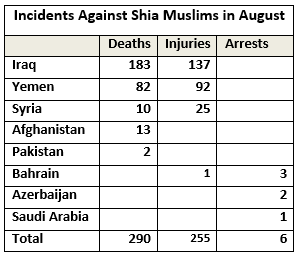
There was a decent decrease in Shia deaths this month compared to last month, and a significant decrease in the amount of Shia injured when one observes the statistics from August. The amount of Shia arrested this month fell drastically from 63 to 4. There were under 300 Shia deaths, and more than 250 injuries this month. The numbers average out to more than 9 Shia deaths per day, and 8 injuries per day. This month is an outlier in the data for the year, and hopefully it is an example of what we will continue to see as the year continues.

Overview

This report will analyze the data compiled on Shia deaths, injuries, and arrests that occurred between September 1st and September 30th. The data for this report was gathered from a variety of different sources. The most well-known incidents of anti-Shiism were retrieved from stories that are reported to Shia Rights Watch by eyewitnesses. Each incident is thoroughly evaluated for both authenticity and relevance. For an incident to be included in this report it has to show clear intent to target Shia Muslims on the basis of religious beliefs. The subsequent sections will present and analyze the data gathered by Shia Rights Watch for September.ShiaRightsWatch_Sept2
Where have Shia Muslims been targeted?

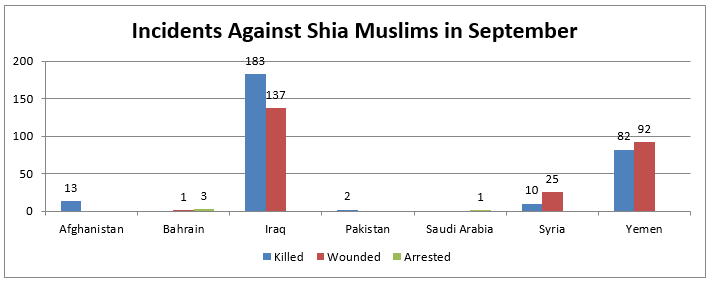
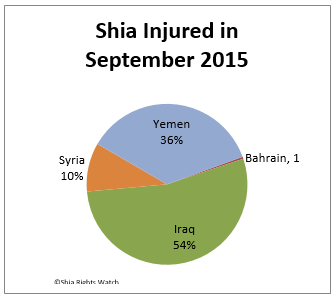
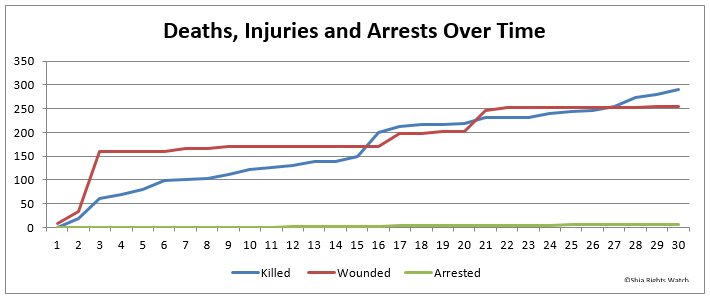
In September, Shia Muslims were victims in eight countries: Iraq, Yemen, Syria, Afghanistan, Pakistan, Bahrain, Saudi Arabia, and Azerbaijan. There were a total of 290 Shia Deaths this month, and 255 injuries as well. There were only 6 Shias arrested this month that we are aware of, but there are many who were arrested and lack proper legal representation.


Iraq

Iraq currently has the threat of being fragmented, by the encouragement of people within the United States government as well as the allegations of corruption within the Iraqi government. Major political figures have advocated for a three separate states for Iraq to break into; the Sunni state, Kurdish state, and a Shia state. This action would further sectarian/ethnic tensions in the region, and make countries with disgruntled people more likely to take desperate measures to hold onto power. This creates a problem for Shias in Saudi Arabia, Bahrain, Yemen, and others where the government will do what they can to cling to power even if the threat is nonviolent protesters and international attention.

The allegations of corruption stem from the Sunnis being deposed from their positions when Sadam Hussein was removed from power, and the Shias gained the same positions of power when they took control of the government. Iraq’s Prime Minister, Haider al-Abadi, has agreed to reforms which would include more Sunnis and Kurds into the government, but this can be dangerous for Shias because there is a possibility for revenge. All parties need to let the things that occurred in the past remain in the past, and move forward to create a functioning country.

In general, this month was a significant improvement from past months, and it also applies to Iraq since it usually accounts for a large majority of violence. There were 183 Shia deaths and 137 Shia injuries as compared to 275 and 603 respectively for August. There was not one day or one incident in Iraq that had a larger than average amount of casualties. Even though there has been an improvement, this senseless violence against Shias needs to stop.
ShiaRightsWatch_Sept3

Yemen

The Saudi Arabian Coalition forces finally made headway in the Southern part of Yemen with soldiers on the ground, but the indiscriminate offensive on the North continues with air strikes. Most, if not all, of the government has returned to Aden, and stated they want to restore the country to civility. Egyptian troops have joined the ground coalition, and the ground forces seem to be impeded at Marib from taking back the capital of Sana’a. There are legitimate concerns about if there will be retribution against all Shias once the country is back in the hands of the Sunnis in the South. Not all Shias fought with the Houthis or Ansarullah, but it is likely that revenge will be sought arbitrarily.

The Shia deaths that were recorded in Yemen this month were a result of Saudi Arabian Coalition forces performing air strikes and Daesh bombing Shia mosques. The Daesh mosque bombings in Sana’a later in the month were not recorded, because Daesh was targeting the Houthis in an area that is well known as Houthi territory. The dual mosque bombings in Sana’a in the beginning of the month killed 32 Shias and injured 92 more Shia. There were at least 50 deaths from air strikes, and most of those hurt from the attack are said to be women and children civilians. Earlier in the month the coalition forces hit a hospital which resulted in several casualties. The attack on the teachers was carried out in Amran, and the other five Shias were killed in Sadaa. This is the worst month for Yemen in terms of casualties since the triple mosque bombing committed by Daesh in March. It is interesting that this month holds the most violence for Yemen yet the government is coming back to power. Hopefully this trend does not continue as President Hadi regains control of the rest of Yemen. Shia Rights Watch condemns these unprovoked, indiscriminate crimes against humanity which plague the Yemeni Shia.

Syria

There were 10 recorded Shia deaths this month in Syria; compared to the six of last month. There was a slight increase in the amount of Shia murders, but there was a slight decrease of injuries from 32 in August to 25 in September. All of these casualties came as a result of Syrian rebels detonating a car bomb in Lattakia. The numbers recorded from Syria are the bare minimum, because it is difficult to get information in or out of the war torn country. It is especially difficult in Shia towns that are surrounded by Daesh or Al Nusra Front. There are reports that Syrians rebels that were armed by the United States gave equipment to Al Nusra Front, an Al Qaeda affiliate. One begins to wonder when the United States will cease supporting militias that are not loyal nor serve their interests.
ShiaRightsWatch_Sept4

Afghanistan

                On September 6, gunmen stopped two vehicles in Balkh, and pulled the passengers out of the vehicles. The assailants killed 13 Shia Hazaras, and the Taliban denies responsibility. Since the Taliban denies the incident, it is most likely the work of Daesh, but it could be the work of rogue Taliban members. It is troubling that the militants are killing the Hazaras instead of abducting them, because this could illustrate a significant shift in policy. There is no news on the abducted Hazaras from previous installments of the monthly anti-Shiism report, but hopefully they have not met the same fate as those of this issue.

 Pakistan

Pakistan continues to become a safer place for Shia Muslims, because Shia Rights Watch only has record of two religiously motivated attacks on Shias for the month of September. This month has the lowest amount of murders for Pakistan all year. The two murders were carried out by terrorist groups, and the third is supposedly unclear if it is driven by sectarian hatred. A Shia convert, Riaz Alvi, was killed in Charsadah by the terrorists of Sipah e Sahaba, and was threatened by Wahhabi groups shortly after following Shiism. A Shia man, Irfan Haider Zaidi, was attacked outside his shop by asailants with a pistol and later died from his injuries. His family claims he escaped an assassination attempt last week, but they did not report it. The pistol was sent to the police for forensic processing. It is promising that a Sunni majority country like Pakistan can stand against anti-Shiism and make real progress toward equal protection for all.
ShiaRightsWatch_Sept5

Bahrain

There were four incidents of anti-Shiism in Bahrain this month, and it began when Iraqi football player, Zulfiqar Malik, flew to Bahrain to join a new professional football team. Upon arrival he was beaten for no reason by the Bahraini authorities in the airport. He was told to go back to Iraq because he was not welcome in Bahrain. Then there is the case of Sheikh Ahmad al-Jidhafsi, who was arrested for delivering an speech criticizing the Bahraini regime. His daughter, and granddaughter were arrested as well. It is reported that there were raids on the rally where he gave the speech, and the police fired tear gas and bird shot as attendees. Shia Sheikh Hassan Isa had his detention extended 15 more days by the government as the police continue their investigation, but it is clear that they do not have any evidence to prosecute him for funding terrorism. Finally, Sayed Ahmed Al-Wadaei, director of advocacy at the Bahrain Institute for Rights and Democracy brought attention to the injustices in Bahrain by making a statement to the UN Human Rights Council where he asserted that Shia Bahrainis were prevented from gaining Shia education, and had 38 mosques and religious sites detroyed by the authorities. As with other countries in the anti-Shiism report, there was a significant decrease in arrests this month compared to previous, but there is a possibility that Shia Rights Watch does not have all of the incidents so reporting to Shia Rights Watch is encouraged.

Saudi Arabia

                Saudi Arabia has taken some drastic steps recently to punish anyone who is Shia, and make an example of those who disagree with them. Within a few days of each other. Saudi Arabia announced that Yemenis were baned from participating in Hajj this year and then they added Syrians would also not be allowed to attend either. This move by the Saudis holds Islam hostage to those who are not involved in the conflicts, politicizes Hajj, and Shia Rights Watch condemns their actions.

Ali ibn Muhammad al-Nimr was arrested 3 years ago for taking part in protests, and was recently given a death sentence. He was underage at the time of the arrest, and has not had a lawyer during interrogation or his trial. Reports also show that he was tortured to give a false confession. Ali Mohammed is Sheikh Nimr’s nephew, and is being targeted for his faith as is his uncle.

Azerbaijan

Jeyhun Jafarov was arrested in March for expressing his right to freedom of religion, and is still being held in a secret police prison. That was  7 months ago, and  he was recently sentenced to 3 more months in jail. Jafarov is not the only prisoner of conscience in Azerbaijan, and the government needs to be held accountable for their lack of religious freedom. Shia preacher, Taleh Bagirov was detained by the secret police for speeches made to Shia residents, but was released the same day, September 22. He traveled with his family to Yevlakh where he was going to speak at the mosque. He arrived to find the mosque surrounded by police, and was brought in for questioning. Taleh Bagirov was a prisoner of conscience in the past
ShiaRightsWatch_Sept6

Tactics

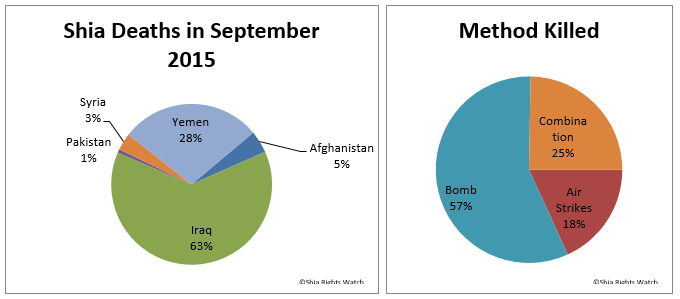
                The amount of Shias killed by bombs this month decreased by 27%, and the amount injured by bombs decreased by 42%. Air strikes were much more deadly this month, but that is not surprising considering the lack of food, water, shelter, and medical supplies in Yemen currently. The amount of Shia killed using a combination of methods has remained about the same as last August. Shooting Shias  increased significantly compared to last month, but that is only because of the one incident in Afghanistan. Afghanistan police and military were most likely more preoccupied about the Taliban taking the city of Kunduz than militants on the side of the road. Arrests have fallen from 53 to 6, but there is a possibility that Shia Rights Watch needs more information. There were no abductions this month compared to last month’s 10.

Conclusion

                The month of September appeared to be very quiet, but the possibility of terrorists killing Hazaras instead of kidnapping them is concerning. The previous months suggest that this month’s data is just an outlier, however Shia Rights Watch would like to remain optimistic that anti-Shiism is on the decline.

[1] Afghanistan, Azerbaijan, Bahrain, Egypt, India, Indonesia, Iraq, Kuwait, Lebanon, Madagascar, Morocco, Nigeria, Pakistan, Saudi Arabia, Somalia, Syria, the United Arab Emirates, the United Kingdom, the United States and Yemen.


Shia Weekly News #33

Iraq

The previous week was yet another deadly week for Shia Muslims as bombs continued to target Shia neighborhoods throughout the country. One such incident occurred on September 22nd when bomb blasts killed 16 and injured over 50 in Shia majority areas of Baghdad. The first bombing this day occurred when an explosive-laden care exploded in the al-Amin al-Thaniyah neighborhood of eastern Baghdad. This attack which ISIS claimed responsibility for killed 12 and injured 42.

Later that day two people were killed after an improvised explosive device (IED) was detonated near a market in the Shia town of Yusufiya which is 24 miles south of Baghdad.

In the Shia town of Balad Ruz, 40 miles northeast of Baghdad, an explosion went off near a restaurant which killed two people and injured eight others.

Lastly, a bomb detonated near an army patrol near the town of Taji, 20 miles north of Baghdad, injuring three soldiers.

Syria

A short-lived ceasefire in northwestern Syria was broken on September 27th as Al-Qaeda-affiliated militants fired shells into the Shia town of Fuaa in the province of Idlib. Shia Rights Watch has reported on the continuing shelling of the towns of Fuaa and Kafaraya by militants in previous news updates but the violence has only continued. On Friday it was announced that a ceasefire had been agreed to by all sides involved in the fighting around these towns but the very next day, reports surfaced of this shelling. No immediate casualties have been reported from this shelling despite the news that it has resumed. Shia Rights Watch will issue any updates on this broken ceasefire as it becomes available.

Yemen

On a holy day for all Muslims, let alone Shia Muslims, terrorist groups are continuing to attack worshippers while praying in mosques. On Thursday in Sana’a, Yemen, bombs were detonated at the Balili mosque which many Shia Muslims attend. The first bomb detonated during prayers on Thursday for Eid al-Adha, as survivors to the first blast ran to exit the mosque they were met by a suicide bomber who detonated his suicide belt. This horrific attack killed at least 25 people and wounded dozens of others. While no group has claimed responsibility for this attack, Al-Qaeda in the Arabian Peninsula (AQAP) and ISIS have carried out such attacks against Shia Muslims in the past.

Shia Rights Watch Responds to Recent Hajj Tragedies

Shia Rights Watch expresses its deep sadness regarding death of more than 1000 pilgrims during Hajj of 2015. This tragic incident is even more distressing as it took place on the Holy Eid al-Adha.  In the past two weeks over 800 people, according to Saudi forces and 1200 according to other sources, have been killed while they were making their obligatory Islamic pilgrimage to Mecca. This period of the year draws over two million people to the cities of Mecca and Media and unfortunately this year’s pilgrimage ended in immense tragedy.

On September 11th a massive crane collapsed in the Grand Mosque in Mecca killing over 100 pilgrims.  A crane operated by the Bin Laden Group, one of the largest construction companies in the region, collapsed after heavy winds and bad weather raged in the area. This poor construction safety and lack of government oversight left many devout Muslims dead.

The second tragedy occurred on September 24th when close to 1000 pilgrims were killed in a massive stampede two miles away from the holy site in Mecca. Those killed were from at least 12 nations including India (14), Egypt (14), and Iran (131). While the causes for the stampede have yet to be disclosed but the Saudi government is ultimately responsible for the safety of pilgrims. The lack of proper safety precautions after such a stampede occurred in 2006 is unfathomable.

The Saudi government proclaims itself to be the guardian of the two holiest places in Islam but does not do enough to protect those that visit these places. Unfortunately the neglect of this important duty has led to the deaths of hundreds of people.

Shia Rights Watch condemns this neglect and urges the Saudi government to implement meaningful reforms that would protect pilgrims at its holy sites.


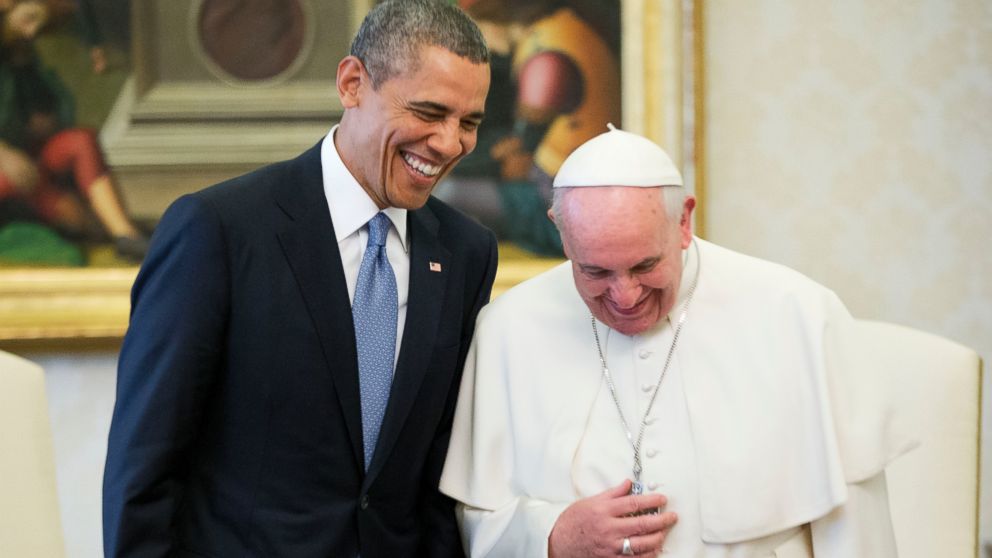
Shia Rights Watch welcomes Pope Francis to the United States

Shia Rights Watch welcomes pope francis
pic abcnews.com

On behalf of the American Shia community, we welcome Pope Francis with open arms. We know that this trip will we be both enjoyable and productive for both the American community as well as the international community at large.

Yesterday afternoon Pope Francis landed in the United States to begin a six-day trip through the country. He will be making stops in Washington, D.C., Philadelphia, PA, and New York, NY. Since his election to the current office, Pope Francis has been an outspoken defender of human rights around the world, drawing attention to global conflict and its effects on innocent people. Pope Francis has been an outspoken defender of the rights of refugees, especially those fleeing to Europe from Northern Africa and the Middle East. Many of these refugees are fleeing the disastrous civil war that is currently raging in Syria. Many of the people leaving their homes in Syria are religious minorities, especially Shia Muslims who have seen this conflict and its offshoots impede on their religious freedom.

Pope Francis has proven to be an avid defender of religious freedom through his speeches, saying “not just a matter of thought or private devotion,” but a “fundamental right of the person” which national and international laws and organizations must “recognize, guarantee and protect” as well as “an indicator of a healthy democracy and one of the principal sources of a nation’s legitimacy”.

The legitimacy of the international community has been weakened as it has largely turned a blind eye to egregious violations of religious freedom around the world. As Shia Muslims continue to suffer from terrorist groups such as ISIS, their plight is largely absent from discussion surrounding the protection of religious minorities. This neglect from the international community only further facilitate the discrimination and violence perpetrated against this group. That is why we at Shia Rights Watch call on Pope Francis to shed light on the discrimination and violence faced by Shia Muslims as a violation of their religious liberties during his stay in the United States.

Shia Weekly News #32

Week of September 13, 2015

Saudi Arabia

Saudi Arabia has handed down yet another death sentence to a prominent Shia activist. This death sentence has come upon Ali ibn Muhammad al-Nimr, nephew of Sheikh Nirm Al-Nimr. On September 13th Saudi Arabia’s Court of Appeals sentenced Muhammad al-Nimr to death after spending the last 3 years in Saudi prison. Nimr, 20, was arrested at 17 under false charges of illegal protesting and gun possession. There was never any evidence to support this gun charge. Nimr’s father Mohammed al-Nimr told reporters that during his son’s trial and interrogation he did not have access to an attorney. Furthermore the death sentence handed down to Nimr will be carried out by crucifixion, an execution long deemed excessive by the international community.

The apparent disregard for due process clearly violate international human rights standards as established in the Universal Declaration of Human Rights and the International Covenant on Civil and Political Rights. Shia Rights Watch demands the unconditional release of both Ali Ibn Muhammad al-Nimr and Sheikh Nimr al-Nimr along with all remaining prisoners of conscience in Saudi Arabia.

Pakistan

In Pakistan, yet another Shia businessman was gunned down in the streets of Karachi. Infar Haider Zaidi, 35, was shot and killed outside of his store- Bismallah General Store- which is located in Block L of the North Nazimabad area of Karachi. Zaidi sustained critical wounds from a 9mm pistol and would be pronounced dead at the hospital later that day.

According to the family of the victim that was the second attempt on Zaidi’s life in the past week. The two attacks occurred by the same men but both times they managed to flee the scene. Shia Rights Watch urges the Pakistani authorities to investigate this incident and take more preventative measures to protect the Shia community throughout the country.

Iraq

This week in Iraq, 13 Shia were reported to be killed and 31 injured in two separate bombings throughout the country. The largest attack occurred on September 17th when three bombs went off in mainly Shia neighborhoods in Central Baghdad. On this day 12 Shia were killed and 18 others injured. No group has claimed responsibility for this bombing but they took place in neighborhoods that are heavily targeted by ISIS.

UN Complaint