Welcome to Shia Rights Watch

spot_imgspot_imgspot_imgspot_img
Home Blog Page 92

Shia women sexually assulted

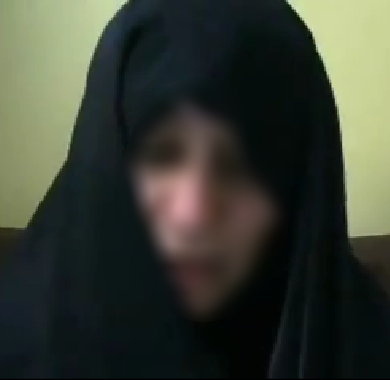
Fatima-KhavajiOne Bahraini’s story

Fatima Khawaji who is a Bahraini Citizen, shares her heart braking story with the world. After returning from one of the recent protests against the monarchy kingdom of Bahrain, dozens of men who were heavily armed and she noticed were Saudi forces joined by Bahraini forces, forcefully entered her house and took her husband, Mr. Khawaji away crudely. Fatima was scared and didn’t know what could 50 soldiers want with her husband. Mr. Khawaji had commited no wrong act, but only had participated in a peaceful protest. As usual they were all masked, only their eyes were visible. They pointed guns towards the family members and asked them to show them were Mr. Khawaji was. They told them “If you don’t say where your men are, we will shoot you”. One of the younger sons, who couldn’t tolerate his mother and sisters’ death, told them that dad is upstairs. After taking the father, five of the soldiers who’s faces and identity were unknown, went back to the house and sexually assaulted Fatima. She was feeling so terrified and scared for her honor. They called her obscene and dirty words. She could not describe what they did to her, but she only mentioned that one of the soldiers put his genitals on her face. Finally they left the house by beating her up and leaving marks in her body. Until now she does not know anything about her husband, and she fears to not see him again. These are the questions that Fatima Khawaji leaves the readers of this story with: What would you do if you were in my place? Who would you trust after the army of the country you live in do not honor the basic rights of any citizen or even human being?

A leading Bahraini human rights activist, Abdulhadi al-Khawaja, is standing trial in a military court

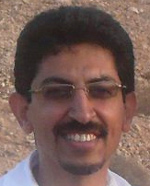
khawaja-twoA leading Bahraini human rights activist, Abdulhadi al-Khawaja, is standing trial in a military court, his daughter Zainab believes. She said he told her the date, time and place of the trial, but when family members came to the court officials denied any knowledge of the case. Mr Khawaja had called for the country’s leaders to be held to account after a brutal crackdown on recent protests. He was seized from his home with two sons-in-law earlier this month.

Zainab al-Khawaja ended a ten-day hunger strike after international activists said they needed her to speak up for those detained in the crackdown. The family was turned away from the court on Thursday morning, although Mr Khawaja had pleaded with them to bring him fresh clothes in time for his appearance. “My father is a very strong man. He used to smile after being beaten-up,” Mr Khawaja’s daughter told the BBC. But in a recent telephone conversation his voice was very weak and he kept telling his family the oppression was great. Ms Khawaja said. “It was something that made me and my whole family very, very scared for him,” she added. Human rights groups and Mr Khawaja’s family say he was beaten and arrested after masked armed police entered their home on 9 April. More than 400 shia activists and protesters have been arrested in recent weeks, Human Rights Watch reports.

Shia activists tortured in Bahrain jails

A Bahraini human rights campaigner says political activists detained by the Manama regime undergo torture in the prisons of the small Persian Gulf kingdom. In an interview with Press TV, Maryam al-Khawaja of Bahrain‘s human rights center called on the Bahraini authorities to stop their crackdown on anti-government protesters and opposition figures . “Within only a number of ten days we saw four people were declared dead by the ministry of interior, and the first one they said was from sickle cell anemia, the second one they said had caused a problem inside the prison and thus had to be subdued and then he died from complications and the third one again they said sickle cell anemia, the fourth one they said had kidney failure,” al-Khawaja said. “But then what we saw actually when the bodies were handed over to their families, wasn’t just they had torture marks on them, their bodies had bruising and even marks of lashings, so we believe that it’s more likely that they have died due to torture rather than the reasons stated by the government of Bahrain,” she added. Al-Khawaja’s sister, Zeinab, has gone on hunger strike to protest the detention of her relatives in the state’s brutal crackdown against anti-government protesters. “My sister started a hunger strike, I believe this is the fourth day now after my father was beaten severely and was unconscious and arrested along with two of my brothers-in-law; my uncle was arrested about three weeks ago so since then we don’t know where their location is,” al-Khawaja pointed out. “They haven’t had access to a meeting with a lawyer or meeting with their families, so my sister launched this hunger strike in an attempt to bring attention to this case and to also put pressure on the government, the US government… She wrote a letter to [US] President [Barack] Obama, asking him to take a stronger stance on what’s happening,” the rights campaigner went to say. Since the beginning of anti-government protests in crisis-hit Bahrain in mid-February, scores of protesters have been killed and many others have gone missing. Their bodies are frequently found days after. According to the opposition, over 800 opposition activists have been arrested. The Bahraini protesters are demanding an end to the rule of the al-Khalifa dynasty. Bahraini security forces with the assistance of Saudi and UAE troops are brutally cracking down on demonstrators. Protesters, however, say they will continue their street demonstrations until their demands for freedom, constitutional monarchy as well as a proportional voice in the government are met.

Abul-Karim Fakhrawi”, April 13

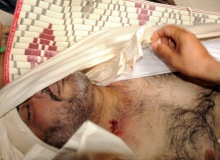
108953Brother of the martyr prevents journalists and photographers from taking pictures of the martyr in washing place of the cemetery. Even martyr’s wife was prevented from having farewell with her husband. It is seems that the martyr’s family had received threats from the Ministry of Interior in the case of the publication of any image.

Two photographers were taking picture on the body of the martyr in washing place of the cemetery, but the brother of the martyr strongly asked him to erase the pictures.

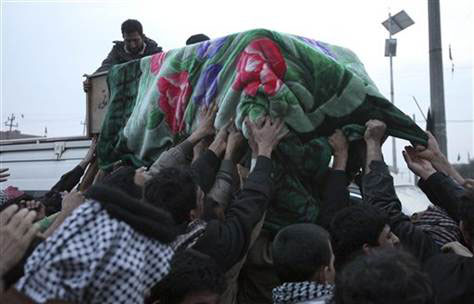
After the eviction of the pure body of the martyr of the mosque to perform burial prayer for him, a group of angry young Bahraini who heard the martyr was tortured in jail opened the shroud and saw the body of the martyr in order to see the effects of torture that led to his martyrdom.

In the fifty-ninth day of Bahrain uprising, another Bahraini citizen martyred in prison due to severe injuries.

A Shi’ite businessman and a member of Bahrain opposition group Wefaq “Karim Al-Fakharawi”, 49, martyred in police custody on Tuesday, due to severe torture of Al Khalifa forces, the group said, and the daughter of an arrested activist said she was on a hunger strike.

Mattar Mattar a member of Wefaq, said Kareem Fakhrawi had martyred in police custody, a week after he failed to return home from a police station where he had tried to complain about his house being demolished by police.

Fakhrawi’s was the fourth known death in police custody in recent days. Bahrain’s government denies there is torture in Bahrain and says all such allegations will be investigated.

He was member of the Wifaq Islamic Society, member of the Al-Wasat newspaper, member of Wefaq Council and And social activist.

17th Feb – 3 Shia martyred in Bahrain

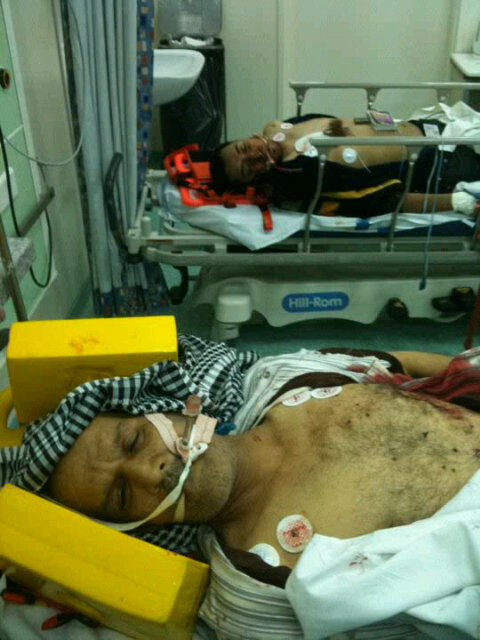
95988Salmanyah Hospital officials said the three martyred men, with ages 23, 62 and unknown,  had been shot at close range with buck shot, a projectile containing hundreds of ball bearings. Hospital officials said more than 100 people had been injured. No official confirmation of the dead or wounded was immediately available.

Shia Right Watch Press — “The police started hitting everyone from every side,” said a medical professional who declined to be named. “People had only one way to run, which was towards this hospital. There was one girl, she was a paramedic, carrying a baby and they hit her; I saw that.”

Riot police firing tear gas and rubber bullets stormed a public square occupied by antigovernment protests early Thursday in Bahrain, driving out demonstrators and killing at least two people, witnesses and hospital officials said, in a drastic turn in the protests swelling across the Arabian Peninsula and the broader Middle East.

Security forces in Manama, the capital of the tiny island kingdom, sealed off every entrance to Pearl Square, then entered the camp from four directions at about 3 a.m., firing tear gas indiscriminately, trampling tents and ripping banners, witnesses said. After police regained control of the square, they continued to chase protesters through side streets.

At Salmanyah Hospital, hundreds of angry protesters gathered at the emergency wing, forming a cordon through which the injured were wheeled on trolleys and chanting “death to the al-Khalifa,” in reference to the royal family, but the protesters also chanted “peaceful, peaceful” in English, in an apparent sign that they would not respond violently.

Friends and relatives of the injured filed in and out of Salmanyah Hospital’s critical room, many wailing or slumping against the hospital walls. Others showed photos on camera phones they said were taken in the square, with some photos showing tanks, suggesting the military had joined the crackdown. Many other wounded were being taken to Ibn Al-Nafees Hospital, a private hospital a few miles away.

Witnesses said police in Pearl Square first attempted to shoot tear gas at the protest from a turnpike overlooking the west of the square, but wind blew the gas back at them. More forces then attacked from the eastern side, first bombarding the encampment with tear gas, then storming it from all sides, the witnesses said.

“They fired at our medical tent, they hurt our people,” said another medical professional at Salmanyah Hospital, who declined to be named. “They throw us, shoot us, hit us with guns. I have a lot of injuries in our staff.”

A 50-year-old man who identified himself as Hussein, who had stayed in the roundabout since it was first occupied, said between 5,000 and 10,000 protesters were in the square at the time of the attack—though his estimate couldn’t be verified. “Then hundreds of police came,” Hussein said.

“We thought that if we were there they wouldn’t do this. We were wrong,” he said.

As the sun rose, witnesses said Pearl Square was empty and sealed off with barbed wire, and at Salmanyah Hospital, hundreds were still gathered outside. Many were crying, some lying on medical trolleys that couldn’t be squeezed into the emergency room. Some gathered in prayer, chanting repeatedly, “We won’t give up.” Others expressed their anger at authorities and the ruling family.

“They are gangs; they are not government. It’s time to finish,” Essan al-Mubarak said. “We will take our friends to our final resting place, then either we will stay or they will stay. We are fed up. We can’t take this.”

Clashes between demonstrators and security police earlier this week in Manama resulted in three deaths.

The decision by authorities to sweep out the protesters by force was significant because it was the move Egypt’s regime never succeeded in making to regain control. In Cairo, police and gangs associated with the government attacked protesters, but the military ultimately preserved civil order by guarding the protesters’ ability to occupy Tahrir Square. There have been violent putdowns of protests in Iran and elsewhere in recent days, but no government has forcibly swept out an established base of mass demonstrations.

In Bahrain, security forces had used tear gas and rubber bullets at close range to forcibly subdue protesters from the beginning, but had not attacked Pearl Square since demonstrators took up residence there. On Tuesday, though President Barack Obama declined to comment on Bahrain when asked, the State Department asked for both the opposition and the regime to refrain from violence.

The crackdown also came as a surprise after King Hamad bin Isa al-Khalifa had made a rare television appearance on Tuesday promising to investigate the deaths of two protesters said to have been killed by security forces in the melees. But as the protests have grown larger, they also have included more calls for the ruling family’s removal, and the shouts of “Death to the al-Khalifa,” have increasingly been heard.

Fears have also grown within Bahrain and among its Persian Gulf neighbors that the Shiite-majority country would be at risk of widespread sectarian violence if the regime became more unstable. That hasn’t marked the uprisings in Egypt, Tunisia and elsewhere, but Bahrain is governed by a Sunni minority and such tensions have simmered and sometimes boiled over violently before the recent unrest.


15 Shia Killed in Suicide Bomb at Iraqi Funeral

www.shiarightswatchA wave of bombings in June on Shi’ite pilgrims and religious sites has killed more than 150 Shia.

On Monday June 19, 2012 , an anti-Shia exploded himself in a funeral killing 15 Shia and wounding more than 40 Shia. The number of Shia killed in the month of June is increasing and no one is taking action toward stopping inhumane crime against Shia.

Violence is increasing again in the country with majority Shia population and  the international community is silence due to the support of Anti-Shia terrorism. It has become clear that humanity is supported in the interest of a countries amount of oil and  money in buying the media in order to hide the truth about Shia massacre .

34 Shia Killed and 140 Injured in Car bomb Attack in Baghdad

Shortly after the major car bomb in June 13,2012 that killed 103 Shia in Baghdad, another explosion took Shia lives again.

On Saturday June 16, 2012 Anti-Shia took 34 Shia life. The first attack was carried out on a highway at about 12:15 p.m. local time (0915 GMT) on Saturday, when Shia pilgrims were returning from the annual commemoration ceremony of Imam Musa Kazim (Peace Be upon Him).

The second bombing targeted an intersection in the area at about 2:00 p.m. local time (1100 GMT).

At least 18 people were killed in the first attack and 16 others killed in the second car bombing.

Meanwhile, medical sources in Baghdad say an additional 140 people were also injured in the two attacks on Saturday.

5 Shia Killed in Roadside Bombs

SRW( Shia Rights Watch) – At least five Shia people have been killed after three roadside bombs ripped through a busy outdoor market in the Iraqi capital, Baghdad on Friday May 19, 2012.

Dozens of others were wounded in the early morning blasts targeting a pet market in in Hussainiya area, northeast Baghdad.

The attack came hours after a bomb attack at a restaurant in southeast Baghdad killed five people.

Nearly 100 people were killed by bomb attacks at two other pet markets in Baghdad in 2008.

Source: ABNA.com

12 Shia Killed on Pilgrimage in Iraq

On Friday (Feb 13th) , two cars blocked a bus carrying pilgrims from Baghdad to a key Shia shrine in the northern, mainly Sunni, city of Samarra. Seven gunmen opened fire, killing five and wounding six of the pilgrims in the attack at around 5 a.m. (10 p.m EDT on Thursday) near Tarmiya, 25 km (15 miles) north of the capital, a local police source said.

The same pattern of terrorist killing of the Shia shows their roots to be the same whether they kill the innocent Shia people in Chilas , Kohistan , Quetta , Karachi , Pakistan , or in Karbala, Iraq. They are the same Anti-Shia (Wahabi) terrorist , funded by Saudi .

A second incident occurred at 7.30 a.m. in the southern outskirts of Baghdad when gunmen killed two Shia pilgrims en route to the holy Shia city of Kerbala in Iraq’s south. Six others were wounded, police and hospital sources say.

While overall violence in Iraq has fallen since the peak of sectarian fighting in 2006-07, bombings and killings still occur daily. Most attacks are being done by the Anti-Shia (Wahabi) Arab insurgents, who are the remenants of Saudi funded insurgency.

On Wednesday, militants targeting Shia families in Baquba killed five people in bombings that occurred after leaflets were distributed telling Shia to leave the neighborhood or be killed.

Shia Rights Watch Condemns the Explosion Targeting Shia in Iraq

shiarightswatch.org_23_iraqbombShia Rights Watch strongly condemn the explosion targeting Shia in Iraq  and ask the government to pay more attention to the Iraq situation, knowing that the country with majority of Shia cannot be unsafe like this. Foreign country do all they can to make the Shia live in fear in their own home.

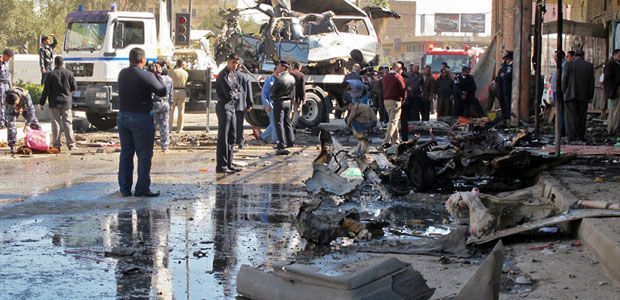
On Tuesday March 20, 2012. At least 26 explosions across Iraq killed at least 49 Shia and wounding more than 200. It was Iraq’s bloodiest day in nearly a month, and the breadth of coordinated bombs in more than a dozen cities showed an apparent determination by insurgents to prove that the government cannot protect the majority Shia population.

Tuesday’s deadliest incident occurred in the southern Shi’ite Muslim holy city of Kerbala, where twin explosions killed 13 people and wounded 48 during the morning rush hour, according to Jamal Mahdi, a Kerbala health department spokesman.

“The second explosion caused the biggest destruction. I saw body parts, fingers, hands thrown on the road,” 23-year-old shop owner Murtadha Ali Kadhim told Reuters.

Tuesday’s attacks were the biggest since February 23 when dozens of explosions across the country killed at least 60 people.

UN Complaint