Welcome to Shia Rights Watch

spot_imgspot_imgspot_imgspot_img
Home Blog Page 93

Attacks on Shia Targets Across Iraq Killed at least 60 Shia and Wounded Dozens

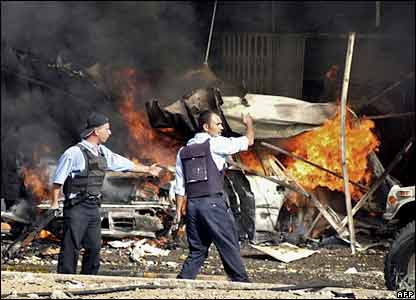
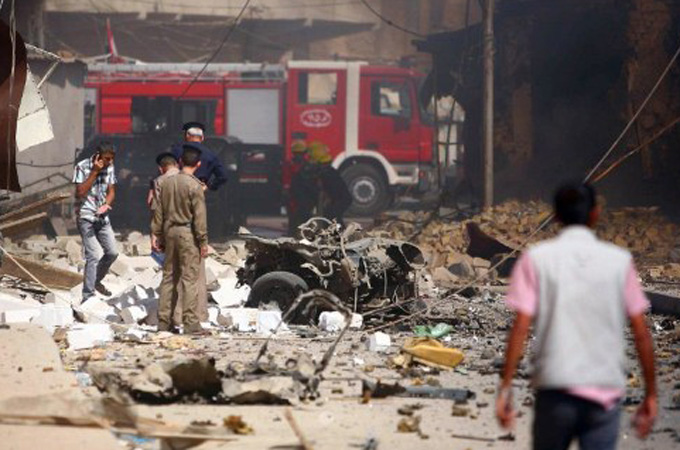
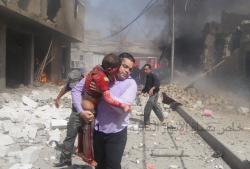
bomb-blast_Simultaneous early morning attacks on Shia targets across Iraq kill at least 60 Shia and wounded dozens

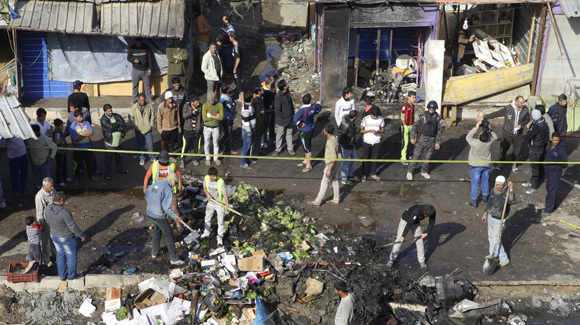
At least 32 people were killed in blasts in Baghdad where 10 explosions tore through mainly Shi’ite neighborhoods during rush hour and other attacks targeted police patrols, commuters and crowds gathered in shopping areas.

In Thursday’s violence, one car bomb in the capital killed at least nine people and wounded 27 in the upmarket Karrada neighborhood, hurling shrapnel into the next street and blowing out glass from nearby buildings.

Witnesses saw four wrecked cars full of shrapnel and bloodied seats near an ice-cream shop at the site of another blast.

In at least three Shia neighborhoods in Baghdad, nine policemen were killed, and in the capital’s northwestern Kadhimiya district, a car bomb killed six Shia when it struck a street lined with restaurants.

In the biggest attack outside the capital, a car bomb killed seven Shia and wounded 33 in the town of Balad, north of Baghdad.

Explosion Kills 32 Shia in Baghdad

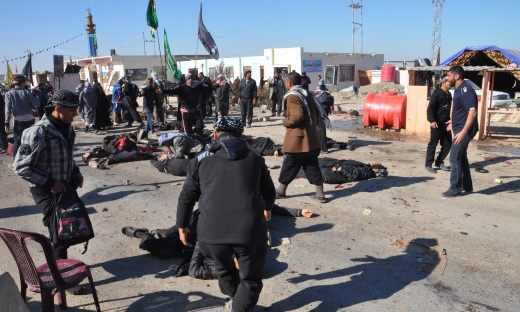
www.shiarightswatch.org-baghdad-exBAGHDAD— A suicide bomber detonated an explosive-packed car near a funeral procession in southeastern Baghdad on Friday, killing at least 32 Shia — half of them policemen who were guarding the march — in the latest brazen attack since the U.S. troop withdrawal from Iraq.

Police officials said the blast occurred at 11:00 a.m. in the predominantly Shia neighborhood of Zafaraniyah, where mourners had gathered for the funeral of a person killed the day before. They said 65 people were wounded in the attack, including 16 policemen.

Hospital officials confirmed the death toll.

Salam Hussein, a 42-year-old grocery store owner in Zafaraniyah said he was watching the funeral procession, which was heavily guarded by police, when the blast blew out his store windows and injured one of his workers.

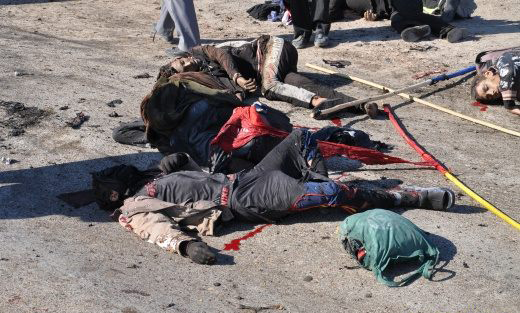
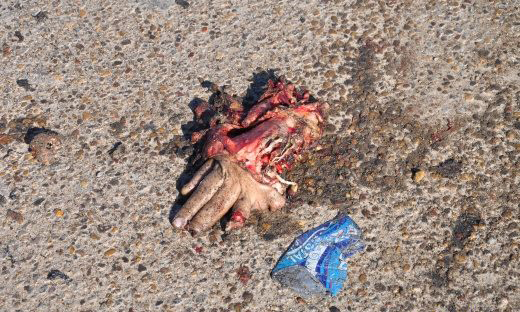
“It was a huge explosion,” Hussein said. As he took his worker to the hospital, Hussein said he saw cars engulfed in flames, “human flesh scattered around and several mutilated bodies in a pool of blood” around where the attacker’s car had exploded.

Across Iraq, at least 200 Shia have been killed in a wave of attacks by suspected insurgents since the beginning of the year. Most of the dead have been Shiite pilgrims and members of the Iraqi security forces.

From the Associated Press January 27, 2012, 4:00 a.m.

Explosions in Iraqi Shia Neighborhoods Killed 13 and Wounded 46

IRAQ-articleLargeBAGHDAD — A series of explosions in Shia neighborhoods killed nine Shia and wounded dozens more on Tuesday (1-24-2012), the latest in a wave of sectarian attacks. During the past month, insurgents have increased their attacks against Shia’s, including pilgrims marching to a shrine in southern Iraq for one of their holiest rituals.The violence began early on Tuesday, while many Iraqis were heading to work.

Around 7 a.m., a car bomb exploded near a gathering of day laborers in the Shia neighborhood of Sadr City, killing six people and wounding 23. About half an hour later, another car bomb detonated near a bakery in the neighborhood, wounding 13.

An hour later, three explosions struck north Baghdad. A blast near a school in Shulla killed two people and wounded 10, including several students. Another person died in an explosion in the neighborhood of Huriya.

Salah Haider, 40, was standing near the first explosion in Sadr City and was wounded in his arms and legs.

Source: The new York Times

86 Shia Killed and Injured in two Explosions

5A wave of explosions struck two Shia neighborhoods in Baghdad, killing at least 36 Shia.

The attacks began with the explosion of a bomb attached to a motorcycle near a bus stop where day laborers gather to look for work in the Sadr city neighborhood. One of those who witnessed the attack said it filled the area with thick black smoke.

“Shia have real fears that the cycle of violence might be revived in this country,” said Tariq Annad, a 52-year-old government employee who lives nearby.

That attack was followed by the explosion of a roadside bomb. Police found a third bomb nearby and defused it.

The two Sadr City blasts killed 12 Shia, according to police and medical officials.

Less than two hours later, two explosions rocked the Shia neighborhood of Kazimiyah in the north of the capital, killing 24 people.

Officials said the Kazimiyah blasts occurred almost simultaneously, with at least one caused by a car bomb.

Hospital officials confirmed the causalities from the four blasts, which included more than 60 wounded.

Coordinated bombings, particularly those targeting Shia areas, are the hallmark of Sunni militants linked to al-Qaida.

Thursday’s attacks were the deadliest in Baghdad since Dec. 22, when a series of blasts killed 69 Shia. An al-Qaida front group in Iraq claimed responsibility for those attacks.

17 25 36 39  4340

205 Shia were Killed and Injured in 10 Bombing Attacks in Iraq

Iraq-0003Ziad Tariq, spokesperson for the Iraqi health ministry, said total of 205 Shia were killed and injured in 10 bombing attacks that rocked nine neighborhoods of the capital on Thursday morning.

The attacks were carried out in the Allawi, Bab al-Muatham and Karrada districts of central Baghdad, the Adhamiyah, Shuala and Shaab neighborhoods in the north, Jadriyah in the east, Ghazaliyah in the west and Amal and Dura in the south.

The deadly incidents in Iraq took place at a time that the country is experiencing a critical situation.

Explosions hit Iraq’s Karbala City, Killed and Wounded 96

Iraq-002Four explosions have rocked the Iraqi city of Karbala, around 118km south of the capital Baghdad, leaving at least 30 people dead and 66 more wounded, sources say.

The back-to-back explosions occurred on Sunday outside a governmental building and damaged many cars, police officials say.

The first blast tore though a crowd of guards and civilians gathered in front of an office issuing identity cards and passports, while the three other explosions went off a short time later as emergency services arrived.

No one immediately claimed responsibility for the attacks, caused by explosive packages, according to police.

“I was inside my house when I heard a big explosion. When I got out I saw many people wounded and some bodies on the ground,” Mohammed Naeim, a local resident, told the Reuters news agency.

Bombings and attacks are once again becoming an almost daily occurrence, often targeting security personnel, after a drop in violence levels.

“The bomb attacks in Karbala today have so far killed nine people and there are 99 people wounded,” Alaa Hammudi, head of Karbala province’s health department, said.

He said the toll could further increase.

Lieutenant-General Othman al-Ghanimi, the army commander for forces across five provinces in central Iraq, including Karbala, put the toll at 10 dead and 86 wounded.

He said the four explosions included two roadside bombs, a car bomb and a suicide explosion, but did not say the order in which they happened.

Collapsed houses

An AFP journalist at the scene reported seeing several bodies covered in blood being taken away by paramedics, and major damage to vehicles and buildings, with some houses completely collapsed.

Security forces cordoned off the area in the aftermath of the attacks, the journalist said.

An interior ministry official said entrances to Karbala had been closed. Karbala is a predominantly Shia city that is home to the mausoleums of Imam Hussein and his half-brother Abbas.

It has frequently been the target of Sunni Muslim fighters in the past, such as on January 20 when a spate of blasts against Shia pilgrims on the outskirts of Karbala killed 45 people.

source:Nahrainnet.net

Six Shia Muslim killed in Pakistan

Once again, Anti Shia terrorist take the life of six Shia in Pakistan.

The atrocity was merely responded by silence from authorities.

Shia rights watch condemn the attack and contacted the Pakistan ambassador Rehman, seeking an answer regarding the government silence toward Shia killing.

SRW also urged the ambassador to accept SRW recommendations in solving the issue.

The recent incident in Pakistan was a roadside bomb ripped through a passenger bus carrying Shia Muslim pilgrims in southwestern Pakistan on Tuesday, killing six people and wounding about a dozen.

Earlier security sources said that four people were killed by the attack, but Deputy commissioner Mastung confirmed the killings of only two people. As of now, informed sources  declare the death of six people.

The blast took place in the Mastung district, about 25 kilometres south of Quetta, the capital of insurgency-hit Balochistan province.

“The bus caught fire after the blast,” he said adding that initial reports said “at least two people were killed and about a dozen wounded”.

The injured, some of them in serious condition, have been taken to a hospital in Quetta.

According to Quetta authorities, the names of Shia who killed in blast include:

1.Saddiqa Bibi 42 years

2.Sakina 18 years

, 3.Hussain Ali 50 years

4.Jan Ali 28 years

5.Rajab Ali 13 years

6.Neroz Ali 28 years.

Bahrain in the Month of September

Bahraini Shia are still facing oppression and discrimination from their government. September has been a month full of violations.

Ongoing violations in Bahrain resulted in 88 arrests in the first two weeks of September according to reliable sources. Local activists reported 87 men and one woman were arrested by authorities during this period. The forces also arrested 16 minors, injured 10 and raided 87 homes of Shia Muslims. The sources also reported 121 collective punishments and attack to a Shia cemetery.

Although ongoing violations in Bahrain are not covered by media outlets, they are escalating. Shia Muslims of Bahrain have been under violent pressure by the Bahraini government because they demand democracy and freedom. SRW has published two detailed reports to highlight the violations. The reports include a separate section dedicated to violations to children’s rights.

Attack to Shia Muslim Mosque

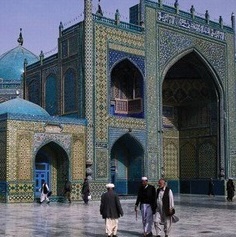
afghanAn attack to Shia Muslim mosque in Kabul, Afghanistan increases concerns of Shia Rights Watch. SRW is concerned about the security and safety of Shia Muslims of Afghanistan after two gunmen holding Pakistani passports attacked the people in the mosque using gun and knife. The attackers were arrested by local people.

As Shia rights violations continue in Middle East more and more Shia, in different countries, are facing violence and attacks to their communities. SRW urges Afghani government to secure Shia populated areas and prevent all violence that threatens its citizens. Prevention strategies are critical to assure security and stability of the country.

59 Shia Died in Terrorism Explosion

(Reuters) – A suicide attack killed dozens of Shi’ite Muslims at a crowded Kabul shrine on Tuesday, and four others died in a smaller blast in a key northern city, in the worst sectarian violence Afghanistan has seen since the fall of the Taliban.

The Kabul bomb was the deadliest in the capital since 2008, and punctured any lingering sense of optimism from a conference on Monday where Western allies made firm but not specific promises to support Afghanistan after troops leave in 2014.

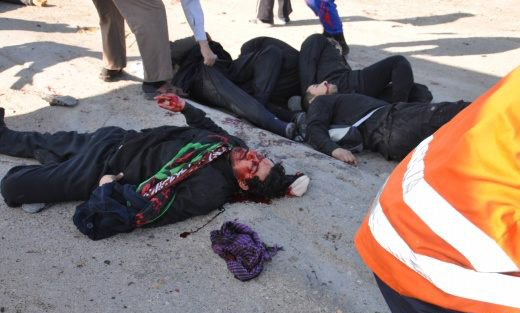
Bodies and blood were scattered down a street in the heart of old Kabul where a crowd of hundreds had gathered to mark the festival of Ashura, with chanting, and self-flagellation. At least 55 were killed and 160 wounded, some critically.

Afghans, who have previously been spared the large-scale sectarian attacks that regularly trouble Iraq and neighboring Pakistan, now face the grim prospect of a new type of bloodshed being added to the dangers of daily life.

“This is the first time on such an important religious day in Afghanistan that terrorism of that horrible nature is taking place,” Afghan President Hamid Karzai told journalists in Germany, where the conference on Afghanistan’s future was held.

Outside a Kabul hospital, mourners cried near a pile of bloody clothes and shoes. A woman in a dark headscarf clutching a bloodstained sports shoe said her son, in his early 20s, had died. “They killed my son … this is his shoe,” she wailed.

No one immediately claimed responsibility for the attacks in Kabul and northern Mazar-i-Sharif. The Taliban strongly condemned the bombings and blamed “invader enemies.”

Afghanistan has a history of tension and violence between Sunnis and the Shi’ite minority. But since the fall of the Taliban the country had avoided the large scale sectarian attacks that have troubled neighboring Pakistan.

“Afghanistan has been at war for 30 years and terrible things have happened, but one of the things that Afghans have been spared generally has been what appears to be this kind of very targeted sectarian attack,” said Kate Clark, from the Afghanistan Analysts Network.

“We don’t know who planted the bomb yet and it is dangerous to jump to conclusions but if it was Taliban, it marks something really serious, and dangerous, and very troubling.”

ACROSS THE COUNTRY

Shortly after the Kabul blast, a bicycle bomb exploded near the main mosque in northern Mazar-i-Sharif city, killing four, injuring 17 others, and sparking a fight at a university mosque where Shi’ites and Sunnis were both praying.

“Enemies wanted to target the Muslim precession attending prayer, but because of tight security they failed,” the city’s senior police detective Abdul Raoof Taj, told Reuters.

Four people were injured in the mosque scuffle, which broke out when worshippers began arguing about the blast.

Police later defused a mine, found near the site of the explosion and likely intended to target rescuers and security forces attending to victims of the bomb.

A motorbike bomb also appeared to be aimed at Shi’ite worshippers in southern Kandahar city, the Taliban’s spiritual home and centre of a strong push by NATO-led troops to push the insurgents out of their stronghold.

It exploded prematurely, injuring two policemen and three civilians, but causing no deaths.

“We cannot say for certain who the bomber’s target was, but it was probably the Ashura (ceremonies),” said Kandahar police chief Abdul Raziq.

“We have 100 per cent security. The enemies cannot enter the prayer sites. With such actions they want to show they exist.”

The Shi’ite Muslim festival of Ashura marks the martyrdom of the Prophet Mohammad’s grandson Hussein in the battle of Karbala in Iraq in the year 680.

Ashura is the biggest event in the Shi’ite Muslim calendar, when large processions are vulnerable to militant attacks, including suicide bombings. Pakistan has deployed tens of thousands of paramilitary soldiers and police during Ashura.

Blood has spilled between Pakistan’s majority Sunni and minority Shi’ite militants for decades.

Sectarian strife has intensified since Sunni militants deepened ties with al Qaeda and Pakistani Taliban insurgents after Pakistan joined the U.S.-led campaign against militancy after the September 11 attacks.


UN Complaint