

Welcome to Shia Rights Watch

spot_imgspot_imgspot_imgspot_img
Home Blog Page 54

The anti-Shia terrorist group Jaish-ul-Islam killed 25 Shia Muslim in Baluchistan

Pk-06The anti-Shia terrorist group Jaish-ul-Islam claimed the deadly attack in Baluchistan, Pakistan.

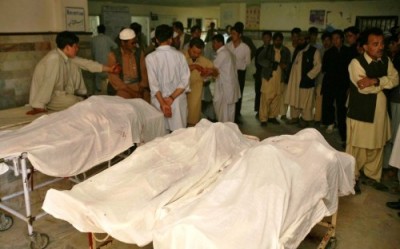
On Sunday June 8th 2014 more than 25 Shia pilgrims, including more than 10 women and children, were killed when suicide bombers attacked their buses. The attack took place yesterday when 10 buses carrying Shia pilgrims stopped at a hotel in Taftan.

According to security forces they killed six of the attackers after exchanging heavy fire. The official mentioned that terrorist groups knew the exact time and place of Shia pilgrims’ stops.

The home secretary of the province, Akbar Durrani confirmed that security forces were able to overpower the attackers after a few hours of heavy gunfire. The masked militants had come heavily armed and prepared for a siege.
“The bodies of the pilgrims are being shifted to hospitals and the injured are also getting treatment,” Durrani said.
“There were explosions after the buses were parked outside the hotels where the pilgrims were going to stay overnight before they commenced their journey back the following day,” Durrani said.
Attacks on Shia Muslim pilgrims have increased in recent years in the Baluchistan province where in the past also such attacks have killed dozens and injured scores of pilgrims.
Two devastating bombings in Quetta killed nearly 200 Shia last year and were claimed by banned anti-Shia extremist group Lashkar-e-Jhangvi (LeJ) which has links to al-Qaeda.
“We have to stand with [the] victim’s family and come up with [a] new strategy to protect Shia Muslims peacefully,“ said Mustafa Akhwand director of Shia rights Watch.

Anti-Shi’ism is increasing in Middle Eastern countries and all countries have a duty to promote peace and nonviolence. Governments must bring terrorist groups to the court of law, set strong messages to prevent human rights violations toward minorities and make our society safer.
Update, Attack on Samarra

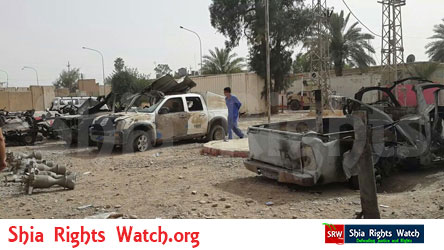
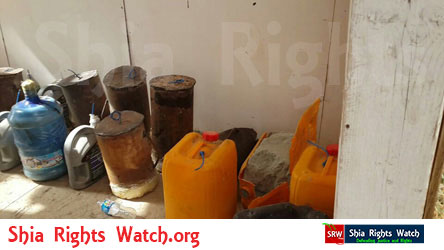
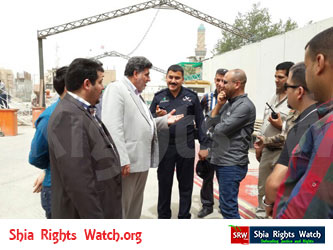
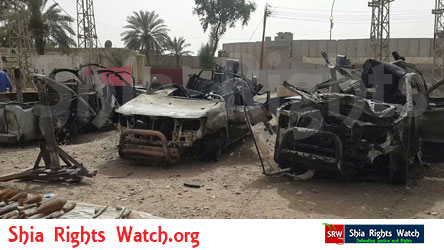
ShiaRightsWatch_Samera2014Samarra, is an ISIS occupied town and home to two very important Shia shrines. Although Samarra is a Sunni populated city, the recent attack targeted Shia pilgrims with and was perpetrated with the intent to destroy two important Shia shrines. As many as 54 people were killed and the shine is still under ISIS siege with pilgrims inside as of yesterday.

According to Reuters, ISIS advanced on Samarra in pick-up trucks, raiding checkpoints along the way and blowing up a police station in an attack that killed several policemen. They also occupied Samarra’s two largest mosques and announced the “liberation” of the city via loudspeaker, urging residents to join their jihad (holy war) against the government.

As a result the Iraqi government bombed the city and a curfew has been imposed on Samarra and neighboring villages. As many as 54 were killed since last night and many more have been injured. ISIS has moved towardMosulandthere is conflict in that area as well.

Attacks against Shia shrines and pilgrims have been an ongoing issue in this country. Every year millions of Shia Muslims visit shrines in Iraq as an important part of their religious expression. . Yesterday’s attack carried by the Islamic State in Iraq and Syria, an al Qaeda splinter group known by the acronym ISIS, is one of the most extreme examples of a systematic violation of Shia rights by terrorist groups.

Shia Rights Watch is concerned for the Shia population in Iraq and urges the Iraqi government to retake the areas from ISIS and protect local citizens and pilgrims. Such a powerful attack and large number of ISIS occupying a city overnight raises question about the security reinforcement in that area.

ShiaRightsWatch_Samera2014_2 ShiaRightsWatch.org_Samera2014 ShiaRightsWatch_Samera2014_4

SHIA RIGHTS VIOLATIONS IN PAKISTAN, MAY 14TH TO 26TH 2014

Shia Shop Owner killed in Karachi
Wednesday, 14 May

Terrorists of Sipah-e-Sahaba attacked the shop of 35 years old Mazhar Abbas Federal B Area Block 18 that is also called Samanabad on May 14th. They opened fire upon Mazhar Abbas and fled the scene leaving Mazhar dead.

Mubarak Ali Shan Ambushed in Quetta

Friday, 16 May

A Shia young man, Mubarak Ali Shan, was ambushed in Mechanki Road in Quetta on May 16th. Although he managed to escape, the fear of more ambushed is present in the Shia community of Quetta.

Custodian of Shia Cenetr Killed in Karachi

Monday, 19 May

A Custodian of Shirazi Imam Bargah ( Shia Islamic Center) was attacked and killed in district south of Karachi. Shaukat Shirazi died on spot.

Shia Shop Owner Killed t in Karachi

Monday, 19 May

Agha Masud was shot and killed while sitting in his shop in Karachi, Liaquatabad on May 19th.

Shia Banker Killed

Tuesday, 20 May

Hassan Mehdi, an employee of Habib Bank, was ambushed in Awami Colony Korangi when he was returning home from bank.

Shia Muslim killed in Dera Ismail Khan

Wednesday, 21 May

Anti-Shia groups attacked and killed Gulzar Hussain while returning from post office in Dera Ismail Khan.

Brothers Killed in Karachi

Thursday, 22 May

Two Shia brothers killed in Karachi on Thursday May 22nd. Zulfiqar Ali and Shakir Ali shot and killed while they were boarding a rickshaw near Nazimabad underpass. Zulfiqar Ali was a student of Hamdard University and Shakir Ali was an employee of K Electric.

Peaceful Protests

Thousands of Shia Muslims marched through streets of Incholi and staged a sit-in on Shahrah-e-Pakistan to protest against the Shia genocide on May 16th. Women, children, elderly persons and youths participated in the rally and the sit-in that was held under tight security by police and rangers.

Also on Friday the 23rd, another peaceful protest was carried out. In protests and sit-ins the Shia community demanded Pakistani government to take action and stop Shia targeted killings. The Pakistani government has not taken any action to create a safe environment for minorities in this country. SRW has demanded Pakistan to be added to the list of Countries with Particular Concern by US government.

Shia Axed to Death in Karachi

The Pakistani government has proven yet again that they lack the capacity to protect their own citizens. Militants from the group Sipah-e-Sahaba, also known as Ahl-e-Sunnat-Wal-Jamaat, attacked and killed a member of the Shia community. Ali Raza was murdered with an axe by this group on May 31, 2014. Ali Raza, described as a prominent Shia Muslim in Karachi, was the custodian of Imambargah Moosa Kazim, which is located in the Ferozabad area of Khalid Bin Waleed Road of the city.

The murder of this man, solely on the basis of their religious affiliation is intolerable. Shia Rights Watch wholly condemns the actions taken by these militants.

Moreover, this incident is just the latest in a series of crimes toward Pakistan’s Shia community which have prompted little to no response from the government. Shia Rights Watch condemns the inaction of the Pakistani government as a violation of the rights of Pakistan’s Shia population which composes roughly one third of Pakistan’s population of 180 million people. Article 3 of the Universal Declaration of Human Rights states “Everyone has the right to life, liberty, and security of person”. It is the obligation of governments to ensure this most basic right is being fulfilled, but here we see that these rights are only granted to certain groups in Pakistan. The international community must call on the Pakistani government and demand that they fulfill the promise they made to each of the people living within its borders when they signed the Universal Declaration of Human Rights.

Despite repeated acts of violence against Pakistan’s Shia population, the United States has yet to add Pakistan to its Countries of Particular Concern for violations of religious freedom. Both Shia Rights Watch and the United States Commission for International Religious Freedom have requested that the United States Department of State would add Pakistan to this list.

By Alan Williams

Bomb Explosions Claiming more Lives in Iraq

Bomb explosion in Najaf killed and wounded many Shia Muslims. A parked car exploded in the Shia populated city of Najaf, 100 miles south of Baghdad and claimed 15 lives.

Two people were killed and 10 wounded in a commercial area in the town of Iskandariyah, 30 miles south of Baghdad.

Another car bomb hit in the southern city of Nasiriyah, killing one civilian and wounding 18.

Mahmoudiyah’s outdoor market was also attacked killing person and wounding.

Killing Shia majority of Iraq and this country’s pilgrims has become a worrisome that has not been addressed by Iraqi government. SRW is concerned for the ongoing violence in Iraq where more than 1500 people have been killed so far in2014.

Saudi Hands Peaceful Protester Death Sentence

Once again the Saudi Arabian government, in front of the blind eyes of the international community has abused its power and oil wealth to ensure the world would not cover what is happening in their country.

Saudi Arabia, has again demonstrated its apathy toward human rights reform, this time by sentencing to death Shia Muslims who participated in a peaceful protest against religious-based inequality. Saudi Arabia has a long track record of arresting political dissidents and convicting them on spurious charges. On May 27, 2014 and May 28, 2014, the Specialized Criminal Court in Saudi Arabia convicted two young adult Shia Muslims under false charges.  Saudi Arabia has consistently treated the 15 percent of its population that is Shia Muslim as second-class citizens, ignoring their rights. For this reason, Shia Muslims of Saudi Arabia continue to petition their government for equality. The Saudi government responds by disproportionately targeting Shia communities and Shia rights activists with arbitrary arrests and spurious convictions. This time the victims of this inhumane treatment where 26 year old Rida Rabih and 20 year old Ali Mohammed Baqir al-Nimr who were sentenced to death on May 27th and May 28th respectively for their involvement in protests that occurred in the eastern Saudi city of Al-Qatif in early 2011. The message the Saudi government is sending to would-be activists and protestors through these arrests, convictions and sentences is perfectly clear. Peaceful protest and freedom of expression will not be tolerated in Saudi Arabia.

Shia Rights Watch views the actions of the SCC as a violation of Article 9 of the Universal Declaration of Human Rights which states “No one shall be subjected arbitrary arrest, detention or exile”. The arbitrary arrest, spurious conviction and excessive punishment violate the rights of these protestors and SRW is calling for these decisions to be overturned. The protesters were exercising their right to express their discontent with a government that has consistently oppressed them over recent years. The death sentences handed down by this court have no place in the 21st century. Shia Rights Watch also calls on the international community to stand with them in condemning these actions.

Shia Muslims are the largest minority group in Saudi Arabia, composing between 15 and 20 percent of the population. Most of the Shia in Saudi Arabia live in the eastern provinces of the country especially around the urban areas of Al-Qatif and Hasa. Shia Muslims have faced widespread repression and discrimination by the ruling government. The uprisings that occurred in 2011 resulted in the arrests of over 900 people, with 300 remaining in jail today.

Anti-Shia Sentiment Simmers Ahead of Indonesia’s Election

Sponsorship and ignorant to Shia rights violations by governmental branches in Indonesia has become a worrisome for many human rights NGOs.

Indonesia is Sunni majority country, with a small yet growing Shia minority. Shia Muslims have been increasingly attacked for practicing their faith, even in the privacy of their homes yet the government of Indonesia is not taking steps to prevent the increasing violations.

            Indonesia has a few branches of government that has either sponsored or ignored the Shia violence. The Council of Ulema. The main role of this council is to provide Fatwa’s (A scholarly point of view of Islamic law) to the people of Indonesia. Shia, Sufi’s, and Ahmadiyya are not allowed in Council of Ulema. This directly goes against the Universal Declaration of Human Rights Article 21 in which Indonesia signed and agreed to protect and maintain. Article 21 states that “Everyone has the right to take part in the government of his country, directly or through freely chosen representatives.: Shia, Sufi, and Ahmadiyya are not given a fair chance to be represented or take part in the government.

            Tardjono Abu Muas, a well know cleric in Indonesia has enabled violations in his speeches. Most of his lectures and sermons seem to be about dissolution of Shia Islam in Indonesia. Muas is the head of Anti Shia Alliance who believes anyone who is deviant from true teaches of Islam, needs to convert or be punished. Tardjono created a conference for Anti-Shia in April of 2014 and openly preached hatred towards Shia, and other sects of Islam he viewed as deviant.

            The government has not done anything to stop or condemn this conference, or any anti Shia hate. The Governor of West Java Province Ahmad Heryawan has publicly supported the Anti Shia Alliance. In fact many government officals was in attendence at this confrence. The Council of Ulema has not spoken out against the conference of this organization. Ahmad bin Zein Al Kaff, the head of the Anti-Heresy Front which is an government branch, said that Indonesia must be cleansed of Shia teaching. At this confrence Muas was also urging people to vote, for non-Shia in the upcoming election. The fear and insecurity that Shia Muslims report from Indonesia prevents them from practicing their right to freedom of religion which is a violation of the Universal Declaration of Human Right Article 18.

            The Indonesian government says that will give freedoms of rights and religion but they believe they have to monitor and watch it because they are a Muslim country. This concept of having freedom yet regulating it in a violent style is not considered practical freedom according to Shia Rights Watch . A country cannot give freedom to their citizens yet regulate it by arrestments and punishments of those who practice their right to it.

By Skye Thompson

UN Permanent Members are Among the Most Important Arms Dealers

SIPRI, the Stockholm International Peace Research Institute, published a troubling report on the increased spending on arms by countries responsible for human rights violations. According to the report, China, Russia and Saudi Arabia are among 23 countries that have more than doubled their military expenditure since 2004. While developing countries are spending more on defense, Western countries such as the U.S. are spending less.

Saudi Arabia’s spending increased by 14 percent and reached $67 billion; Bahrain’s spending increased 26 percent; and Iraq’s spending is up 27 percent.

The report also points out that eight states bordering the Persian Gulf — Bahrain, Iran, Iraq, Kuwait, Oman, Qatar, Saudi Arabia and the United Arab Emirates (UAE) — invest the highest percentage of GDP in armed forces and weapons.

While it is important to know who is buying weapons, it is also critical to know who is selling them. Interestingly, the five U.N. Security Council permanent members — China, France, Russian Federation, the United Kingdom, and the United States — are among the largest arms dealers.

According to its own documents, ”The purpose of the United Nations is to bring all nations of the world together to work for peace and development, based on the principles of justice, human dignity and the well-being of all people.”

While the U.N. is trying hard to resolve the world’s most difficult problems of violence and conflict, its most influential and powerful members are making money selling arms. The are not just selling arms, but providing services and training to governments with well-known history of human rights violations.

Saudi Arabia, one of the countries to increase its expenditures on weapons, is one of the most repressive monarchies in the world. Its laws relegate women to second class status; it mistreats migrant workers and oppresses minorities; it trains and arms terrorist groups in the Middle East. Yet some peacemaking and prodemocracy members of the U.N. sell Saudi Arabia arms at clearance prices.

General Dynamics recently secured a 14-year contract worth $10 billion to sell Saudi Arabia military vehicles as well as training and support services. The Kingdom is Germany’s largest military customer, accounting for almost a quarter of Germany’s arms sales.

Like Saudi Arabia, Bahrain and Qatar are rights violators that enjoy friendship and close business relations with big arms dealers.

Oppressive governments use the language of security and defense to justify their excessive investment in weapons and personnel, and civilians pay the highest price. The arms are often used to oppress minorities and stifle their demands for reform. Every dollar spent on arms diverts resources from citizens as governments cut basic services to purchase weapons. This exacerbates  poverty and harms many of the vulnerable poor.

All nations engage in trade and have economic relationships, but these trade relations can help or harm the people of other nations. It is unethical to sell arms to governments that do not respect human rights and human dignity.

To defuse regional conflicts and reduce the oppression of ethnic minorities:

  • U.N. members should fulfill the U.N. mission of peacekeeping, by not selling arms and to known human rights violators or resign from their U.N. membership;
  • governments must value human dignity over money and economic gains;
  • the U.N. must ban selling arms to countries with human rights violations.

And most importantly, the concept of human rights and dignity has to be revisited and retaught to all, civilians and governments.

A Human Rights Researcher at Shia Rights watch

Minor Killed at the Funeral of other Teenager

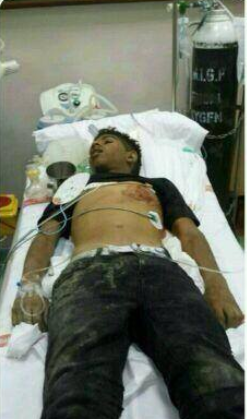
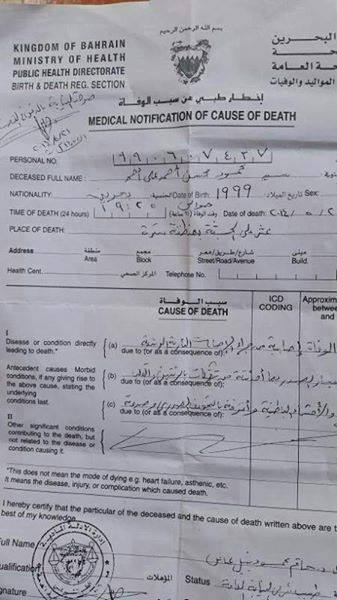
seyedSayed Mahmood Sayed Mohsin, a 14 year old teenager, died after a direct gunshot from Bahraini forces. Sayed Mahmood was attending the funeral of another teenager, Ali Faisal Al Akrawi, who was killed by governmental forces this week in Sitra.

The forces used gunshots to disperse the crowd. One of the gunshots directly hit Sayed Mahmood’s heart. His body was transported to Sitra Health Centre where he was announced dead. The hospital stated that the cause of death was the direct shot. ( see picture)

Family members have requested an investigation. Meanwhile, the police station director stated: “Police will continue to protect the security of the nation and will respond lawfully to any individual attempting to harm the security of Bahrain.”

Bahraini forces have killed many minors and detained many more during peaceful pro-reform protests. Despite condemnation from international human rights committees, Bahrain has not freed the detained minors. Bahrain is the only country in the Gulf region that spends a significant amount of money buying off human rights lawyers, and pay media outlets. SRW condemns Bahrain’s mistreatment of its Shia majority and the international apathy which has enabled it.

death

54 Killed due to Bombing in Iraq

Ongoing violence in Iraq claimed 54 lives in Shia populated areas of Baghdad yesterday. Sadr City, neighborhood of Kadhimiyah, Mosul , and Tuz Khurmatu areas most effected by bombings. The bombings also wounded 37 some of which are in serious condition.

1,666 people died in the first three months of 2014 due to terrorist attacks or other acts of violence, according to UN statistics and the violence is claiming more lives every day.

Bombings have also resulted in destruction of many houses and businesses and that adds to the poverty of the Iraqi families. Despite ongoing violence millions of Shia Muslims visit Iraq year around and many bombings target pilgrims. Iraq serves as a most important country with many shrines that matter to Shia population. The government has failed to protect and decrease violence and that is a growing concern

UN Complaint