

Welcome to Shia Rights Watch

spot_imgspot_imgspot_imgspot_img
Home Blog Page 61

Shia Muslims Killing, Rise of Intolerance in Egypt

Introduction

Media and technology are improving every day, but human rights are not. New pro-democracy movements in the world, especially in the Middle East, aim to defend suppressed nations and bring justice to the table, but the results have been the opposite. Minorities, whose rights were always violated, continue to face discriminations even after recent historical Arab Spring events. Egyptian Shia have never been fully accepted into society. They have faced discrimination, violation and exclusion in the Salafi-based society before and after the Arab Spring. Shia are forgotten minorities in Egypt, where there is no respect for them as Muslims living in a Muslim society. This report intends to highlight the violations toward Shia in Egypt and urge the new government to take action to stop suppressing Shia and promote their human rights, as every government is responsible for spreading peace and democracy in the world.  

Historical Background

Egypt is a country mainly in North Africa, with the Sinai Peninsula forming a land bridge into Southwest Asia. Egypt is thus a transcontinental country, and a major power in the Mediterranean Basin, the Middle East and the Muslim world. Covering an area of about 1,010,000 square kilometers (390,000 sq. mi), Egypt is bordered by the Mediterranean Sea to the north, the Gaza Strip and Israel to the northeast, the Red Sea to the east, Sudan to the south and Libya to the west.

Egypt is one of the most populous countries in Africa and the Middle East, with a population of over 80 million. The vast majority of Egyptians live near the banks of the Nile River, an area of about 40,000 square kilometers (15,000 sq mi)[1], where the only arable land is located. The large areas of the Sahara Desert are sparsely inhabited. About half of Egypt’s residents live in urban areas, mostly spread across the densely populated centers of greater Cairo, Alexandria, and other major cities in the Nile Delta. Islam is the official state religion, Arabic is the official language and Shari’a (Islamic Law) is the primary source of legislation.

Egypt has been undergoing many political changes since the Arab Spring. The Arab Spring gave hope to many, especially minorities, that the new changes would bring freedom and democracy to their communities. However, in most cases, the transition phase provided opportunities for some to take advantage of the unrest and target minorities violently. Shia are among the growing numbers of minorities that became victims of the unrest. Shia, under pressure under the Mubarak government, are still facing discrimination in the new Egyptian government and political system.

Shia in Egypt; Past and Present

Egypt is a country with strong Shia ties. Egypt was a Shia country when it fell under the Shia Fatimid caliphate, in opposition to the Abbasid caliphs in Baghdad at that time, who were Sunni Muslims, according to Osama Hammad, professor of Islamic history at Alexandria University.[2]In fact, Egypt was a Shia nation when ruled by Fatimids from AD 969 until 1171, but became Sunni ruled after the fall of the Fatimids dynasties. The Fatimid Islamic Caliphate was a Isma’ili Shia Muslim caliphate that spanned a vast area of the Arab World, from the Red Sea in the east to the Atlantic Ocean in the west. Originally based in Tunisia, the Fatimid dynasty extended their rule across the Mediterranean coast of Africa, and ultimately made Egypt the center of their caliphate.

Despite this history, Shia are now a forgotten minority in Egypt to the point that there are no accurate official statistics about the number of Shia in Egypt. Government and Salafi authorities claim that there are only a few thousand Shia in the country, less than 1% of the entire population[3]. However, Ahmad Rasim Al-Nafis, a Shia author and activist, believes there are more than 100,000 Shia in Egypt today, but they hide their faith for security reasons.[4] Many believe that the number of Shia living in Egypt is increasing.

Shia Muslims are being targeted as a group with political intentions that are tied to Iran. However, in reality, the vast majority of Shia, including Egyptian Shia, has no personal or political ties to the Islamic Republic; they are practicing their faith and honoring their belief with no political intentions. As Vali Nasr states in his book, The Shia Revival, “most Arab Shias are ethnically Arab…Nevertheless, Sunni extremist propaganda would make them out to be sinister interlopers.” [5]

It is time for the world to disconnect Shia from Iran and honor their dignity and rights.

Human Rights Condition

Human rights activists and organizations are concerned about extremist groups who support policies aimed at destroying the rights of others. These groups are continuing to advance in the Egyptian government. Sources reveal some religious groups in Egypt, such as the Salafis, became heavily involved in the Egyptian political arena after the 2011 uprising. These groups are extremely against Shia establishing a political party or even engaging in any political activity, a basic human right for all citizens.[6]

The state of human rights and freedom of religion in Egypt remains poor due to government intolerance toward minority religious groups. Religious freedom, in particular, has worsened dramatically in recent months. Authorities continued to prosecute and sentence citizens with different religion or faith. They allowed official media and Sunni clerks to encourage violence and hatred against religious minority members, especially Shia, while failing to protect them or to convict responsible parties.

The Egyptian Constitution, under Article 46, provides for freedom of belief and the practice of religious rites; however, the Government restricts these rights in practice. United States Commission on International Religious Freedom states:

“Egypt has a poor overall human rights record that includes repressive practices which seriously violate freedom of thought, conscience, and religion or belief, and serious problems of discrimination, intolerance, and other human rights violations against members of religious minorities, remain widespread.[7]

Even though the restrictions and violations are widespread, minorities always face the most difficult situations compared with the majorities within societies.

Shia face political and employment discriminations: arbitrary arrest, jail, and closure of Islamic centers are some major violations that Shia face in Egypt.


Shia Rights Condition

Shia in Egypt have faced discrimination and human rights violations, especially in recent years. News reports have documented that some Shia have had to leave their homes, often moving to other cities, because of threats from Salafis. Farah Sesames, a reporter for Emma Magazine reveals the life story of Abu Hasan, an Egyptian Shia, who fled with his family from their apartment after a neighbor posted a note on their door threatening to kill them if they did not leave the area.[8] “This is third time we have had to move in four years” said Abu Hasan[9]. He and his family represent one of many cases of Shia who have no security and freedom to practice and show their faith in Egypt.

Activists complain about the Shia situation in Egypt. Ahmed Rasim An-Nafis, an Egyptian Shia and professor of medicine at Mansura University, said: “There have been smear campaigns about us in the state press and in mosques, and our loyalty has been questioned.”[10]

Shia faced discrimination during Mubarak’s regime, and even after his resignation the situation did not improve. Many were arrested during the Mubarak regime and asked to identify Shia members of their communities. The recent revolution has not changed the situation, but the human rights violations could worsen. Wahabbis and Salafies are spreading hatred and intolerance among Egyptians in public and social media even more than before; this will cause increased intolerance and lack of safety for Shia in the future

 Egyptian Scholars Spreading Hatred Against Shia

Sheikh Mohammad Zoghby is one of many Salafi scholars who threaten Shia in public and during TV interviews. In a YouTube clip, he says that he would cut off Shia’s fingers and tongues: “I must chop off the breath of Shia in Egypt.” Sheikh Zoghby calls on Egyptian authorities to act against Shia in this country.[11]

In a similar YouTube video, another Salafi cleric, Sheikh Muhammad bin Hussein Ya’ghob, states that he only supported Morsi as the new president of Egypt because Morsi considers Shia more dangerous than Jews for Islam. Ya’ghob predicts that under the new government Shia’s power will decline. [12]

The head of Alexandria’s Al-Fattah mosque, a Salafi scholar, said “We cannot have Shias in our mosque,” in an interview. When asked if he would support the construction of a Shia mosque to allow Shia to pray in their own center, he answered, “No.”

Salafi and Wahabbi’s fatwas and teachings have mirrored the government’s actions. In 2011, security forces put on end to an Ashura celebration and detained seven attendees. EgyptIndependent.com reported that nearly 3000 Shia were attending the Ashura celebration that day at Cairo’s Hussein Mosque. Ashura, which marks the death of the Prophet Mohamed’s grandson Imam Hussein, is one of the most important Shia celebrations. [13]

There are increasing numbers of incidents in which Shia were arrested, detained, questioned and threatened for practicing their faith.

Discrimination by Al- Azhar University

A Shia Muslim student is under investigation in al- Azhar University. A female student of the most important university of Egypt could face legal action and be expelled from school if proven to be Shia Muslim. Students of the university filed a complaint against a female student, accusing her of being Shia Muslim.

Recently Egypt has been showing more and more discrimination toward Shia Muslims. SRW found it unfortunate to see anti-Shi’ism growing so rapidity in Egypt that citizens believe it is a crime to practice Shia faith. Salafi and Wahhabi extremist have been encouraging anti- Shi’ism in Egypt through social media and media outlets, as the result discrimination and hatred toward Shia Muslims are increasing among public.


Most Recent Human Rights Violation by General Public

On Sunday, June 23rd, 2013 a mob of 3000 people attacked houses of Shia Muslims in the small village of Zawya Abu Muslim in Giza, killing four people including Hasan Shahate, a very well-known and peaceful Shia leader.

The attack was motivated by lectures of anti-Shia clerics who called Shia infidels in the village. Wahhabi and Salafi clerics have been spreading and encouraging sectarian conflict in mosques as this report highlighted earlier. This incident was motivated by one of those speeches according to Shia natives of the area.

Albawaba news quoted an eyewitness Barakat, who reported the incident live on Twitter. He took photos and videos showing one of the Shias began dragged in the street after being beaten. “I saw several Shias stabbed several times while they were being dragged in some sort of public lynching,” said Barakat.

Other eyewitnesses stated that police forces arrived late at the scene and only watched the crowd with not effort to stop them.

Shia rights violation in Egypt has passes the political and systematic phase and now general population, neighbors and community members are acting against Shia Muslims in such an inhumane way.

  
Conclusion

There is substantial evidence that Egyptian Shia abstain from practicing their faith or participating in rituals in fear of detention or arbitrary arrest. The status of Shia in Egypt may lead to dissatisfaction and unrest among this forgotten minority. Since Mohammed Morsi was declared President of Egypt, there has been growing speculation about the future of Egypt’s minority under the new government, but little has been said about the Shia community [14]

SRW had previously warned the Egyptian authorities about violations towards Shia Muslims in Egypt. Shia rights violation escalated especially after president Mursi took office in 2012. President Mursi has supported hatred languages and activities against Shia minority and his support lead to harassment, human rights violations, oppression and now assassination of Sheikh Hassan Shehata and three more.

Because of the increasing violation towards Shia Muslims, SRW calls on Egyptian Judicial Council to trial the Egyptian president in charge of inciting sectarian conflict in country. Mursi must be held responsible for the crimes against Shia Muslims since there are many evidences available that his leadership is leading to crimes against human rights.

SRW believes the right to freedom of religion or belief should extend to every individual in every community and country. Since its inception, Shia Rights Watch has been committed to this fundamental principle and universal standard and will continue to report on countries where this freedom is lacking and make recommendations for reform.

SRW Recommendations


Shia Rights Watch believes that the new Egyptian government must:

  • Recognize Shia as Muslims,
  • Protect their human rights,
  • Give them freedom to practice their faith in public
  • Promote tolerance among different religious groups.

To these ends, SRW urges the U.S government to encourage Egyptian authorities to protect human rights for all, unite the minorities and work with them to build a stronger nation.


[5] VAli Nasr. The Shia Revival. Page 110

[7]http://www.metransparent.com/old/texts/magdi_khalil/magdi_khalil_rights_in_the_egyptian_constitution.htm

Also see The Egyptian Constitution and principal laws (Cairo, El Amiria print house, 1996).


[divider style=”normal” top=”0″ bottom=”0″]

Get the Report

[divider style=”normal” top=”-20″ bottom=”0″]

Conference to End War in Syria

As the RT news agency reports leaders from more than 30 countries will meet to end war in Syria. Most important world leaders are to gather next month is Switzerland to come up with “peaceful political” solution to end war in Syria. Amongst countries invited to the conference are Iran and Saudi Arabia. The war in Syria has caused more than 120,000 lives and displaces of millions, leave alone damages to the county’s political, historical and economical aspects.

It is unfortunate that it took these leaders almost three years to plan for such a conference. The war in Syria resulted in many war crimes, ethnic cleansing, and mass slaughter. Syria with its rich history and historical sights became a land for extremists’ apparitions.

This conference is a great opportunity for the leaders to show their willingness and power to resolve their issues, says Shia Rights Watch. Leaders should view the ongoing issues in the world and specifically Syria from humanitarian perspective not religious or political aspects.

Children, who lost their rights to education and life, and women who lost their rights to dignity and security, or men who lost their rights to freedom and expression need to see real results from this conference. The victims of this war, innocent Syrian families, depend on this conference to gain their joy back.

If the leaders of these 30 countries fail to come up with a peaceful end to the war in Syria, their leadership skills, their humanitarian aims and most importantly their values would be questioned.

As a human rights organization SRW asks and expects to see real leadership skills that results in peace from the leaders in this conference.

Thank You Letter to Patrick Cockburn

Thank You Letter to Patrick Cockburn

Shia Rights Watch appreciates Patrick Cockburn’s recent articles in the Independent news agency. The journalist analyses the role of Saudi Arabia government and donors in that country in Shia killings in Middle East.

Accounting to Cockburn the target of Saudi Arabia is Shia. Thousands of Shia Muslim have been killed in countries such as Syria, Iraq, Pakistan, Libya and Egypt yet newspapers do not report them.

SRW and many other human rights groups have repeatedly emphasized on the fact that Saudi Arabia is spending billions of dollars to kills Shia Muslims, yet political figures refuse to hold this country responsible for the Shia rights violations. It is unfortunate to see human lives have lost its value because of political interests, says SRW.

SRW believes journalist such as Cockburn awaken many whose ignorance results in human rights violations. All journalists should report based on facts without any bias or political interest. As a human rights organization dedicated to the rights of Shia Muslims we are thankful to Cockburn and we hope his model of an ethical journalist can help others to practice their profession in an ethical style.

Shia Rights Watch at Human Rights Summit

piccShia Rights Watch joined the annual Human Rights Summit hosted by Human Rights First on December 4th and 5th. The two day Summit enabled the SRW members to meet with an influential figures in human rights field such as senator Patrick Leahy, Dan Doctoroff CEO of Bloomberg, Reda Al Fardan, Eli Wolf, and Kespars Zalitis.

Issues such as human trafficking, leadership in human rights, and issues in Middle East were discussed. Such Summits and conferences help activists and leaders to bond and share visions and concerns. All human rights organizations should work hand in hand to improve the humanitarian mission that they all share, says SRW.

Members of SRW used this opportunity to expand their network and cooperate with others to give voice to voice less.

The Sky’s the Limit

This phrase used to be a phrase to encourage for development and success, to break the cycles of limitations and shoot high.

However,

To some, when it comes to courage to hurt, kill, harm, and hate, the sky’s the limit. In past violations and hate crimes was limited to killing and hitting. However as we develop and improve, crimes change their appearances too.

As a researcher is a human rights field I witnessed crimes change; social media, YouTube and apps are new tools for increasing trend of human rights violation.

Most recently Shia Rights Watch was informed of number of iPhone and iPad apps with misleading names. The users downloaded them assuming these apps are to teach about Shia faith however they found many hate messages toward Shia Muslims in them. The apps encourage for hatred and call Shia infidels. Unfortunately most of such apps are in Arabic, the language that many app developers and stores are not knowledgeable about.

SRW contacted Apple and inform them that such apps violate app development guidelines and human rights. They wrote back with promise to study the cases and delete them.

I wish we could still use the phrase to make big wishes and dream big……. It could be possible…. only if human rights violators were “human”….

By Hawraa Zakery, Human Rights Researcher               on December 6th, 2013

17 Died in Sadriya

Shia of Sadriya city in Iraq lost another 17 souls in two bomb explosions. Explosions happened in a coffee shop that people gather up for socializing. The explosion also wounded 37 civilians.

Most recent explosions in Iraq take place in areas such as markets and coffee shops where civilians use as gathering places. Evidences suggest the attacks are designed to target civilians, especially in Shia populated areas.

Although no group has claimed responsibility of any of the explosions, it is clear anti-Shia groups are involved since most targets are Shia Muslims. Targeting innocent civilians is the most inhumane violation, says Shia Rights Watch.

Europe, a New Concern?

Europe is becoming a new concern for Shia Rights Watch as Shia rights violation is increasing in different countries of that region. On the November 14th, 2013 a Shia Islamic Center was burned down by unidentified people in Lausanne. The Center was scheduled to hold Muahrram campaign the next day. There were many damages to the building and its properties, as activists reported. SRW has contacted the embassy of Switzerland in Washington DC and asked them to investigate the violation.

Shia Muslims have lived in different countries of Europe in peace for centuries, and newly reported violations does concerns SRW. Last year a mosque was burned down in Belgian and resulted in death of a Shia cleric. Other attacks and violations have been reported from London.

SRW is very concerned about the increasing Shia rights violation in Europe and hopes authorities prevent any future violation.

Please note the incident was not reported to local officials. SRW is exchanging information with the embassy to follow up with the issue.

Letter to Embassy of Switzerland

Letter to Switzerland Embassy

His Excellency Didier Burkhalter,

Federal Councillor of Switzerland to United States,

2900 Cathedral Avenue N.W.
Washington, DC 20008-3499
United States of America

Dear Mr. Councillor:

On behalf of Shia Rights Watch we are writing to highlight our concerns regarding the safety and security of the Shia Muslims in Switzerland as a Shia Islamic Center was burned down on November 14th, 2013. Switzerland has been a safe country in which Shia Muslims live in peace and security. The recent incident that took place on the most important Shia holiday raised concerns about the safety of this minority group.

As you may know, on November 14th, 2013 a Shia Islamic Center was burned in the city of Lausanne. Unknown anti-Shia people burned down the center late at night. The center was scheduled to hold important Muharram Campaign as part of Shia rituals in the next morning. Fortunately no one was hurt, however there were many damages to the property such as scholarly and prayer books, prayer rugs, and many others belongings.

SRW is concerned that anti-Shi’ism is reaching Switzerland as it reached many countries in Middle East and Africa. Shia Muslims are minority within Islam and their rights have been violated by many terrorist groups.

SRW is writing to follow up on the case and urge the Switzerland government to prevent any Shia rights violation by investigation the violation. Please do update us on the results of the investigation.

Sincerely,

Mustafa Akhwand

Director of Shia Rights Watch

Two days of bloodshed, 54 Died

Iraqi Shia Muslims lost another 25 souls today after at least 29 people were killed and dozens wounded in a series of bombings across the capital yesterday.

The bombs mostly target Shia populated cities or areas as about 7000 Shia Muslims have been killed so far in targeted killings in Iraq since January 2013.

Shia Muslims are majority in Iraq, yet they are under attack by terrorist groups every day. Total Shia Muslim killed in Iraq in the year 2013 is more than all killings in Syria that is going under war and unrest. Iraqi government has failed to protect Shia Muslims. This government must clean the country form all terrorist groups and stop any foreign founding in order to prevent violence, says Shia Rights Watch.

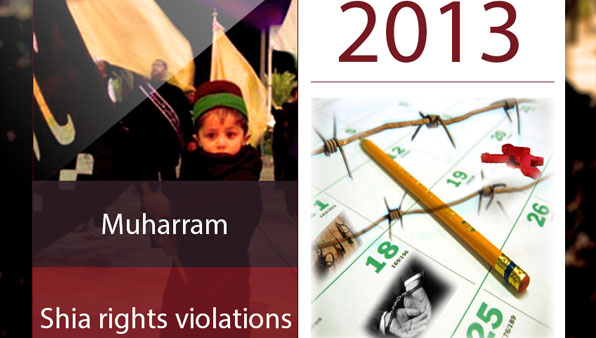
Muharram Campaign of 2013; Summary of Shia Rights Violations

Shia targeted killings and violations spikes in the first month of lunar calendar, as Shia Muslims participate in Muharram campaign. Muharram campaign is the very first universal campaign against violence and discrimination that was initiated by Shia Muslims after the tragedy of Karbala in the month of Muharram of 680 CE. In this universal campaign all Shia Muslims wear black attire for nearly two month and attend seminars and conferences to spread the message of freedom, respect, and non-violence. Shi’ism is the only faith that holds universal campaign against human rights violation as part of their religious rituals.

Every year hundreds of Shia Muslims are killed, their centers are closed and their active members are arrested by anti-Shia governments or extremists. Muharram of 2013 was another campaign full of fear and bloodshed.

As Shia Rights Watch predicted this Muharram Campaign was another unfortunate opportunity to pressure and limit Shia Muslims in different countries. In some cases such as Saudi Arabia, Kuwait, Iran and Bahrain the oppressor and violator is the government and in other countries such as Egypt, Pakistan and Morocco the government is not the obvious violator but supports the violators by covering up their actions.

This article intends to summarize violations that Shia Muslims faced during their peaceful participation in Muharram Campaign of 2013.

Egypt:

Traditionally Egyptian Shia Muslims carry their campaign at Al-Hussein Mosque in Cairo. Last year and this year Salafis and anti- Shia groups threatened to kill whomever attend the Al-Hussein Mosque. As activists complained many Salafis gathered and blocked the Shia Muslims to enter the Mosque to participate in Muharram Campaign. The government has not taken any action to protect Shia Muslims or provide safe environment for them to participate in their humanitarian campaign.

Pakistan:

Wahhabi and anti-Shia clerics carried motivational speeches and called Shia infidel starting the month of Muharram. They urged people to prevent Muharram Campaign. According to SRW representative in Rawalpindi, about 600 people stopped Shia from entering their center by throwing stones at them. Numbers of gunmen were present among the attackers and shot and killed as many as 10 Shia Muslims, and wounded 30 others. Also numbers of Shia Islamic Centers were burned down.

Also Syed Shabir Hussain Shah, director of student affairs at a university in the eastern city of Gujrat city in Punjab province, was attacked while on his way to the campus by unidentified gunmen riding a motorcycle. Pakistani government has failed to protect Shia Muslims in all their peaceful rituals.

Kuwait:

Forces of one of the local government attacked and destroyed a tent designated to Muharram campaign. As activists report Shia Muslims have obtained permission to set up the tent, yet the authorities destroyed it. They also damaged flags and banners and personal properties of Shia. 

India:

Authorities attacked and injured Shia Muslims at their gatherings. Indian Shia who were participating in Muharram campaign were attacked by tear gas and arrested for no legal reasons. The government was directly involved in the violation toward Shia Muslims.

Iran:

As Muharram campaign is honored by many Iranians, some social media outlets and web sites with domain name .IR insulted some Shia rituals in Muharram and even disrespected Shia scholars who advocate strongly for Muharram campaign. There is no evidence that government stopped or investigated this violation as they should have.

Iraq:

Iraq is the most important country for Shia in which Muharram campaign is carried by millions of people. Many Shia Muslims travel to this country in the month of Muharram. As many as 6000 Shia were killed in the year 2013 so far and 44 were killed for their participation in Muharram campaign. Terrorist have repeatedly aimed to destroy Shia historical sites and kill people who visit this country as part of Shia rituals.

Geneva:

Unknown terrorist targeted Shia Husseinia ( Islamic Center) in the city of Lausanne burning down the place. There were many damages to the property and the attackers are not identified yet. This is the first time such incident happens in Geneva.

Bahrain:

Many Shia Muslims activist reported Bahraini authorities raided Shia gatherings and took down their banners and advocacy signs. Also government collected all the flags and flyers from private properties. The authorities threatened Shia Muslims to prevent them from participating in Muharram campaign. The Bahraini government is directly responsible for Shia violations especially during Muharram campaign.

The violations are not limited to those summarized in this paper but these are some evidences that show Shia Muslims are being oppressed and violated against in many parts of the world. One of the reasons that Shia honor Muharram campaign is to show their opposition to oppression and violence against humanity. It is expected to see oppressor governments fight and prevent Muharram campaign because this campaign threatens their powers, although Muharram campaign is not a politically motivated movement, says Shia Rights Watch.

By the start of month of Muharram SRW sent letters to all the embassies of the countries above urging them to honor Muharram campaign and protect Shia Muslims yet many Shia Muslims lost their lives and safety due to their governments’ ignorance.

UN Complaint