Welcome to Shia Rights Watch

spot_imgspot_imgspot_imgspot_img
Home Blog Page 20

The Case of Amri che Mat

On the 26 of November 2016, Amri Che Mat’s car was found near the Perlis Timah Tosah Dam in Perlis, Malaysia with its windows shattered. From then on, the whereabout of Mat remain unknown.
Mat was a foreign exchange trader, a husband and father to four minor children. He was also the co-founder of Perlis Hope, a charity organization active in the community.

Previous to his disappearance, Mat had received numerous warnings from the Perlis Religious Department to reduce his social activities. The local mufti (non-Shia religious leader), Mohd Asri Zainul Abidin, had shown up on Mat’s doorstep along with local law enforcement questioning him and his family about their Shia beliefs. Asri and other local religious leaders had made assertions that increased prominence of Perlis Hope activities could be a “threat to national security”.

Recently, witnesses have come forward stating that Mat’s car had been stopped by five vehicles close to his home around 11:30 pm on November 24.

Locals have compared the disappearance of Mat to that of Pastor Raymond Koh, who was also abducted in a “military-like assault” by his home on February 13, 2017. Neighbors recall seeing five cars, two of which were SUV’s, and 15 men stopping Koh and pulling him out of his car in broad daylight.

Despite the emerging facts and the continued violence against minority groups in Malaysia, little has been done by local law enforcement. Norhayati Mohd Ariffin, Mat’s wife states she has lodged numerous police reports over the past year, yet her case was not taken seriously. During investigations, the Koh family recalls the same procedure- instead of investigating the crime, the police questioned the Pastors social activities.

Religious Freedom in Malaysia

In 1996, Shia Islam was officially referred to as deviant. Although officials have said private practice of Shiism is permitted, Shia Muslims, along with other minority groups face constant discrimination. In 2017, $10 Billion were spent on the building of the King Salman Center for International Peace that aimed to “bring together Islamic scholars and intelligence agencies”. Funded and educated by conservative Wahhabi schools, religious authorities in Malaysia have welcomed intolerance against nonconformist to their definition of Islam and the new center, sources say, is a way to increase resources to identify and locate religious minority communities and their leaders.
Prejudice against minority groups have become systematic in the nation as law enforcement, too, ignores acts of violence that threaten these communities. The lack of due-process for direct violence welcomes increased bigotry and targeting of these groups. Further, lack of safety for religious minorities in the nation creates a power vacuum, allowing other religious extremist organizations such as the Kumpulan Mujahiddin Malaysia (KMM) to become active in the region.

Decades long religious intolerance in Malaysia not only threatens the diversity in the country, but it also reduced pro-social efforts. Perlis Hope is a charity organization that provides aid to those in need in the area. By providing well needed social services, Perlis Hope, and its likes, are creating stability for their constituents.

Intolerance in Malaysia is a growing threat to the nations security. By targeting religious minority leaders, authorities have created opportunities for the expansion of extremism and violence to the nation.

A Brief Look at the Shia Muslims in 2017

Shia Muslims are the most significant minority group in the world. Although they make up half of the worlds Muslim population, Shia Muslims remain targets of human rights violations. Cases of Anti-Shiism are widespread and extensive. Over the past year, Shia Rights Watch declared 6,388 incidents in which Shia Muslims have been killed, injured, arrested, or harassed solely by their religious association. The number above is only in a handful of nations in which Shia Muslims make up a significant portion of the population and feel courageous enough to broadcast their human rights violations. Such countries are inclusive, but not limited to Pakistan, Bahrain, Saudi Arabia, Iraq, and Malaysia. Anti-Shiism in each country is unique. In countries such as Saudi Arabia and Bahrain, the government limits its Shia constituents while in countries such as Iraq, terror organizations independently target Shia Muslims. In Asian countries such as Malaysia and Pakistan, terror organizations are the primary source of direct violence. However, the lack of protection for Shia Muslims and the prosecution of anti-Shia agents has created a void by which extremist organizations can further their anti-Shia actions.

In both nations in which terror organizations are active, and in those by which the government limits its Shia Muslim constituents, security is a significant issue. Frequently, Shia Muslim entities report a lack of security for their communities. In March of 2017, 3,000 Shia Muslims protested the lack of government protection. Men, women, and children sat at the Taftan border for a week, demanding security for the 25 buses carrying Shia pilgrims traveling back from Iran. The protests came after some attacks targeting buses moving Shia Muslims killed tens of civilians. The travelers stated they feel “unsafe” in their nation.

In a separate incident, Shia mourners reported a lack of security after complying with the state organized schedule of ritual processions in Moharram. Government leaders had allocated specific areas for Moharram mourning rituals, claiming aims of city organization. Later in the month, numerous groups reported harassment and violations by anti-Shia groups. Due to a lacking in communication lines, Shia Muslims state they could not contact and warn their fellow mourners at other locations. Local sources reported that they felt “vulnerable and susceptible” because the new organization of mourning processions did not take into account the anti-Shia sentiment in neighboring areas. Further, locals report a lack of trust towards the local officials as the rate of arrest and prosecution of anti-Shia agents are extremely low.

The trend of perceived lack of justice and mistrust is not unique to Pakistan. In Gulf nations such as Bahrain and Saudi Arabia, Shia Muslims also feel that they are treated as “others” in their home nations. Many feel they are denied due process granted to their non-Shia counterparts. For example, in late 2016, the Bahraini government ratified a law that would allow for civilians to be tried in military court- thus far, those who have been tried in military court have been of the Shia faith. In Saudi Arabia, students and workers report they are denied access to the same education and work opportunities that their non-Shia counterparts have. Numerous humanitarian reports note the stark developmental differences between Shia populated areas such as Awamiyah, in comparison to non-Shia populated areas, despite the fact that the Eastern Province is the oil-rich region of the Kingdom.

A history of perceived lack of justice has created mistrust among Shia Muslims and their nations. Having been left alone to defend their populations, some Shia Muslims feel as though they are not regarded as members of their geopolitical community.

Perceptions of violence and anti-Shia sentiment is, by the fact, independent from the universal yearning for peace and safety. The frequency of violence in the Middle East affects everyone. The regularity of violence reduces tourism, and the instability diminishes foreign investments in the region. Thus, peace is benefits all walks of life.

Peace in the Middle-East

To create stability in the Middle East, security measures to protect Shia Muslims must be put into place. To do so, both the Shia populace and government officials (local and national) must work in unison. First, the unity of command must be created by these two groups.

Trust is a cornerstone of any social construct. For people to act, they must first trust that said action is to their benefit, at least it won’t endanger them. Security measures are no different. Everyone wants ultimate stability. It’s just a matter of how the balance will be achieved. Fact is, balance cannot be made by enforcement of the government alone. Take Bahrain as an example. By allowing civilians to be tried in military court, the Bahraini government aimed to reduce insurgency involvement. Saudi Arabia also sought to minimize anti-government action by using military action against the residence of Awamiyah. As seen by the increased humanitarian outrage on both Bahrain and Saudi Arabia, the government’s efforts did everything except stabilize the Gulf region. In these two nations, the government failed to take into account citizens of the country. Their concerns were completely undermined. The anti-Shia sentiment of government action in turn fuels anti-government protest creating a cycle of violence. The current level of violence in the Gulf region is destructive to all facets of society. Not only has the number of international business ventures in Bahrain decreased, but numerous studies have also shown a reduction in the nations education rate when compared to non-conflicting Gulf nations.

Upon investigation, it becomes clear that upholding national identity is a prominent goal of their actions. Thus, patriotism should be a cornerstone in joining government officials and protestors together. A developmental plan to redefine means of improving the global standing of Bahrain can be used to drive a unified command to build stability in the nation. With the unity of leadership is a unity of enforcement, by which, both parties can carry out legislative changes in their circles of influence.

Suggestions:

A transparent map of co-evolution of parties at power (national and grassroots) through space and time are needed to ensure trust, confidence, and activity between the parties and onlookers. While coevolution of power is not always tangible, the dynamic nature of power can be traced, at the very least in comparison to the point of departure. The mapping must define party participants, their values, objectives, and their roles.

Within the dialogue process, validation must be made for the others perceived hardships. Keep in mind; conflict is defined by perceived divergence of needs or goals, not necessarily an “actual” divergence of interests. Validation is a form of power, and when communicated diligently it can be in the hands of the giver. By recognizing hardships each is enduring, the struggle to “prove an upper hand” diminishes and parties can move on to building a resolution.

To reduce damages of anti-Shiism, parties must focus on the overarching damages created as a result of violence. Recognizing that pro-Shia and anti-Shia agents both act with a perceived goal of advancing the state, national economics and wellbeing must be a cornerstone of pro-peace plans.

Shia of Nigeria

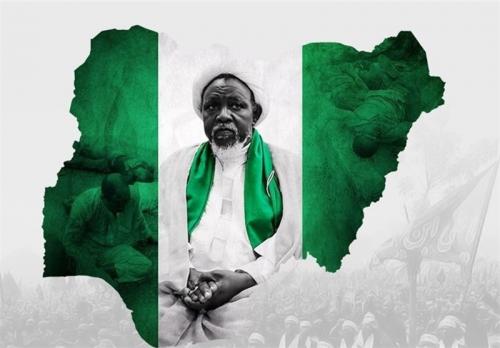
The case of Shia Muslim in Nigeria has been a measure of the nation states morality. In December 2015, a Shia Muslim religious center in Kunduna was attacked amidst religious processions. The Nigerian army killed over 400 Shia men, women, and children on that day alone. Two days later, a mass grave was discovered with the bodies of those killed. Local respondents report the burial was based on a court order by the state government, in attempts to thwart consequences of the militaries actions.

The attack in December was not the first case of anti-Shiism but an escalated direct act of violence against this community. In addition to systematic discrimination in the broader community, the leader of the mosque, Ibrahim Zakzaky faced the loss of his sons and his sister in previous clashes with armed forces.

In the attack in December, Zakzaky and his wife, Hajia Zainab Zakzaky were taken into custody without arrest warrants or viable charges. Despite increased international awareness and efforts of local activists, the Zakzaky’s are yet to be released.

Sources report Zakzaky has lost sight completely in his left eye and has a deteriorating vision in his right eye as a result of violence. Zainab Zakzaky still has a bullet lodged in her chest from the 2015 attack. The couple has been denied medical attention.

Backed by international humanitarian organizations, Femi Falana, the couple’s lawyer secured an order form the Abuja division of Federal High Courts to release the Zakzaky’s. The judge awarded Zakzaky 50 million NGN and temporary accommodations as reparations.

The state and the federal government have yet to follow through with the judge’s orders. The lack of compliance and accountability in the Nigerian judicial and executive branches of government are unsettling. In 2015, the Kunduna state governor, Nasir el-Rufai set a Judicial Commission of inquiry to probe the military’s actions against Shia Muslims in the state. The panel investigation concluded that Zakzaky must not be held in the trial as evidence against him is lacking.  Not only did Rufai keep Zakzaky in detention, but the governor’s office also failed to prosecute military personnel who were active in the attack against Shia Muslims.

Falana notes that Zakzaky’s case is the first case since 1914 of a couple’s detention such as long duration.

The brutal lack of justice against Shia Muslims in Nigeria brings the credibility of the State into question. Injustice is apparent in the prosecution of Zakzaky’s case as evidence is lacking and there is inconsistency within the governments judicial and executive actions.

Nigeria is home to one of the fastest growing populations of Shia Muslims in the African region. Despite the government’s attempts to thwart such growth, more Nigerian nationals have turned towards the religion. Discrimination against Shia Muslims has only made it clear that the Nigerian state thrives on inequality and injustice. Further, anti-Shiism has reduced the peoples trust towards their government.

Shia Rights Watch (SRW) calls for increased international attention in the case of Nigerian Shia Muslims. SRW offers its deepest condolences for the lives lost as a result of the anti-Shia action and provides its full support to those demanding justice in their communities.


Incidents of Anti-Shiism in November, 2017

November Monthly Analysis

The month of November stood witness to the continued restriction of religious expression for Shia Muslims. Anti-Shiism spanned the East and West as Shia Muslims faced attacks for their livelihood.

Shia in Bahrain and Iraq faced the most number of Anti-Shia violations. Algeria is a newly added country with Shia rights violations concerns.  

As we analyze the human rights violations toward Shia population, SRW is deeply concerned over reduced media coverage of this community. Inadequate coverage, in addition to fear and insecurity of Shia activists, has resulted in lack of data on Shia rights violations.

Bahrain

Human rights status of the Shia in Bahrain has not improved. Arrests, pressures, torture, and raids continue in this country as majority Shia struggle for freedom of expression, religion, and assembly.

The Shia population in Diraz remain limited in their religious expression as the al-Sadiq Mosque remains under seizure by army forces. In late November, the ban on Friday prayers and congregation in the mosque enters its 72nd week.

Peaceful protest has been met with extreme violence. Forces used tear gas and pellets to disperse protesters, causing irreparable injury and harm. In the western village of Dumistan, security forces flooded the streets with tear gas as residents rallied in a show of support for Bahrain’s highest religious authority, Sheikh Isa Qassim.

Also, Bahraini security forces reportedly raided the headquarters of the Islamic Awareness Society in the country’s northwestern village of Diraz.

Raids were also reported in Sitra, Bani Jamra, Eker, Sehla, Buri Mahaza, and Damistan.

Across Bahrain, religious leaders and prominent members of the community are arrested and detained, many times without due cause. Activist Majeed Abdulla Hasan and  Hadi Sayed Alawi were detained after raiding to their his houses. Two clerics, Al-Shaala and Sheikh Hani Al-Bazaz, are sentenced to 6-month jail for their pro-democracy activities. Cleric Mohiuddin al-Mishal was sentenced to one year in prison.

Those arrested, such as Maher Al-Khabaz, have reported extreme torture inside the prison.

Activists are also concerned over the health status of  Sheikh Isa Qassim. He has been under home arrest and threatened with deportation after the revocation of his Bahraini citizenship.

Some activists such as  Zainab al-Khamees was prevented from traveling to the Iraqi city of Karbala to take part in the annual Arba’een pilgrimage.

Pakistan

Targeted killings and violations toward Pakistani Shia have always contributed to creating an insecure environment for this population.  In November targeted killing claimed the life of  Aqeel Hussain Naumi and Samar Abbas as they were shot and killed in Dera Ismail Khan by unknown men. In another incident, shooters opened fire on Muhammad Elias, a Shia officer, his wife, and minor child in their car. An attack on a Shia mosque in Islamabad killed Haidar Shah and Ain Zaidi and wounded four others.

Pakistani Shia also has a limited right to movement.  Pakistani pilgrims traveling to Iraq have reportedly been questioned and searched in discriminatory manners. A protest was organized as a response to such actions of the border guards.

India

Indian Shia has faced discrimination in their country.  A Shia cleric, Seyed Hasan, was prevented from traveling due to Indian government’s refusal to renew his passport. It is believed such action was to limit his movement as a Shia cleric.

Nigeria

Nigeria is home to one of the fastest growing Shia communities in Africa and therefore growing Shia rights violations have been reported from that area. Governmental forces have repeatedly raid Shia gatherings during Muharram.

A leader of the Shia Muslim identified as Sunusi Abdulkadir and an unidentified female member of the community, have been killed by mobile policemen in Kano state during Arbaeen rituals.

Lastly, there is no update on the status of Sheik Ibraheem Zakzaky and his wife, Hajia Zinah Zakzaky. The couple were arrested on December 14, 2015. Although the local judge ordered their release, they are still under arrest.  

Algeria

More than 400 Shia Algerian pilgrims were investigated at the airport during two weeks window as they returned from Iraq to their country.  Pilgrims reported harsh investigations, long waits, discriminatory treatment by the airport security forces.  Shia returning from Iraq visit stated their Shia specific books, prayer materials, and even attire were seized by the troops and had not be returned to them yet.

Such behavior has not been reported in Algeria in the past and is concerning the human right NGOs.  

Saudi Arabia

Saudi security forces arrested two young Shia in the town of Tarot in Qatif. The detainees Mohammed Saeed Salman al-Abdalal and Mustafa Ali Saleh al-Sabiti were shot while attempting to escape arrest.

A Saudi court sentenced the activist Naima Al-Matarud to six years in prison and a ban on traveling for the same period on charges related to her role in the movement of contractors in the Eastern Province of Saudi Arabia, which began in 2011.

The Saudi authorities have arrested and accused activists of assisting, providing medicines and medical equipment for the treatment of people injured in peaceful marches in Qatif.

Syria

Although lack of security has limited media’s access to affected areas, the targeting of Shia majority areas of Syria continues. At least one civilian was killed and another ten were wounded when rebels attacked the Shia towns of Al-Zahra’a and Nubl in the northwestern countryside of Aleppo.

Egypt

Security authorities detained eight men and four women of Saudi Shia pilgrims and banned their entry to the Egypt. Pilgrims reported being humiliated, insulted and prevented from eating and drinking throughout the detention that lasted for hours.

Iraq

A number of roadside bombs claimed lives of Iraqi Shia in different areas of Iraq: in addition to Tuzkurmatu,  Saba al-Bur, Latifiya, Radwaniyah, Doura, Zoba,  Diyala, Suweib Yusufiya are the most affected areas of Baghdad.

At least 12 roadside explosions were reported in November killing 34 and wounding 91 people.

Iraqi forces foiled two suicide bombings in the Radwaniyah, one in  Alwa Al-Rashid and one near Essaouira bridge.

Conclusion

Shia Muslims continue to live in fear as they are ostracized in their home nations, and arrests of Shia activists and scholars proceed in the Gulf states and the surrounding countries.

Activists and humanitarians who are standing up to the injustice are facing the backlash from governments and other principal actors.

SRW believes the sudden decline in Shia news and violation coverage is another systematic discrimination and must be addressed.

Shia Rights Watch calls for governments across the region to increase protections for Shia and other religious minorities and to reverse and stop all ill-treatment of these populations.

Incidents of Anti-Shiism in October, 2017

The month of October stood witness to the continued restriction of religious expression for Shia Muslims. Anti-Shiism spanned the East and West as Shia Muslims faced attacks to their livelihood.

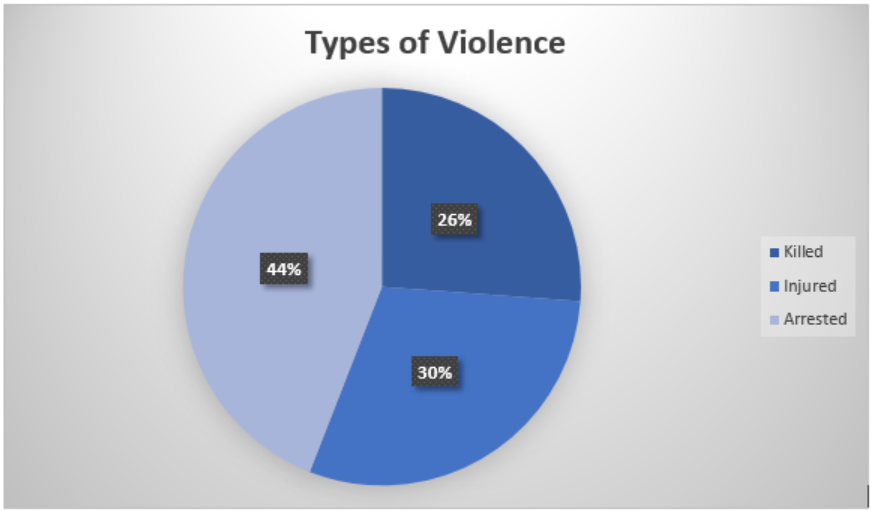
This month, incidents of anti-Shiism reached 278. The majority of attacks occurred in the Gulf region, specifically in the Kingdom of Bahrain. Over 44% of attacks were in the form of arrests.

Although 27% has reduced death count. This reduction is due to decreased reporting in Iraq and a shift in violence measures in Bahrain. Although deaths counts have been cut, it must be noted that discrimination of Shia Muslims continues all over the world. Shia Muslims are limited in expression and congregation.  

Bahrain

Arrests continue in Bahrain as human rights defenders stay active in the struggle for freedom of expression.

The Shia population in Diraz remain limited in their religious expression as the al-Sadiq Mosque remains under seizure by army forces. In late October, the ban on Friday prayers and congregation in the mosque enters its 67th week. Peaceful protest has been met with extreme violence. Forces used tear gas and pellets to disperse protesters, causing irreparable injury and harm.

Across Bahrain, religious leaders and prominent members of the community are arrested and detained, many times without due cause. Those detained include Sayed Ali al-Mosawi, Ali Abdullah Jomaa, Jassem Abdul Jalil Hassan, Ali Hussain Abdullah, Hussein Ali, Mahmoud Zoheir, Ali Mohammad Jaafar al Motghawi and Mahdi Fattah Mahfouz.

The month of October stood witness to an all-time high in the arrest of minors. Issam Hadi Jassim, 15, was detained in the village of Karrana in the early morning, Although his whereabouts are unknown, sources report he was taken to the criminal investigation building. Six other people were detained with Jassim.

Those arrested face maltreatment on a record extend. Sources report physical, sexual and mental abuse as a result of torture. The deteriorating conditions of the detainment centers led to an outbreak of one of the most significant hunger strikes in modern history. SRW activists report fast failing health of hunger strikers.

Afghanistan

Despite promises to increase security in Shia populated areas of Afghanistan, recent Taliban attacks display a need for the development of substantial security measures. In mid-October, the Valley of Mirza Olang was seized by Taliban forces as Afghan forces withdrew their troops from the region. Mirza Olang was home to attacks in August, which lead to the death of over 50 villagers. It must be noted that Shia populated areas of Afghanistan, including Mirza Olang, are areas that have been, and continue to be, tactically used against foreign intrusion. Further, these are areas are home to abundant natural resources.

Pakistan

Terror organizations target Shia dominant areas of Pakistan. In mid- October, suicide bombs and shooters killed over 25 civilians and injured 37 others. The attacks occurred in the Jhal magsi district of Baluchistan and aimed at Hazara populated areas of the country.

Despite the prevalence of attacks on the Hazara community, little has been done to protest this population. Despite increased international pressures, Pakistan has yet to implement adequate security plans against terrorism in this nation. In addition to the failure of prevention, Pakistan has failed to carry out prosecution of hate-promoting agents.

Malaysia

Raids in the Ulu Titram area of Malaysia has led to the arrest of 21 people. Shia teachings, books, a Moharram banner and Karbala stone, were seized; “they were arrested for an offense under Section 9 of the Syariah Criminal Offences Enactment 1997 and could face a fine of not more than RM3,000, or imprisonment for up to two years.”

In recent years, anti-Shiism has propagated all over Malaysia. Anti-Shia agents in the government take to target Shia homes and limit their expression and congregation. Items seized in the raid are not political but purely forms of religious expression.

Nigeria

Nigerian police have disrupted Muharram ceremonies in the northern city of Sokoto, arresting at least six of the participants.

Nigeria is home to one of the fastest growing Shia communities in Africa. In early 2016, clashes with the Nigerian army led to the killing of over 300 Shia Muslims. Sheikh Ibrahim Zakzaky was arrested in the clashes. His whereabouts remain unknown.

Shia in Nigeria continues to be prosecuted for their beliefs. Thier religious expression is limited and prosecuted.  More information about Shia in Nigeria can be found on ShiaRightsWatch.org

UK

Outside the Idaara Maarif – e- Islam Mosque Syed Hassan Abbas Bokhari al- Naqvi was stabbed and left for dead. Al-Naqvi, a minor, was left in critical condition and was found my his father who had gone to park the family car. The Birmingham Mail reports, ““It happened on the pavement. By the time the dad parked his car his son was on the floor. There was a young man who was brutally beating the boy with a knife. There was blood everywhere; he was hitting the boy’s neck and head. Then the attacker ran off and got into a car.” Al-Naqvi’s was one of the numerous attacks in the UK.

Syria

Targeting of Shia majority areas of Syria continues. Early this month, two rocket shells were fired in the residential neighborhoods of al-Zahraa. The attack resulted in the material damage of homes and buildings. While no casualties have been reported, the attacks severely reduced public service resources.  

Iraq

As the event of Arabeen approaches, SRW invites increased security measures. Arbaeen has been noted as the second largest peaceful congregation in recent history. In continued commemoration of Hussain, Mohammed’s grandson, Shia Muslims gather in unison. During this ritual, Shia Muslims from all over the world walk on foot towards the city of Karbala, many of them traveling distances as long as Gulf countries.

Sources report a halt in all transportation inside the main city bounds of Karbala with the aims of regulating human traffic. On average, over 10 – 20 million pilgrims travel to Karbala for Arbaeen. In addition to limiting vehicle in the city, SRW proposes increased security checkpoint and implementation of a well planned pedestrian guidance. Further SRW warns pilgrims to be on the lookout for strange behavior and suggests communication methods found on ShiaRightsWatch.org.

Saudi Arabia

Saudi Arabia continues to limit known human rights activists in travel and speech. In mid-October, 22 arrested were over social media postings; another 24 were detained in the ha-il district for “exploiting social networking sites to promote lies and exaggerations” with the goal of provoking “sedition and tribal tensions.” A Qatari citizen was among arrested. Saudi Arabia refuses to acknowledge the ongoing violence and targeting of Shia Muslims by government forces. Demands for rights are seen as means of “tribal tension.”

India

On the 10th day of Moharram, authorities arrested six people. Officers attacked a congregation of mourners with batons, injuring them. The attacks were a means of restricting mourning processions.

Conclusion

Limitations of Shia expression continue all over the world. It must be noted that Shia rights violations are not limited to those presented in this paper. In fear or persecution or social isolation, Shia Muslims do not report incidents of anti-Shiism. More information on Shia Muslims can be found at ShiaRightsWatch.org.  

Incidents of Anti-Shiism in September , 2017

September Monthly Analysis

Shia Muslims all over the world began their commemoration of the holy month of Muharram late September. Shia religious expression is augmented in the beginning in early Moharram thus making them susceptible to targeting by anti-Shia groups. SRW Muharram safety advisory and more information on Shia and Moharram can be found on ShiaRightsWatch.org.

In Gulf nations such that of Saudi Arabia and Bahrain a fresh wave of arrests and travel bans have been issued. This recent increase in crackdowns correlates with the 2017 United Nations Human Rights Council meeting. The analyst believes restrictions are in an attempt to limit reports of anti-Shiism in the meeting.

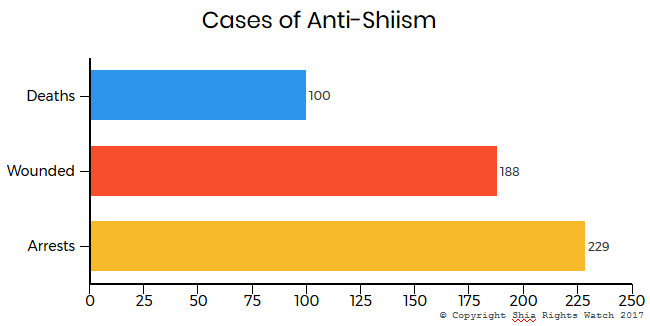
Overall, 517 cases of anti-Shiism have been seen in the month of September-100 deaths, 188 injuries, and 229 arrests.Trends of anti-Shiism are nation-specific. Gulf-nations, Saudi Arabia, and Bahrain have had Shia arrests, detainments and travel bans. Iraq and Afghanistan are home to the targeting of Shia dominated routes of travels as well as well-known religious sites.

Iraq

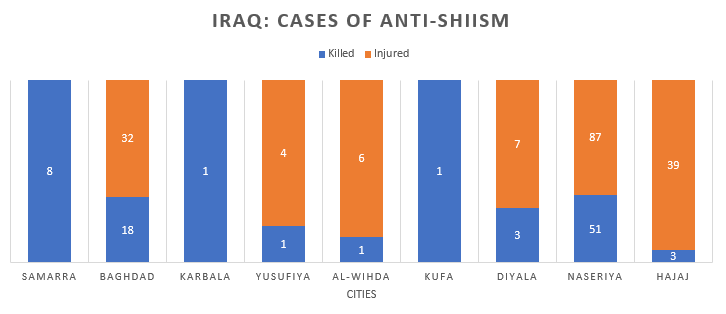
Trends in anti-Shiism have been perpetrated by ISIS extremists. However, in addition to targeting Shia populated areas, incidents in September display a shift in targets. Twin blasts in Hajaj, Salahedin province, targeted a restaurant frequented by Popular Mobilization Forces (PMF), a prominently Shia anti-ISIS group. A third assailant was shot before the detonation of his suicide belt.

Recent attacks target Popular Mobilization force members and their families. Even when not on duty, members of the PMF are followed and killed. While ISIS killings have been, and continue to be bombs that target a large mass, there exists a recent shift towards individual assassinations by firearm.

Shia Rights Watch requests a report on new security measures taken up to meet new shifts in violence.  


Bahrain

The prevalence of restrictions on religious expression and congregation in Bahrain sets this report apart from previous reports. Beginning early September, Bahraini officials called upon religious scholars and centers ordering limitations in visibility and restriction of religious expression to inside religious centers. The ministry of interior furthered that failure to meet the new guidelines will result in detention and torture. Days following the threats, security forces raided numerous Shia villages, namely Shahrakan, Jid Ali, Malkiya, Ekr, Abu Saiba, Shakhura, Sitr, and Karzakan, removing visible banners, posters, and flags that mark the commemoration of Muharram. Also, any and all civil services such that of food and drink donations have been placed under scrutiny. Shia Rights Watch sources report forces ripping down Muharram symbols (flags and banners) in different towns, even arresting people who displayed the symbols. Some of those arrested were released after forced agreements to stop displaying Moharram symbols.

In the town of Diraz, in addition to tearing down commemoration signs, forces stopped commemorators from attending Imam al- Sadiq mosque. It must be mentioned that Shia in Diraz remains banned from holding Friday prayers.

Prominent activist like (but not limited to) Farida Ghulam, Jalila al-Salman, Mohammad Issa Al-Tajer, Fatimah al-Halwaji and Hussain Radhi has been placed on travel limitations and summoned for questioning by the Bahraini public prosecutor. In addition to activists themselves, a family of activists has been used as leverage against activists. On numerous account were family members of human rights activists called upon in local and national police stations.

Despite immense attempts by the Bahraini government to limit Shia presentation at the United Nations Human Rights Council held this month, human rights activists were still able to deliver oral statements, reporting discrimination and systemic targeting of the Shia majority in this nation.

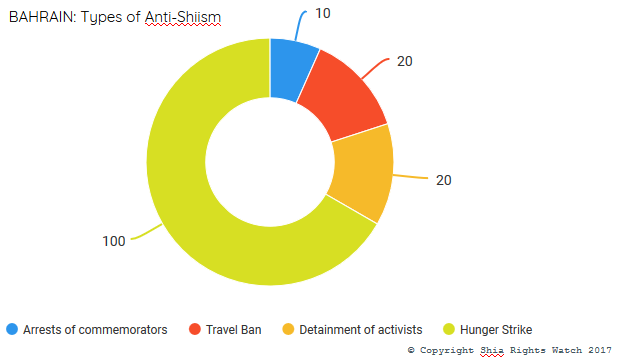
Despite the prevalence of arrests and torture, morale remains high among inmates and activist. In mid-September, over 1500 detainees announced hunger-strikes in protests to the ongoing torture and ill-conditions of detainment centers and prisons in Bahrain. The current hunger strike in Bahrain is the biggest mass hunger-strike in recent history.

Saudi Arabia

September in Saudi Arabia has been especially dangerous as fresh waves of arrests have taken place. On the one hand, Shia in this nation continues to be prosecuted based on their religious expression. Government forces restrict religious practices by prohibiting congregation.  

In correlation to the United Nations Human Rights Council dates, activists have been detained and imprisoned. Members of the Civil and Political Rights Association (ACPRA), Abdulaziz al-Shubaily and Issa al-Hamid were arrested late September. Sources report their arrest linked to convictions as recently as early 2016, suggesting the recent arrests as a means of restricting the activists from engaging with activists presenting in the United Nations Human Rights Council in aims to shed light on anti-Shiism in the kingdom.

A 62-page report by Human Rights Watch (HRW) sheds light on the propagation of hate-crime of Saudi clerics. The report notes the labeling of Shia as “rejectionists” and “brothers of Satan,” as well as denouncing of systemic discrimination of this population. Lastly, HRW traces hate-crime by terror organization such that of al-Qaeda to the kingdoms propagation of hate.  

Pakistan

Sources report negligence on the part of regional governments to meet a need for the seasonal increase in activity. Shia Muslims feel their operations have been “impeded” by lack of procedural security measures and basic access to electricity and local management.

Cases of prosecution due to allegedly “blasphemous”  social media posts continue in this nation. The US Commission on International Religious Freedom reports that 40 people are on life-sentences, some on death row, on charges of “blasphemy.” Trends of increased religious and ethnic minorities charged on the grounds of this law show that this law is used as a means of limiting expression and speech in the nation.  

Targeting of minority groups by extremist groups continues to rise. Shia Rights Watch demands a re-evaluation of Pakistan’s anti-terror efforts as they are misdirected and ineffective.


Malaysia

Government forces arrested 200 Iraqi Shia residents for attending Muharram commemoration. All arrestees are university students in Kuala Lumpur. They were released after Iraqi government pressured and criticized Malaysian authorities.  Historically Shia in Malaysia has been under pressure by the government as all Shia practices, publications and educational materials are banned in this country.

Afghanistan

An explosion in Kandahar kills six civilians on September 18. The nature of the crime point to Taliban insurgency.  Another explosion killed 10 and wounded 16 on September 29th as Shia prepared for Ashura commemoration in Kabul.

Shia in Afghanistan continue to be treated as second-class citizens as prosecution for anti-Shia groups are yet to take place. Shia frequently reports a systemic discrimination in hate-crime cases.

Shia Rights Watch demands a report on Afghan government’s efforts to reduce anti-Shiism and targeting of religious minorities as they remain ineffective.

India

Shia in India report feeling limited as government resources promised to them has been delayed. SRW sources report feelings of anger as people feel cheated for state services, particularly as they have kept will meet all government requirements and have respected local laws.

Moharram processions are a multicultural and multi-religious activities in India.

Egypt

The Religious Endowment Ministry closed the tomb of Imam Hussein on Saturday, to prevent any Shia Muharram commemorations. This center has been subject to closure before by the authorities in the past. Information on Shia in Egypt and the nation’s history of anti-Shiism can be found on ShiaRightsWatch.org

Conclusion

The month of September stood witness to at least 517 cases of anti-Shiism. Shia Muslims continue to live in fear as they are ostracized in their home nations, and arrests of Shia activists and scholars proceed in the Gulf states and the surrounding countries.

Violations are expected to increase in October and November as Shia Muslims participate in Muharram commemorations. Activists and humanitarians who are standing up to the injustice are facing the backlash from governments and other principal actors. Shia Rights Watch calls for governments across the region to increase protections for Shia and other religious minorities and to reverse and stop all ill-treatment of these populations.


SRW’s Statement to UN in Regards to Bahraini Shia Rights Violations

In advocacy effort for Bahraini Shia  and their basic human rights, the following statement is submitted by SRW to the 36th Session of the Human Rights Council in Geneva

Greetings esteemed colleagues and member states,

On behalf of Shia Muslims around the world, it is a pleasure to be able to present this address to the commission. Today Shia Rights Watch would like to highlight the UN body’sttention towards acts of anti-Shi’ism and terror in Bahrain. The country has great variety in cultural and religious heritage which must be embraced. However, ongoing and increasing systematic crimes against the majority Shia are instigated by government and individuals who condemn Shia as infidels. Bahrain is the only Shia majority country with such high rate of anti-Shiism. Although Shia rights advocacy has increased since the Arab Spring, Shia rights violations continue to rise.
During the first six months of 2017, a total of 982 people have been arrested. Arrests were with aims to suppress protests. Some Shia were arrested in peaceful protest and others by night time raids. Bahrain has shown little mercy in suppression as 84 of those arrested are minors, and 28 are women.

The violations continue as an increasing number of arrest, and ill treatment has been reported since July 2017.

Those arrested report harsh torture and violence in detainment in addition to denial of their rights to medical needs.

  • Prominent human rights activist Nabeel Rajab received a two-year sentence on July 10th after being accused of spreading ‘fake news’ about Bahraini authorities.
  • Ebtissam al-Saegh, a prominent activist, has testified to sexual assault and coercion of false confessions. Al-Saegh was previously held in May where she reported torture and sexual assault. She started an open-ended hunger strike on July 11th.
  • On July 3rd, the same day that Ebtisam al-Saegh was detained for the second time for government criticism on social media, Yousef Ali Riza reported sexual harassment by guards in his prison cell.
  • The Bahraini authorities arrested Shia cleric Sheikh Hani al-Banaa’ while he was visiting his detained son in Dry Dock Prison on July 3rd. Al-Banaa’ was released after being held in the prison for nine days.
  • Another prisoner, Hussein Mohamed Habib died on July 5th after being arrested and subjected to severe torture and abuse in prison in March 2011.
  • On July 20th in the northwestern coastal town of al-Budaiya, state troopers stormed the house of Sheikh Bashar al-Aali and arrested the cleric without providing any reasons.
  • In July 28th, Bahraini authorities charged 60 Shia for forming a group against the king. These individuals were accused of “forming a terrorist group,.” Their arrests are graphic displays of continued suppression of government opposition.
  • In August Abdel-Jabbar and Ahmed Mansoor, two teenagers detained were subjected to electric shocks while in detention at the Dawar 17 police station.
  • Another human rights activist, Ebrahim Sarhan, stated being tortured, punched and kicked during interrogations at the National Security Agency office. He also shared that he was stripped down, and threatened.
  • On August 5th, another Shia, Al-Jamri, revealed that he was subjected to torture at the National Security Agency.
  • On August 28th, the family of Hassan Mushaima reccounted that Jaw prison’s administration continues to deprive him of his right to receive medical treatment.The 65 years old English teacher and human rights activist was arrested in 2011 and sentenced to life in prison. In 2010, Mushaima was diagnosed and treated for stage four follicular lymphoma in London and had since been on regular medication to prevent relapse of the disease.
  • On August 17th, Bahraini authorities arrested another Shia cleric, Mohieldin Al-Mashaal.
  • Forces also attacked prisoners inside Jaw Prison on Tuesday the 22nd, as detainees held religious ceremonies inside their cells. Some detainees were transferred to solitary confinement as punishment.
  • Pro-rights protests continue to be met with violence. In late August, the village of Sanabis was left in toxic smoke in response to the villagers’ demand of updates of the whereabouts of 11 women arrested.
  • Zainab Al Khamees was detained on September 6th.
  • At least 10 activists were arrested on September 8th for their involvement in peaceful protests.
  • In response to the ongoing violations and ill treatment, 1500 prisoners of conscience started a hunger strike as of September 10th.

In addition to the reprehensible treatment of prisoners, many Bahrainis have lost their citizenship.

  • By July 8th, 2015, 103 people had citizenship revoked or denied (that year alone).
  • On July 22, the wife of Sheikh Abdullah Al-Deqaq lost her citizenship after refusing to spy on her husband.

The denial and revoking of citizenship have seemingly become the way in which the Bahraini government suppresses their critics. Loss of citizenship in combination with the growing detention of human rights advocates and their ill-treatment while in prison reinforces the regime’s systematic crackdown on minority populations and Shia Muslims in the country.

Worrisome Future of Bahraini Shia

With many children and women under arrest, the future of Bahrain is widely destabilized. Children arrested are not able to attend school and in many cases, are not given the opportunity to make up missed work. The current lack of national stability because of direct violence creates an opportunity for foreign involvement in Bahrain. Mistrust and lack of cooperation among protesters and the government have also led to a shift in national identity. SRW predicts a decreased rate in Bahrain’s educated population. Further, due to the increased detainment of women and the high rate of mortality for Shia men, SRW predicts a rise in single parent families and even orphan children. These predictions are further supported by the approximate 780 sentenced Bahraini citizens and the revocation of 92 others. To this point, over 60 people have been given life sentences. The numbers are expected to rise as Bahrain has issued death sentences for many activist despite a de facto moratorium on the death penalty.

The government’s unwillingness to engage in dialogue has created a rift between it and its citizens. Sources say, Bahraini citizens, do not trust the government. This mistrust, one can relate to the lack of sufficient representation in legislation and years in the suppression of rights by officials. Furthermore, sources report that the extent of Saudi involvement in Bahrain undermines the Bahraini government. Many feel as though dialogue with Bahraini officials are insignificant as officials are under the influence of Saudi policy.

Through this statement, SRW, requests in depth investigations in regards to increasing violence toward Shia majority in Bahrain. The pro-democratic peaceful protest must be supported and protected by United Nations to reach peace in Bahrain.

Sincerely,

Shia Rights Watch

Muharram 2017 Advisory

Muharram Advisory

Dear Fellow Shia Muslims,

As a human rights NGO dedicated to protecting and promoting the rights of Shia Muslims globally, we are writing to bring to your attention the veneration and importance of practicing safety in your community in the month of Muharram.

Since Muharram is the time Shia Muslims openly campaign against the terrors of their time, they are subject to Shia rights violations. Every year thousands of Shia Muslims are either killed or wounded or their centers closed.

To prevent such violations and to insure safety of Shia community, SRW presents following tips with the aim of creating a united platform for expression that not only meets religious guidelines but also lends to international and domestic regulations.

We encourages you to pay attention to following advisory tips:

Know your rights as knowledge is key to rights,

  •  As constituents your nation, you have civil liberties. Familiarize yourself and your community with the nation’s defined human rights and freedom of religion.  

Build a relationship with your community law enforcement   

  • Approach your community law enforcement and communicate your observations for the month of Muharram.
  • Seek consultation from your local police department on the placement of security measures such as camera systems and alarms.
  • Ask for increased security. In many communities, police provide special security for your institution given your coordination. Keep in mind increased security measures must be requested in advance.  
  • If needed, obtain the necessary congregation permits in advance.

Reach out to Government Representative:

  • Meet with the governor and mayor of your town. Have a conversation of your concerns. Reach out and open a line of communication.

Be cognisant of your non-practicing community

  • Recognize that you are a part of a larger community that may or may not commemorate Muharram.
  • Respect local regulations.
  • Reach out and communicate an increase in activity to neighbors and surrounding institutions.
  • Prepare and provide brochure or pamphlets educating others on the significance and relevance of Muharram.  

In case of a human rights violation, Know Your Resources!

  • In case of emergency, contact your local police immediately.
  • Contact Shia Rights Watch to inquire rights based counseling and broadcast.
  • Use #Muharram2017  to update the international Shia community as well as media outlets of recent anti-Shia incidents.

Incidents of Anti-Shiism in August, 2017

Scores of violations bear witness to the continued systematic targeting of the Shia Muslim population around the world. The breaches of human rights range from arrest and detainment to sexual abuse and torture in prisons, and as seen this month, mass execution.

Iraq, Saudi Arabia, Afghanistan, Pakistan, and Bahrain had the most reported Shia rights violations in the month of August.

Shia Rights Watch (SRW) has compiled a list of the reported attacks that occurred in August, confirmed through extensive research and collaboration with Shia rights activists around the world. This report will detail instances both physical and psychological human rights violations, including deaths, injuries, sentencing, and tortures.

Further attacks and human rights violations may have occurred in other places; however, this list consists of the cases recorded by SRW researchers.

SRW acknowledges incidents often go unreported due high risks and fear of attack and further social discrimination.

Iraq

Iraq continues to be a haven for ISIS extremists, terrorist groups, and radical individuals.  Although less bombings and explosions were reported in August, causalities in this country are still high.

In the past, most causalities were due to explosions. However, that was changed in recent months in Iraq. Mass graves with unknown causes of death, gun men attacking individuals, the death of children due to malnutrition and killings by airstrikes have been increased.

The Iraqi army has pushed ISIS into cities like Tal Afar. The Islamic State is now consolidating power in Tal Afar, and Tal Afar remains the closest ISIS-controlled urban area the so-called caliphate that can be used to launch terror operations back into Mosul.

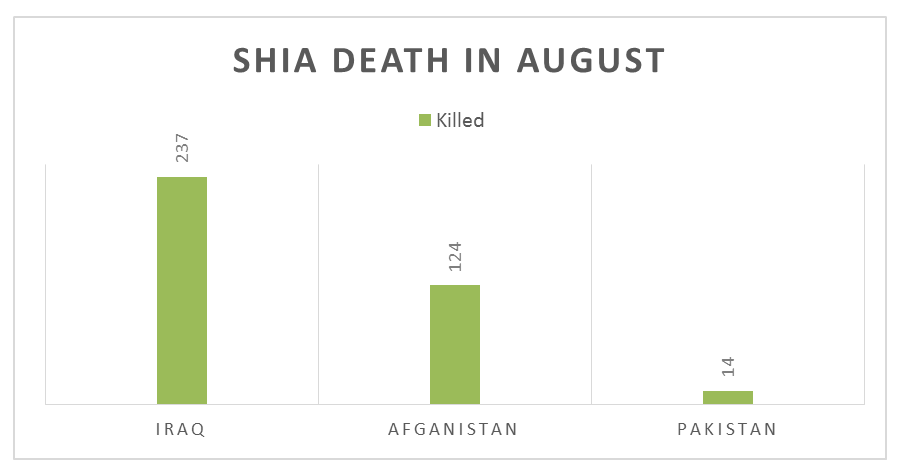
A mass grave was discovered in Tal Afar containing 80 bodies including children and women. As many as 163 people have been reported killed in this city alone in August.

Shia rights violations in other areas of the Iraq claimed at least 65 lives including the explosion in Sadr city on 28th that killed 14 and wounded 28. Death toll is expected to increase as many are critically injured.

Concerns over the safety of Shia and pilgrims are increasing as the month of Muharram is approaching, and millions will be visiting this country for pilgrimage.

A systemic re-evaluation of security measures must take place, ensuring the safety of travelers into and out of Iraq.

Bahrain

Shia rights violation is Bahrain is an ongoing concern of human rights NGOs. Torture, arrests, denial of basic rights of prisoners, and increased presence of government forces in Shia populated areas has been reported in August.

Abdel-Jabbar and Ahmed Mansoor, two teenagers detained were subjected to electric shocks while in detention at the Dawar 17 police station. Their families have reported seeing the teens in very concerning conditions on August 3rd. The teens were arrested on July 22nd as Bahraini authorities continue to arrest minors in peaceful protest.

Another human rights activist, Ebrahim Sarhan, stated being tortured, punched and kicked during interrogations at the National Security Agency office. He also shared that he was stripped down, and threatened.

On August 5th, another Shia, Al-Jamri, revealed that he was subjected to torture at the National Security Agency.

On August 17th, Bahraini authorities arrested another Shia cleric, Mohieldin Al-Mashaal. Al-Mashaal resides in Kuwait and has been subject to multiple harassments by Bahraini authorities since 2005. He was arrested on King Fahd Causeway, between Kuwait and Bahrain.  There is no update on his case as of August 17th.
Forces also attacked prisoners inside Jaw Prison on Tuesday night, 22nd, as detainees held religious ceremonies inside their cells. Some prisoners were transferred to solitary confinement as punishment.

On August 28th, the family of Hassan Mushaima revealed that Jaw prison’s administration continues to deprive him of his right to receive medical treatment.

The 65 years old English teacher and human rights activist was arrested in 2011 and sentenced to life in prison. In 2010, Mushaima was diagnosed and treated for stage four follicular lymphoma in London and had since been on regular medication to prevent relapse of the disease. SRW is concerned for the health of Hassan as depriving him of receiving his medical needs can result in death.

Pro-rights protests continue to be met with violence. In late August, the village of Sanabis was left in toxic smoke in reponse to the villagers demand of updates of the where-about of 11 women arrested in the past month.

Pakistan

At least 14 people have been killed and 26 injured in an explosion in a high-security neighborhood of Quetta on Saturday, August 12th.

Fear generated by attacks like this one has caused some Shia to avoid traveling alone. A group of pilgrims have taken shelter in Taftan near Pakistan/Iran borders since July. They have requested to be escorted by the security forces, but their application has not been granted yet.

Although Shia makes up at least one-third of Pakistani population, Shia face discrimination and live under psychological and physical torment. In the past five years, targeting of Shia individuals in prominent sects of society has increased. Shia Rights Watch predicts an aim of inducing fear in the Shia population in this nation as a means of limiting Shia expression.

 Saudi Arabia

Saudi Shia are undergoing the largest military crackdown in the history of this country. Although Shia has always been discriminated against in Saudi Arabia, recent crackdowns are happening publicly and the world stands witness in silence.

Al-Awamiyah has been under siege for the last couple months. Residence report their access to the internet and other communication means such as phone lines are either limited or under the direct control of the government. Main roads to hospitals and urgent care centers are blocked. Activists, protesters and journalists are repeatedly arrested, and detainees are tortured. Homes and businesses are demolished creating financial burdens and hardship for families. Saudi Shia are among low social economic status in the country despite living in the most oil rich areas of the Kingdom. Saudi activists shared, on social media, videos of government forces calling Shia “dogs” and “infidels” as they demolished Shia mosques.  Several Shia worship centers, including Hussainyat Um-Albanin, were damaged or totally destroyed as part of a military campaign against Shia in this country.

On August 14th, government sources sealed off al-Awamiyah completely. And on 16th they demolished 488 homes in al-Moswara, forcing home owners to leave the area.  Extensive examination of violence in al-Awamiyah can be found on ShiaRightsWatch.org.

Afghanistan

August was the deadliest month of the year so far as at least 124 Shia killed and hundreds wounded in three major attacks to the Shia and Hazara communities in this country.

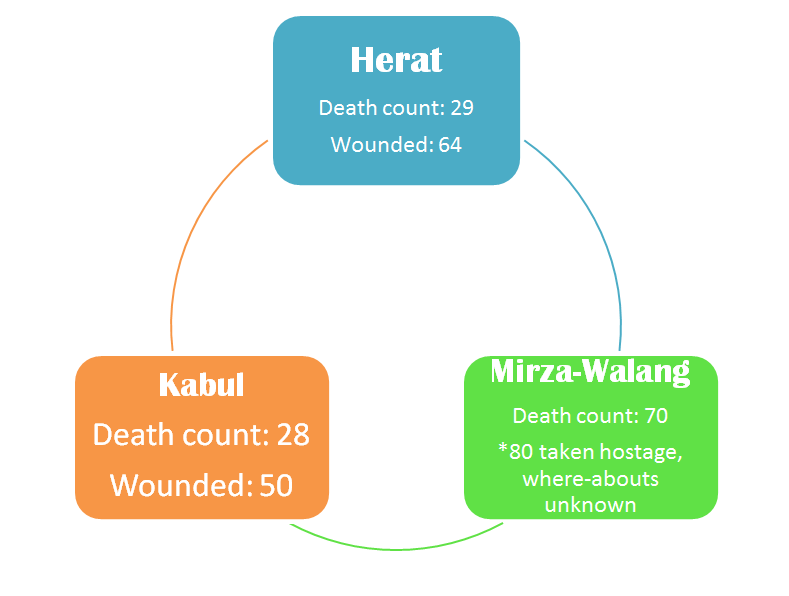
Two suicide bombers attacked a Shia mosque in the western Afghan city of Herat on August 1, 2017. The attacks were reported to have killed as many as 29 individuals and wounded up to 64. Officials said there were at least two attackers: a suicide bomber, and a gunman who shot at worshippers as people gathered in Jawadia mosque for evening prayers at around 20:00 local time.

Another major attack killed 70 and wounded an unknown number of individuals in Mirza-Walang. On Friday, August 4, approximately 800 armed men launched a three pronged attack on a village in a remote mountainous region in north-central Afghanistan. Mirza Walang is a large and densely populated area in a strategic district called Sayyad in the province of Sar-e-Pul.  In a joint effort, ISIS and Taliban agents attacked the village at midnight. More than 1800 families were trapped and surrounded by the extremists. According to local activists, 80 people including women are reportedly taken hostage and transported to different regions.

Ethnically, Mirza-Walang is inhabited by Hazara who were very active in the war against the Soviets and the subsequent regimes installed by the Soviets.

The governor of the district, Sharif Aminyar, said. “Despite several demands for air support and special forces, the demands were ignored by central government,” he told the New York Times.On the 15th, three mass graves were discovered in the area containing bodies of more than 40 people including beheaded women and children. Families and friends gathered to honor the victims and bury their bodies the next day.

Afghan Shia were attacked again at Friday prayers on August 25th, by a suicide bombing followed by gunfire as they gathered at a mosque in Kabul. The attack killed at least 28 people and wounded 50. ISIS claimed responsibility.

Concerns for more human and Shia rights violation increased as President Trump announced, on August 21st, his plan to send more troops to Afghanistan. There are 8,400 US soldiers in this country, and another 4000 will join them based on the new plan. Trump said, “a hasty US withdrawal from Afghanistan would leave a vacuum for terrorists to fill.” He said his original instinct was to pull US forces out but had instead decided to stay and “fight to win” – avoiding the mistakes made in Iraq.

On 22nd, Taliban spokesman Zabiullah Mujahid said Afghanistan would become a “graveyard” for the US troops. “If America doesn’t withdraw its forces from Afghanistan, soon Afghanistan will become another graveyard for this superpower in the 21st century,” he said.

The attack on the 25th to Shia community, two attacks on the 27th and 29th in Helmand and Kabul that killed 18 and wounded 27 others could be response to the US new strategies in Afghanistan.

More than 1,700 civilians have been killed in attacks in Afghanistan during first six months of 2017 according to UN, many of which belong to the minority Shia community.

On average, 4 Shia are killed (as of 28th) and tens are wounded on a daily basis in Afghanistan, making this country the most dangerous for Shia community in August.

Conclusion

The month of August stood witness to just over 367 deaths and an unknown number of injuries as a result of anti-Shiism. SRW estimates the mortality rate to increase as many of those injured were in critical condition and treated in areas with limited medical resources.

The increased incidents of anti-Shiism are consistent with those estimated in previous reports. Shia Muslims continue to live in fear as they are ostracized in their home nations. Arrests of Shia activists and scholars proceed in the Gulf states and the surrounding countries.

In Saudi Arabia, the siege in al-Awamiya continues, and hundreds of properties such as homes and businesses are either demolished or damaged.

Afghanistan has witnessed at least four major attacks on Shia mosques and communities killing more than 124 and wounding tens. SRW is concerned more killings, and attacks might take place as US government announced its new strategies including sending more troops to Afghanistan.

Shia Rights Watch calls for governments across the region to increase protections for Shia and other religious minorities and to reverse and stop all ill-treatment of these populations as the month of Muharram is approaching. Historically Shia rights violations increases during this month in all countries as this community mourn in large gatherings.

International Religious Freedom 2016 Report- Shia Rights Violations

Bureau of Democracy, Human Rights and Labor International Religious Freedom released their 2016 Report detailing human rights violations, including some of what Shia face around the world.

At Shia Rights Watch (SRW) we welcome this report and the attention given to the important issue of human right. Shia Rights Watch hopes to see more detailed report in following years with more collaboration between State Department and right NGOs.

We believe highlighting minority rights in such reports will raise attention to these groups and result in more international effort to recognize and protect human rights of all.

Saudi Arabia

Shia clerics and activists who advocated for equal treatment of Shia Muslims were arrested, and the Shia cleric Nimr al-Nimr was executed after being convicted on a number of charges including inciting terrorism and sedition.

The government convicted and imprisoned individuals on charges of apostasy, blasphemy, violating Islamic values and moral standards, insulting Islam, black magic, and sorcery. A pattern of prejudice and discrimination against Shia Muslims continued to occur with respect to access to public services and equitable representation in government, educational and public-sector employment opportunities, and judicial matters.

There were attacks during the year targeting Shia worshipers.

On July 4, there were two attacks, one in Medina against the Prophet’s Mosque, a holy site for both Sunnis and Shia, and the other in Qatif.

On January 29, suicide attackers killed four and wounded 18 in an attack on Shia al-Ridha Mosque in al-Ahsa province.

Authorities arrested Shia clerics and activists who advocated for equal treatment of Shia Muslims, and one Shia cleric was executed after being convicted of numerous charges including inciting terrorism and sedition.

Authorities continued to engage in instances of prejudicial treatment and discrimination against Shia Muslims with respect to access to public services, equitable representation in government, educational and public-sector employment opportunities, and judicial matters.

Authorities have arrested more than 1,000 Eastern Province Shia since 2011 in connection with public protests demanding greater rights for Shia. Shia Muslim groups that track arrests and convictions of Shia reported more than 300 persons remained in detention in prisons throughout Eastern Province and others remained subject to travel bans. Most were held on charges involving nonviolent offenses, including participating in or publicizing protests on social media, inciting unrest in the country, and insulting the king.

Shia mosques were generally required to use the Sunni call to prayer, including in mixed neighborhoods of both Sunni and Shia residents.

The government neither recognized nor financially supported several centers of Shia religious instruction located in the Eastern Province; it did not recognize certificates of educational attainment for their graduates or provide them employment benefits, which the government provided to graduates of Sunni religious training institutions

Shia were reportedly not represented in proportion to their numbers in academic positions in primary, secondary, and higher education and virtually all public school principals remained Sunni, while some teachers were Shia. In Najran, which has a high concentration of Ismaeli Shia, some Shia principals were hired but Najran University’s administration allegedly continued to discriminate in the hiring of Shia professors, according to a Shia academics.

The government continued to exclude Shia perspectives from the extensive government-owned religious media and broadcast programming. Shia bookstores were reportedly unwilling or unable to obtain official operating licenses.

Shia Muslims managed their own mosques under the supervision of Shia scholars. Most existing Shia mosques in Eastern Province did not seek official operating licenses, as doing so would require asking the government to extend its explicit endorsement of these mosques. The government did not finance the construction or maintenance of Shia mosques. Authorities prohibited Shia outside of the Eastern Province from building Shia-specific mosques. Construction of Shia mosques required government approval, and Shia communities were required to receive permission from their neighbors to start construction on mosques.

Multiple reports from Shia groups cited discrimination in the judicial system as the catalyst for lengthy prison sentences handed down to Shia Muslims for engaging in political expression or organizing peaceful demonstrations.

Reported instances of prejudice and discrimination against Shia Muslims continued to occur with respect to educational and public sector employment opportunities. Shia stated they experienced systemic government discrimination in hiring. There was no formal policy concerning the hiring and promotion of Shia in the private sector, but some Shia stated that public universities and employers discriminated against them, occasionally by identifying an applicant for education or employment as Shia simply by inquiring about the applicant’s hometown. Many Shia reportedly stated that openly identifying as Shia would negatively affect career advancement.

Although Shia constituted approximately 10 to 15 percent of the total citizen population and at least one-quarter of the Eastern Province’s population, representation of Shia Muslims in senior government positions continued to be much below their proportion of the population, including in national security-related positions in the Ministry of Defense, the National Guard, and the MOI. There was only one Shia minister in the national government. There were no Shia governors, deputy governors, or ministry branch directors in the Eastern Province.

Sunni clerics continued to employ anti-Shia rhetoric in Sunni mosques during the year, according to local reports. In a May interview on the Saudi Al-Majd TV channel, for example, one cleric referred to Jews as “enemies of (Islam). In fact they are at the top of the list.”

At least two attacks occurred during the year that targeted places of worship. A suicide bomber detonated himself on July 4, the last day of Ramadan, killing four security personnel at the Prophet’s Mosque in Medina, a holy site for both Sunnis and Shia. Also on July 4, two suicide bombers attacked a Shia mosque, the Faraj Al-Omran Mosque in Qatif, Eastern Province, killing only themselves. On January 29, suicide attackers killed four and wounded 18 in an attack on Shia al-Ridha Mosque in al-Ahsa Province.

Instances of prejudice and discrimination against Shia Muslims continued to occur with respect to private sector employment. Social media provided an outlet for citizens to discuss current events and religious issues, which sometimes included making disparaging remarks about members of various religious groups or “sects.” In addition, terms like “rejectionists,” which Shia considered insulting, were commonly found in public discourse.

Bahrain

The government continued to question, detain, and arrest Shia clerics, community members, and opposition politicians. It convicted a Shia cleric on charges of giving an unauthorized sermon, and revoked the citizenship of Sheikh Isa Qassim.

After Qassim’s supporters staged a sit-in demonstration around his home, police sealed off access to the neighborhood where Qassim lived, detained over 70 individuals in connection with the sit-in, and judges sentenced two Shia clerics to prison terms for participating in the sit-in.

The police continued to restrict entry and exit into the predominately Shia neighborhood though the end of the year.

In December an appeals court agreed with an earlier appeals court and resentenced Sheikh Ali Salman, Secretary General of the Shia opposition political society Wifaq, to nine years after he continued to appeal his 2014 conviction and four-year sentence on charges of inciting hatred and promoting disobedience to the law.

International human rights organizations published reports stating Shia prisoners were vulnerable to intimidation, harassment, and ill-treatment by prison guards because of their religious affiliation. Shia community representatives complained about what they said was ongoing discrimination in government employment, education, and the justice system

Representatives of the Shia community reported the continued higher unemployment rate and lower socioeconomic status of Shia were exacerbated by continued discrimination against Shia in the private as well as the public sectors.

On August 31, a court sentenced Sayed Majeed al-Mashaal, former leader of the Ulama Islamic Council, to two years in prison based on accusations he had calling on the population to rally outside Qassim’s house.

On August 18, a court convicted Sheikh Ali Humaidan of “illegal gathering” and sentenced him to one year in prison for his involvement in the sit-in.

On August 14, police summoned Sheikh Maytham al-Salman for questioning and held him overnight, on suspicions he had participated in the sit-in in Diraz. Police reportedly refused four requests by him to have a lawyer present, saying they had no orders to allow a lawyer to be present. They reportedly kept him awake in an interview room for more than a day without allowing him to change his clothes or take a shower and required him to remove his clerical robe and turban, which he said was a measure intended to “insult and intimidate a Shia cleric.” He was released on August 15, and as of year’s end a date had not been set for his trial.

The government continued to not provide regular statistics on detainees, but according to a report on Jaw Prison published in January by the government-funded Prisoner and Detainee Rights Commission, the courts had sentenced 1021 of the 2468.

Local human rights organizations and activists stated individuals imprisoned were overwhelmingly Shia.

International NGOs reported Shia prisoners were vulnerable to intimidation, harassment, and ill-treatment by prison guards because of their religion, which at times led to coerced confessions. Some Shia prisoners at Jaw Prison and at the pretrial Dry Dock facility reported they were not allowed to practice their faith freely.

Human rights activists reported discrimination against Shia in education continued. They stated the government hired foreign teachers over qualified Bahraini Shia teachers

Activists also continued to report the interview panel for university scholarships asked about students’ political views and family background if their name or address suggested they might be Shia, and believed the panels used such information to select out Shia.

The activists said many top scoring Shia applicants continued to receive scholarship offers in less lucrative or less prestigious fields.

Pakistan

In November several groups in Karachi protested after the police arrested Allama Mirza Yousuf Hussain, a prominent Shia cleric, and Faisal Raza Abidi, a Shia and former senator. Hussain was arrested under a law meant to curb the misuse of loudspeakers for hate speech for allegedly instigating violence during a speech in May at the funeral of rights activist Khurram Zaki. Hussain was released on bail a few days later.

Sectarian violent extremist groups targeted Shia houses of worship, religious gatherings, religious leaders, and other individuals in attacks resulting in 25 people killed and 19 others injured in 16 separate attacks throughout the country, according to a public database of attacks.

Jamaat-ul-Ahrar (JuA), claimed responsibility for two attacks in Shikarpur that injured 13 people at a Shia mosque and congregation hall on September 13.

Media reported that two men on a motorbike threw a homemade explosive device at a Shia congregation hall in Karachi on October 17, killing one child and injuring 20 others. Lashkar-e-Jhanvgi al-Alami, a cell of the Sunni LeJ, claimed responsibility for the attack.

On October 29, unidentified gunmen opened fire on a Shia gathering in Karachi’s Nazimabad area, killing five and injuring six. Lashkar-e-Jhanvgi al-Alami claimed responsibility for the attack.

Terrorist groups also continued to target the predominantly Shia Hazara community. Suspected militants shot and killed a Hazara man in Quetta on December 8. Gunmen in Quetta killed two Hazara Shia men on August 1, with JuA claiming responsibility for the attack.

Throughout the year, unidentified attackers targeted and killed Shia, Hazaras, and Ahmadis in attacks believed to be religiously motivated, including multiple attacks during the Islamic month of Muharram.

On November 11, three Shia students were shot by unknown gunmen on a motorbike; one of the students died from his wounds.

On October 7, gunmen shot four Shia men in two separate incidents in Karachi, killing one. Prominent Shia civil society activist Syed Khurram Zaki was shot and killed in Karachi on May 7 in an apparent targeted killing.

Four Shia were killed in two separate incidents on May 5 in Dera Ismail Khan in KP, prompting protests in the area.

On April 8, unidentified gunmen in Karachi killed three men outside a Shia mosque in Karachi.

Unidentified assailants regularly targeted the predominantly Shia Hazara community. On November 30, unidentified assailants killed a Hazara woman in Quetta.

On October 4, gunmen boarded a bus in Quetta and shot five Hazara Shia women, killing four.

Afghanistan

Shia Muslims, although holding some major government positions, said the number of positions did not reflect their demographics and complained the government neglected security in majority-Shia areas.

The ISKP publicly claimed responsibility for attacks killing over 100 members of the Shia community.

In June unknown militants kidnapped 17 Shia Hazaras from a bus in the northern province of Sar-i-Pul. A provincial council member said the Taliban likely had abducted the passengers to exchange them for a local commander who had been detained by Afghan forces during clashes the day before. The incident came two days after the Taliban killed 13 people and took several others hostage after ambushing a bus convoy in Kunduz province

In July a suicide bombing targeted a protest attended primarily by members of the Shia-majority Hazara community, killing at least 97 and injuring more than 260.

In October gunmen entered the Karte-Sakhi mosque and opened fire on worshippers gathering to mark the Shia holiday of Ashura, killing 17 worshippers and wounding 58, including women and children. The ISKP claimed responsibility for both attacks.

The Taliban were responsible for a number of kidnappings of Shia Hazaras and continued to threaten clerics with death for preaching messages contrary to the Taliban’s interpretation of Islam.

In November a suicide bomber struck a gathering of Shia Muslims commemorating Arbaeen, a Shia observance of loss and grief, in the Baqir ul-Uloom mosque in western Kabul, killing at least 30. ISIS subsequently claimed responsibility.

A day later, a suicide bomber killed 14 civilians and wounded 17 in a bomb blast outside a Shia mosque in Balkh province

Shia leaders urged the Shia community to avoid any violent reaction that might escalate tensions between Sunnis and Shia, and asked the government to investigate the incident and take necessary steps to protect Shia.

In September 8  Hazaras traveling from Bamiyan to Kabul were reportedly kidnapped in Wardak province, just 150 meters away from a police checkpoint.

In another incident, a group of militants stopped two passenger vans in Ghor province. The militants singled out five passengers they identified as Hazaras, and took them away at gunpoint.

According to government contacts, the Hazaras were kidnapped by the Taliban, who were hoping to exchange them for one of their commanders. One student was killed when government forces attempted to secure their release, while the rest were later freed when tribal elders intervened to mediate.

In Ghazni, a student was killed during a clash between the Taliban and government security forces following a Taliban attempt to abduct 6  Hazara students.

In October the Taliban abducted 25 Hazaras traveling on the Kabul-Bamiyan Highway.

Indonesia

Reportedly “Intolerant groups,” disrupted religious gatherings, illegally closed houses of worship, and widely disseminated materials promoting intolerance.

Shia Muslims and Christians reported threats of violence and intimidation for gathering in public or attempting to return to their hometowns to celebrate holidays.

Other local regulations forbid or limit the religious activities of minority religious groups, especially Shia and Ahmadi Muslims.

Local governments selectively enforced blasphemy laws, permitting regulations, and other local regulations in ways that affected various religious groups. For example, local governments issued decrees banning Ahmadi and Shia teachings, and reportedly did not act when threats were made against these groups.

Government officials and police sometimes failed to prevent “intolerant groups” from infringing on others’ religious freedoms and committing other acts of intimidation. Police did not always actively investigate and prosecute crimes by members of “intolerant sectarian groups.”

Other religious minorities such as Ahmadi and Shia Muslims and Christians faced problems even when seeking approval to move to temporary facilities while a primary place of worship underwent renovation. Religious minority communities said administrative suspicions and inaction blocked renovation or construction of new facilities even when they fulfilled the legal prerequisites.

Ahmadis and Shia reported discrimination in the administration of public services if they chose to leave the religion column blank on their KTPs

NGOs warned of rising anti-Shia sentiment in East Java, the heartland of the Nahdlatul Ulema (NU). According to reports, local NU-affiliated imams continued to block reconciliation and the return of Shia internally displaced people (IDPs) to their homes in a case that has continued for several years. Several days before Eid al-Fitr, certain local Sunnis in East Java prevented hundreds of Shia IDPs from returning to their homes on Madura for the holiday. They threatened to kill Shia who tried to return and harm people who assisted them.

More than 300 Shia reportedly remained displaced and unable to return to Madura. Anti-Shia rhetoric was also common in some online media outlets and on social media.

On April 1, hundreds of people calling themselves the Aswaja (Adherents to the Sunnah and the Community), a loose coalition of a number of NU and Persatuan (an Islamic educational organization) schools, broke up a gathering of 100 Shia women in Pasuruan district south of Surabaya. The women were celebrating the birthday of the Prophet’s daughter, Fatima, an important event in Shia tradition. Police, military, and district public order forces who were present to safeguard the event responded to Aswaja’s demands, and after two hours the Shia dispersed.

In North Maluku, on August 24, seven members of the Shia Jafariyah congregation led by Nawawi Husni were subject to intimidation by local residents after holding a religious event in Marikurubu Subdistrict. Local police were deployed to ensure the safety of the Shia members. The police later evacuated the congregation to the police headquarters after local residents tried to damage their houses. The Shia eventually returned safely to their homes.

Kuwait

In the wake of the June 2015 bombing of the Imam Al-Sadeq Mosque, the government continued to order the Shia community to commemorate Ashura and other holidays indoors; it retained other steps it defined as security measures that affected all non-Sunni religious groups.

The government questioned several imams, and in some cases banned some of them, for making what it considered provocative statements harmful to national unity.

In January the government prevented several foreign imams from entering the country because it accused them of “terrorism and sectarianism.” The government permanently prohibited four imams from speaking in mosques because of comments they had made, which the government disapproved.

The government kept in place the ban on outdoor religious observances, for what it stated was security concerns, instituted following the bombing of the Imam al Sadeq Mosque in June 2015, which killed 26 persons.

All Ashura activities for the Shia community were required to be conducted inside closed structures rather than at outside locations. The government did not permit public reenactments of the martyrdom of Hussein or public marches in commemoration of Ashura.

Some Shia leaders said discrimination continued to prevent Shia from obtaining training for clerical positions as well as leadership positions in public sector organizations, including the police force and the military/security apparatus.

The government continued to prevent the establishment of Shia religious training institutions. Shia who wanted religious training had to seek training and education abroad. The College of Islamic Law at Kuwait University, the country’s only institution to train imams, provided some Shia jurisprudence courses but did not permit Shia professors on its faculty.

According to Shia leaders, the lack of Shia imams continued to limit their ability to staff Shia courts thus causing a backlog of personal status and family cases. To address the backlog and shortage of staff, an ad hoc council created by the government under the regular marital issues court to apply Shia jurisprudence continued to function. The establishment of a Shia Court of Cassation, approved in 2003, remained delayed, according to Shia leaders, because appropriate training for Shia to staff it was unavailable.

Iran

Shia religious leaders who did not support government policies reportedly continued to face intimidation and arrest.

The government continued to monitor the statements and views of senior Shia religious leaders. Shia religious leaders who did not support government policies or supreme leader Ali Khamenei’s views reportedly continued to face intimidation, arrest, and imprisonment on charges related to religious offenses.

Critics stated clerical courts were used to control non-Shia Muslim clerics, as well as to prosecute Shia clerics who expressed controversial ideas and participated in activities outside the sphere of religion, such as journalism or reformist political activities.

On August 16, Vice President for Legal Affairs Majid Ansari declared cases of individuals and entities who insulted the president would be tried in the Special Clerical Courts.

According to Amnesty International, Shia cleric Ayatollah Hossein Kazemeini Boroujerdi, serving an 11-year sentence after conviction on charges including “moharebeh” and “abusing his clerical flock,” was transferred to a medical clinic on January 19 to treat recurring stomach pain, nausea, vomiting, and dizziness, but was returned by prison officials to his cell the same day without undergoing full treatment.

Grand Ayatollah Mohammad Reza Nekounam, who was originally arrested in 2015, remained in prison in Qom despite appeals for his release on medical grounds to the Special Clerical Court after he suffered a stroke during the year while in solitary confinement, according to Human Rights Activist News Agency (HRANA). Reportedly, the authorities brought him before the Special Clerical Court in June for further investigation.


Iraq

The United Nations Assistance Mission to Iraq (UNAMI) reported ISIS IEDs caused at least 5,403 casualties (1,167 killed and 4,236 wounded), amounting to half of all verified casualties in the first half of the year.

After forcibly transferring large numbers of civilians from subdistricts of Mosul to Tal Afar, ISIS killed 172 civilians held in al-Jazeera secondary school in the Hay al-Khadraa neighborhood of Tal Afar, according to UNAMI. Reportedly, among those killed were 43 Yezidi and Shia girls and women who had been enslaved by the group since June 2014.

Coordinated ISIS bomb attacks continued to target Shia neighborhoods, markets, mosques, and funeral processions, as well as Shia shrines.

On July 3, a coordinated bomb attack in Baghdad resulted in the deaths of more than 300 and injuries to hundreds more. A few minutes after midnight, a suicide bomber in a truck targeted the mainly Shia district of Karrada, busy with late-night shoppers for Ramadan.

A second roadside bomb was detonated in the suburb of Sha’ab, killing at least five.

On April 4, there were multiple coordinated suicide bombings, including two in the Shia-majority southern provinces of Basrah and Dui War. Five people died in Basrah and in Dui War, and 14 people were killed and 27 wounded at a restaurant popular with Shia PMF fighters. ISIS claimed responsibility for the attacks.

ISIS fired chemical weapons into the Salah al-Din villages of Tara and Basheer on March 16 and May 2, respectively. The attacks injured more than 400 victims, who were primarily Turkmen Shia civilians. ISIS fighters continued their practice of claiming responsibility for these attacks via social media postings.

According to the mayor of Sinjar, as of September 27, mass graves containing the remains of ISIS victims were under investigation.

NGOs reported ISIS continued to kidnap religious minorities for ransom. According to officials from a Turkmen Women’s Association, ISIS militants had kidnapped and held 500 Turkmen women and children from Tal Afar and Mosul since June 2014. A Shabak member of the Ninewa Provincial Council said ISIS held over 250 Shabak people (most of whom are thought to be Shia) captive, and had executed three Shabaks in October.

Malaysia

The government continued actions against Shia Muslims engaged in religious practice.

In October the Selangor State Islamic Department (JAIS) detained 50 Pakistani nationals believed to be Shia Muslims at an event to mark the day of Ashura.

In November the Melaka State Islamic Department arrested 15 suspected members of what authorities said was a “deviant” Shia group. Those arrested were free on bail pending trial as of the end of the year. Under state sharia law, each faced up to three years in jail or a 5,000 ringgit (RM) ($1,115) fine for “insulting Islam.”

The government prohibited publications, public events, and public debates that it stated might incite religious disharmony. Officials at the federal and state levels oversaw Islamic religious activities, distributed sermon texts for mosques to follow, used mosques to convey political messages, and limited public expression of religion. In January JAKIM released pamphlets, flyers, and other promotional materials that said Shia Muslims were potential “radical” threats.

The federal and state governments continued to forbid religious assembly and worship for groups considered to be deviant Islamic groups such as Shia, Ahmadiyya, and Al-Arqam.

In August a court in Kuala Lumpur upheld the government’s ban of four books by novelist Faisal Tehrani for allegedly spreading Shia teachings.

Nigeria

On November 14, Nigerian security forces clashed with members of the IMN who were marching from Kano city to Zaria, resulting in an indeterminate number of deaths and injuries. According to the police, nine people died, including members of the police, while the IMN said 100 of its members were killed and 87 detained. Other reports estimated several dozen dead and well over 100 injured as a result of the violence. Members of the Shia group were embarking on their annual symbolic pilgrimage to Zaria, Kaduna State, to mark the end of the 40-day period of remembrance of the death of Imam Hussein.

Katsina, Kebbi, Kano, and Jigawa States banned religious processions just prior to the annual Ashura processions, performed by Shia Muslims worldwide in remembrance of the death of Imam Hussein.

On October 12, mobs and security forces in a number of northern states attacked Shia participating in the processions, killing at least 15 people. Authorities subsequently arrested hundreds of Shia and charged them with disturbing the peace. The Islamic Human Rights Commission said it echoed the IMN’s statement that the arrests and charges were “an embarrassment to the nation” and called on authorities to release those detained, among whom were women and children, describing them as “prisoners of conscience.”

Azerbaijan

According to the international NGO Forum 18, Inqilab Ehadli, a Shia Muslim, was arrested in January and transferred to the secret police Investigation Prison for allegedly supporting the Muslim Unity Movement. A human rights activist reportedly told Forum 18 Ehadli had been in poor health when arrested and as of April was in critical condition in a prison hospital. No further information on his case was available.

In May authorities and the police demolished a Shia seminary in Nardaran reportedly in order to widen a street that residents said could not be widened. Community members filed a complaint with the judicial authorities. No further information was available about this case as of the end of the year.

In February President Ilham Aliyev participated in the opening ceremony of the Shia Imamzade religious center in Ganja after its extensive renovation.


Egypt

Some government entities continued to use anti-Shia rhetoric in the country.

In January Al Azhar canceled a competition entitled “The Spread of Shia Islam in the Sunni Community: Reasons, Dangers, and How to Confront It.” According to press reports, the cancellation was due to the Grand Imam of Al-Azhar’s desire to promote unity and fraternity among Muslims.

On November 5, the press reported that residents in Ezbet Talata village in Damietta Governorate filed a complaint about a teacher who had converted from Sunni to Shia Islam and whom they alleged was preaching the Shia faith to her students. Residents had learned about her conversion after she called in to a Shia satellite channel. The Ministry of Education subsequently transferred the teacher to another school in a different village. When her landlord in the new village learned that she was a Shia he evicted her, according to the mayor of Ezbet Talata. The teacher returned to Ezbet Talata but residents there ostracized her, the mayor told the press in a video interview.

Representatives of some Salafist groups, including the Coalition of Muslims in Defense of the Companions and the Prophet’s Family, published negative remarks about Shia Muslims.

On February 1, the group threatened to sue the minister of culture for “spreading Shia ideology” when the minister rejected their calls to confiscate Shia books exhibited at the Cairo International Book Fair.

Syria

Nonstate actors, including a number of groups designated as terrorist organizations by the United States and other governments, such as ISIS and Jabhat al-Nusra (JAN, also known as al-Nusra Front), targeted Shia, Alawites, Christians, and other religious minorities.

ISIS destroyed churches, Shia shrines, and other religious heritage sites.

JAN and other rebel groups continued to subject the surrounded Shia villages of Fu’a and Kafraya to periodic violence.

Antigovernment protests, particularly those that occurred under the auspices of extremist groups, and publicity materials from antigovernment groups continued to include anti-Alawite and anti-Shia messages as well. For example, JAN sponsored several protests in Idlib in which some protestors carried signs against Shia Islam, and the group erected billboards in the province declaring that “the Shia are the enemies of Islam.”

Bangladesh

ISIS claimed responsibility for the killing of a Shia preacher, Hadith Abdur Razzak, who was stabbed to death in Jhenaidah on March 14.


UN Complaint