

Welcome to Shia Rights Watch

spot_imgspot_imgspot_imgspot_img
Home Blog Page 37

Incidents of Anti-Shiism in November 2015

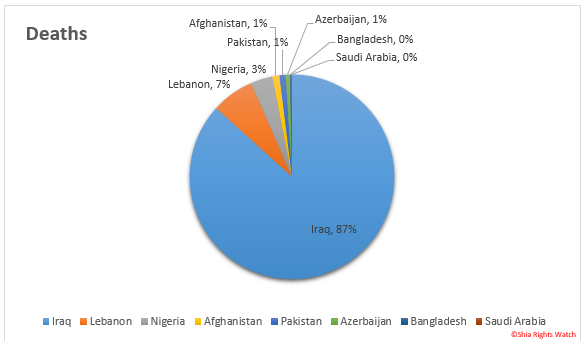
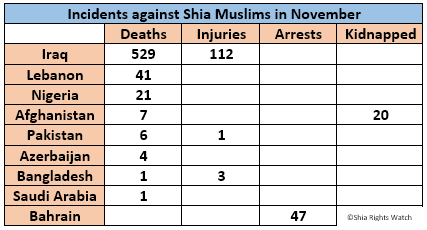
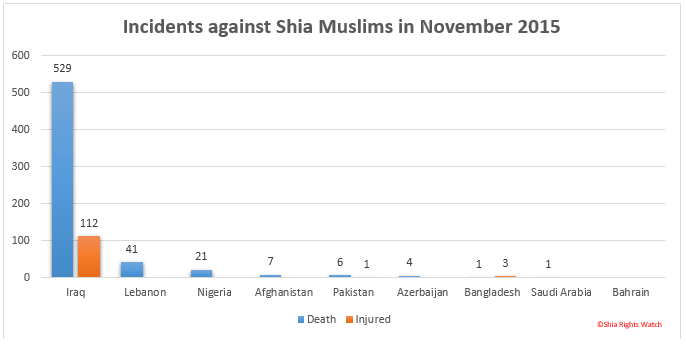
This report will analyze the data compiled on Shia deaths, injuries, and arrests that occurred between November 1st and November 30th.  November has been a high risk month for Shia Muslims around the world.  The attacks towards Shia Muslims stretched from Nigeria to Bangladesh.  Iraq had the highest number of Shia killed, like the previous months.  The total of 610 deaths of Shia were officially reported and 360 were wounded.  The data for this report was gathered from a variety of different sources. The most well-known incidents of anti-Shiism were retrieved from stories that are reported to Shia Rights Watch by eyewitnesses. Each incident is thoroughly evaluated for both authenticity and relevance. For an incident to be included in this report it has to show clear intent to target Shia Muslims on the basis of religious beliefs. The subsequent sections will present and analyze the data gathered by Shia Rights Watch for November.


Where have Shia Muslims been targeted? 
Shia Rights Watch_November2015

In November, Shia Muslims were victims in nine countries: Iraq, Afghanistan, Pakistan, Bahrain, Saudi Arabia, Bangladesh, Nigeria, Azerbaijan and Lebanon. There were a total of 610 Shia deaths this month, 316 wounded, 47 arrests and 20 Shias kidnapped. Three major events happened this month that made November a high risk month for Shias around the world: the first one was the devastating bombing in Beirut, Lebanon.  41 Shias died in this bombing which ISIS took the responsibility.  The second one is the unexpected violent event in Bangladesh which ended in one Shia killed.  Bangladesh does not witness much violent activities against Shias.  This event starts an unfortunate cycle of terror against Shias in Bangladesh.  The Third high risk violent events belong to Iraq, which continues to witness a high number of Shias being killed.

Iraq

Compared to last month there has been a %41 increase of death tolls in Iraq.  The number of injuries are almost the same.  This month, like the month before, the city of Baghdad had the highest number of shias killed.  ISIS is still the main responsible group for these killings.  In November we witnessed for the first time the use of explosive dolls.  These dolls target little children and it has been a major shock for the communities and the Iraqi security forces to see this level of brutality.\
Shia Rights Watch_November2015_2

Lebanon

Beirut, Lebanon, witnessed one of its devastating bombings in many years.  This suicide bombing attack was targeted at the southern part of Beirut with majority Shia population.  More than 200 people were injured.

Nigeria

At the end of November, we witnessed a brutal suicide attack by Boko Haram.  This attack was targeted at the Shias of northern Nigeria who were present at an Arbaeen procession.

Afghanistan

The Hazara community has been targeted again in Afghanistan, part of a long history of being persecuted.  Later, 20 Shia Hazara were kidnapped.  After these events the Hazara community filled the streets and protested in Kabul to demand more security for the Hazara Shias in Afghanistan.

Pakistan

The Hazara community in Pakistan has been under great pressure and risk.  This month we witnessed the same pattern of individual extremists attacking Shias and their mosques.  Gunmen riding motorcycles and shooting towards Shias is the typical format of such attacks.  In these events the police were injured and in one instance killed.

Azerbaijan

The population of Azerbaijan is %85 Shia, and although the country is secular and relatively safe, the government does not tolerate any kind of religious activity that expressed any level of criticism towards the President.  Press TV reported that in a big gathering the police killed 4 people who were members of the Movement for Muslim Unity (MMU) during a raid earlier in the day at the north part of the capital Baku.  Several leaders of the MMU were arrested.  Yahoo News reported the same event, but did not mention the religious affiliation of the deceased.

Bangladesh

This country has been relatively safe for its Shia citizens.  But this month we witnessed a shooting at a Shia mosque which killed one person and injured 3.  ISIS of Bangladesh claimed the responsibility.

Saudi Arabia

Saudi Police officer was shot and killed in the majority Shia neighborhood of Saihat in the eastern city of Qatif. Nobody has taken responsibility for this attack.

Bahrain

Bahrain’s police arrested 47 members of a group of Shia youth.  The police believe they have links to “terrorist elements in Iran” who it said were planning to carry out attacks in the coming days.  The family members and the Shia community denied such allegations.
 

Shia Rights Watch_November2015_1

Achieving Sustainable Development Goal 7: Ensure access to affordable, reliable, sustainable and modern energy for all by 2030

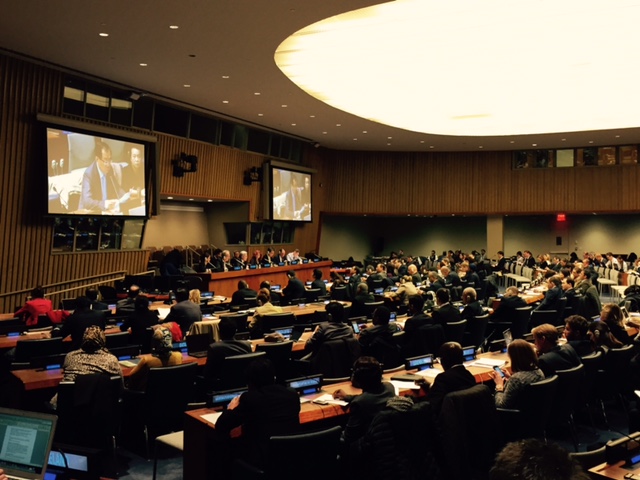
On December 1st Shia Rights Watch attended the event at the United Nations Headquarters entitled “Achieving Sustainable Development Goal 7: Ensure access to affordable, reliable, sustainable and modern energy for all by 2030”. This program marks the release of the World Energy Outlook 2015 report which presents groundbreaking data on the world’s most pressing issues surrounding energy consumption. Attending this discussion were representatives from the International Energy Agency, Sustainable Energy for All (SE4All), and the permanent missions of Germany, Pakistan and Turkey. Dr. Fatih Birol, Executive Director of the International Energy Agency states that the major problems of the current energy markets are the sustainability of current resources and the implications of the current Paris Climate Talks. He states that in regards to the Paris climate talks, the international community is hopeful because many states have approached these talks with commitments to reduce emissions. Shia Rights Watch praises the commitment to reduce dependence on fossil fuels and increasingly shift towards the use of renewable energy due to the positive effects this will have on global energy inequality.

The movement towards renewable energy will have a widespread effect on the poorest countries and emerging nations. In resource rich countries, ethnic and religious minorities do not enjoy in the revenue that high energy prices have brought. In fact, resource revenues have been employed to develop tools and tactics to further repress these minority groups. Fossil fuels such as petroleum have entrenched authoritarian states and intensified repression against dissenting voices, a phenomenon widely studied by scholars who study rentier states. Shia Muslims that live in rentier states face widespread discrimination and fear criticizing their government due to state-sponsored repression. Human rights violations have been deeply connected to the reliance on fossil fuels. While the reduction of the harm done to the environment is the immediate effect of achieving Sustainable Development Goal 7, the human rights implications could be immense.

Shia Weekly News #43

Iraq

This past week, Iraqi security forces discovered eighteen bomb infused dolls along a key road between Baghdad and Karbala to be used for the upcoming Arbaeen pilgrimage. Security forces stated that these bombs were deliberately laid to target Shia children who were going to take part in the Arbaeen pilgrimage. This pilgrimage marks the end of the 40 day mourning period on the anniversary of Imam Hussein’s death. While no group has officially taken responsibility for the plot, ISIS has been suspected to be behind this plot. Shia Rights Watch condemns the deliberate targeting of Shia children and calls for the continued protection of this vulnerable group.

Afghanistan

According to an Associated Press report, up to 20 Shia Hazaras in the southern province of Zabul. The Hazaras have not been identified and it is not yet known if the abductees were men or women. Parallel to many previous kidnappings, the Hazaras were stopped and forced off of the bus. No group has yet to take responsibility for these attacks but the Taliban has been behind such attacks in the past. Shia Rights Watch condemns the continuous kidnappings and murders of Shia Hazaras in both Afghanistan and Pakistan.

Pakistan

In Peshawar, protests and a set in were sparked by the murder of a local Shia leader. Imam Hussain Shah was the vice president of the ANP in the Gunj area. Shah was also the caretaker of the Pathar Wali Imambargah which is located in the Mohallah Huda area of Peshawar. On Friday unidentified gunmen opened fire on him near the city’s police station as he was on his way to the imambargah for prayers. Despite the fact that this incident occurred near a police station, the assailants remain at large and neither the number of assailants nor their identities are known. Shia Rights Watch condemns the actions of the gunmen and supports the calls of the Shia community for an investigation into this attack. The government of Pakistan both at the national and local level must do more to protect the Shia community.

Saudi Arabia

Three Shia Muslims were injured in raids by Saudi security forces on Monday November 24th. Security forces raided shops in the town of Awamiyah and discharged their weapons at those present. One of those critically injured would be later arrested by security forces. The reason behind the raids has yet to be disclosed but this underlines the discrimination faced by the Shia community in Saudi Arabia. Even when subject to raids and violence, Shia Muslims aren’t afforded the right to know what is happening to them. Shia Rights Watch condemns these raids and calls on the Saudi government to disclose the purpose behind the raids.

Palestine

A well-known Shia Palestinian was shot and killed near Nazareth on November 21st. Sheikh Ahmad Shahwan was shot three times at his bookstore in the Iksal settlement. A Palestinian cultural figure who converted to Shiism in 1988, he was well known in his neighborhood as Haj Abu Muhammad. His death dealt a blow to both the Palestinian community and the Shia community and Shia Rights Watch calls for a proper investigation into this crime.

Bahrain

Beside arbitrary arrests, killings, citizenship depraving, the Bahraini kingdom is also responsible for number of forced disappearances.

Mohammad Taqi Hassa al-Ghossra is reported disappeared since November 3rd, 2015. According to local witnesses he was taken from his home by security forces and his family has not heard from him. The government denies having any information about his place. The family reported that he called home once and only said “ I’m Ok” with very low voice.

His family has been trying to find a trace of him or his file without any success.

Under international law, forced disappearances are considered one of the most serious violations of the fundamental rights of human beings. The United Nations General Assembly has said that forced disappearance “constitutes an offence to human dignity, a grave and flagrant violation of human rights and fundamental freedoms and a violation of the rules of international law.”

However” Disappearances” have come to be regarded as an exemplary violation practiced by abusive governments, including Bahraini government.

Bangladesh

Gunmen attacked Shia Mosque in northern Bogra, Bangladesh, raising the fears among the country’s Shia Community.

The goal of Anti-Shia terrorist groups is to raise tension between the communities and minorities in order to foster hatred towards one another.

Nigeria

Shia Muslims recently faced another attack by an Anti-Shia terrorist group, when suicide bombers approached the Shia procession in Nigeria’s Kano state, leaving over twenty-one people dead.

During the holy month of Muharram many Nigerian Shia gather together to commemorate Imam Hussein martyrdom, Anti Shia groups take advantage from this gathering to take a life of many Shia.

This time attach took place in the village of Dakasoya, southern village of Capital Kano.


Azerbaijan

In a wave of government crackdowns, four were killed in an Arbaeen ceremony in the town of Nadaran.

Azerbaijan is a majority Shia nation whose population has been suppressed for years.  In addition to ideological suppression, the people of Nadaran have witnessed great discrimination in regards to their economic and other legal (human) rights compared to the rest of Azeri villages. Post-raid, officials cut off utilities such as power and telephone lines, to the town and put up barricades.

The lack of freedom of speech in this nation has a long history as human rights activists, journalist and defense lawyers have been detained, interrogated and incarcerated for their actions and beliefs.


The UN’s Security Council Counter-Terrorism Committee’s (CTC) Global Research Network

UN-ShiaRightsWatch_counter_terrorisim

Countering terrorism remains leading focus of Shia Rights Watch, due to its importance to restore justice about crimes done towards innocent people and saving lives. It is essential to understand what different types of extremism are, how do they operate and what are they motives. Shia Right’s advisor on counter Terrorism attends a United Nations Counter-Terrorism Committee meeting titled “Foreign Terrorist Fighters,” with the hopes of being educated more about new terrorist groups.

Following the launch of the United Nations Security Council Counter-Terrorism Committee’s (CTC) Global Research Network last February, the Committee on 24 November held an open briefing with research institutions from around the world to analyse and discuss emerging terrorism issues and trends, particularly pertaining to foreign terrorist fighters (FTFs).

The half-day briefing consists of two thematic sessions focused on research by network partner institutions on “The motivations and backgrounds of foreign terrorist fighters,” and on “Rehabilitation and reintegration strategies for returning foreign terrorist fighters.”

Shia ( Shiites ) have been victims of inhumane crimes in more than dozen countries and it is essential to understand the new and upcoming terrorist groups and be able to reduce their crimes and finally eliminate their violent behavior.

NGOs Urge Sec. Kerry to Act in Case of Sheikh Nimr al-Nimr

20 November 2015 — Washington, DC — Today, a collection of 17 organizations and two individuals working on behalf of human rights and international religious freedom sent a letter to US Secretary of State John Kerry, urging him to press Saudi Arabian King Salman bin Abdulaziz Al Saud to halt the execution of Sheikh Nimr Baqir al-Nimr and several other demonstrators from the country’s marginalized Eastern Province. On 24 October 2015, the Saudi Supreme Court ratified the sentence of death issued to Sheikh Nimr in October 2014; since September, the Saudi criminal justice system has also ratified the death sentences of Ali al-Nimr, Dawood al-Marhoon, and Abdullah al-Zaher, three men arrested as minors in 2012 for their protest activity.

Stating that many of the charges on which the men were convicted are unrecognized by international law, the signatories referred to the trials of Sheikh Nimr and the others as “grossly unfair” due to ongoing and credible allegations of torture and lack of due process. Furthermore, in sentencing Sheikh Nimr, the Specialized Criminal Court, Saudi Arabia’s terrorism tribunal, considered sermons made by the cleric as evidence against him, despite independent analysis confirming that Sheikh Nimr did not incite others to violence in his preaching.

The letter ends by urging Sec. Kerry to leverage his “close relationship with King Salman to press him to grant Sheikh al-Nimr access to any medical attention that he requires, commute his death sentence, as well as those of Ali al-Nimr, Dawood al-Marhoon, and Abdullah al-Zaher, and order a fair trial for each of them.”

Click here to read a PDF of the letter.

The signatories:

Americans for Democracy & Human Rights in Bahrain (ADHRB)

Amnesty International

ARTICLE 19

Bahrain Institute for Rights and Democracy (BIRD)

Center for Inquiry (CFI)

European Center for Democracy & Human Rights (ECDHR)

European Saudi Organisation for Human Rights (ESOHR)

Freedom House

Human Rights Foundation

Human Rights Watch

Hindu American Foundation (HAF)

International Institute for Religious Freedom (IIRF)

Monitor of Human Rights in Saudi Arabia (MHRSA)

Muslim Public Affairs Council

PEN American Center

Project on Middle East Democracy (POMED)

Shia Rights Watch (SRW)

Dr. Toby Matthiesen, Senior Research Fellow in International Relations of the Middle East at the University of Oxford

William C. Walsh, Partner, Bisceglie and Walsh


Shia Weekly News #42

Iraq

Last Friday on November 13th we reported on the deadly bombing at the Shia mosque that killed dozens of people. In addition to this bombing, there was a roadside bomb at a Shia shrine in Sadr city which killed at least 5 people and wounded 15. No group has formally taken responsibility for this attack but it is widely believed that ISIS carried out these attacks as well since they occurred just hours within the mosque bombing which they took responsibility for.

A week after the previously mentioned bombings, another suicide and roadside bombing occurred in Baghdad. On Friday November 20th a roadside bomb was detonated outside of a Shia mosque in the Nahiyet al-Rasheed neighborhood of Southern Baghdad during Friday prayers. Soon after that, a suicide bomber detonated themselves inside the mosque. Official reports state 10 people were killed and 10 were wounded. While no group has claimed responsibility for this attack, this is eerily similar to ISIS facilitated attacks in Baghdad last week. Shia Rights Watch condemns these attacks and urges the Iraqi security forces do more to ensure the safety of innocent worshipers.

Indonesia

In Indonesia announcements of the creation of an anti-Shia alliance reverberated around the country. The so called Anti-Shia National Alliance (Annas) declared an anti-Shia movement in West Java. This announcement has come on the heels of various incidents of anti-Shia protests and mild violence has been present around the country, especially in East Java. Earlier this year in East Java, Shia Muslims who were displaced were hindered from returning to their homes by residents of the town of Sampanng. Leaders of the country’s two largest Muslim organizations have condemned the creation of this new movement, stating that this is going hamper ongoing reconciliation efforts. Shia Rights Watch urges the government of Indonesia to do more to ensure that hateful rhetoric does not materialize into violence.

Pakistan

In Karachi, Pakistan yet another assassination occurred in a Shia neighborhood.

November 16th two policemen deployed to a security checkpoint at the Ismaili Shia community’s residential complex were shot and killed by unknown gunmen. Ali Raza, 50, and Ghulam Jaffer, 46, were shot by four armed gunmen on motorcycles and were pronounced dead at the scene. Reports stated that there have been 79 policemen murdered in Karachi this year alone. While the gunmen weren’t identified, Tehreek-e-Taliban Pakistan claimed responsibility. Unfortunately, like many of these attacks, investigations have been unsuccessful. Shia Rights Watch condemns this horrendous attack and urges the Pakistani security forces to continue their investigation into this murder and the hundreds more that occurred in Karachi this year.

Saudi Arabia

In the eastern city of Qatif, a Saudi Police officer was shot and killed in the majority Shia neighborhood of Saihat. This attack occurred on November 18th and further details have yet to be released. While no group has claimed responsibility for this attack, this has been the site of numerous ISIS inspired and facilitated attacks.

Shia Weekly News #41

Pakistan

On November 16th two policemen deployed to a security checkpoint at the Ismaili Shia community’s residential complex were shot and killed by unknown gunmen. Izzatullah and Muhammad Hussain were travelling in a van from the city center of Quetta to their home in a suburban Hazara town when two unidentified gunmen open fired on their vehicle. Izzatullah was killed at the scene while Muhammad died on his way to the hospital.

Shia Rights Watch condemns the actions taken by these militants against the Hazara community and calls for the Pakistani government to immediately investigate this murder.

Afghanistan

In Afghanistan, the continuous murders of Shia Hazaras sparked massive protests in Kabul on November 11th. Thousands of protestors marched throughout West Kabul with coffins carrying the decapitated bodies of seven Shia Hazaras, including several women and children.

“This is a protest to demand justice for the victims who were so mercilessly murdered, we demand justice for people who are being brutally killed by terrorists every day”- Mohammad Hadi, Hazara protestor.

Shia Rights Watch stands with the Shia Hazara community as they demand justice for the wave of terrorist violence that has ravaged their community.

Bahrain

On November 11th a criminal court in Bahrain sentenced a Shia opposition figure to two years in prison on the basis of his political affiliation. Majeed Milad received this sentence for a speech he gave in which he expressed his opinion about political reconciliation between his party (al-Wefaq) and the government.

The sentencing of Majeed Milad is part of an ongoing campaign by the Bahraini government to stamp out any political dissent in the country. Basic civil and political rights have been violated by the regime and this has largely happened without any substantial condemnation from the international community. Shia Rights Watch condemns the arrests of political prisoners and demands the immediate reversal of his sentence and the release of all political prisoners.

Iraq

Iraq has seen the continuation of senseless violence directed against Shia communities around the country. On Friday November 13th bombings targeting Shia communities in Baghdad killed at least 15 people. One such attack was a suicide bombing inside the Al-Ashara al-Mubashareen mosque during a funeral. This attack killed 13 people and wounded 33.

The second attack occurred in Sadr City where two roadside bombs were detonated near a Shia place of worship, killing at least 2 people and wounding nine.

No group has yet to take responsibility for these attacks but these attacks closely resemble those perpetrated by ISIS.

Lebanon

In an attack which rocked the country, a suicide bombing in a Shia suburb of Beirut killed at least 37 people and wounded 181 on November 12th. Two suicide bombers detonate themselves on a busy street in the Burj al-Barajneh neighborhood of Beirut. Local media sources are saying this is the deadliest bombing in the country since the conclusion of its civil war which ended in 1991.

ISIS has taken responsibility for this attack but this claim has yet to be independently verified. Burj al-Barajneh is being referred to as a Hezbollah stronghold but it is clear that this indiscriminate attack in an area with a large civilian presence was not merely an attack on Hezbollah but an attack on Shia Muslims. This attack mirrors the vicious attacks ISIS perpetrates in Iraq, Syria, and Saudi Arabia.

Shia Rights Watch strongly condemns this brutal attack and calls on the Lebanese government to ensure the protection of religious groups within their borders.

Importance of Nationality in Today’s World

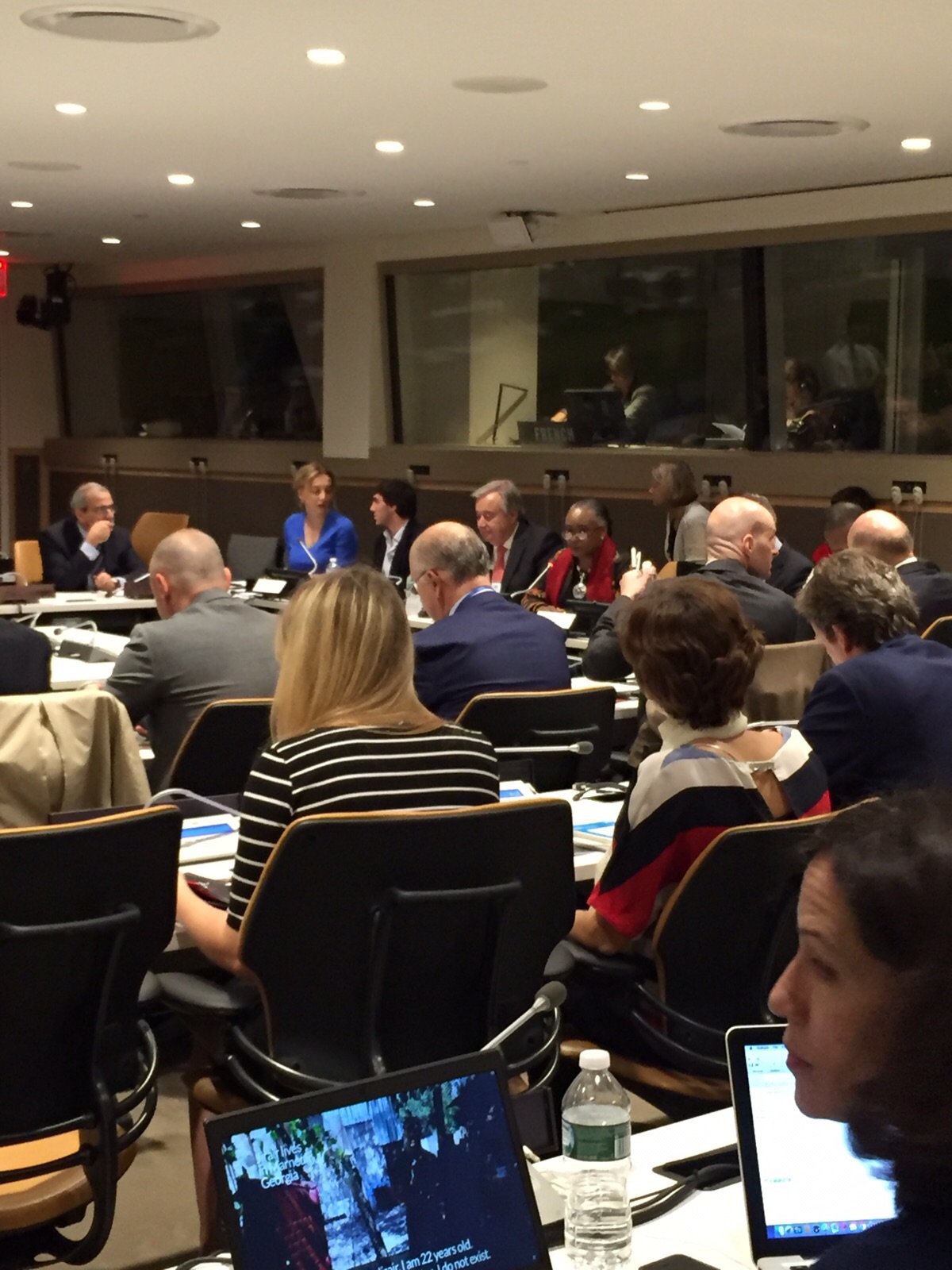
On November 3rd Shia Rights Watch attended the UNHCR High-Level event on the importance of nationality in today’s world. In addition to the UNHCR, this event was jointly hosted by the Permanent Missions of Brazil, Italy, Germany, Thailand, Cote d’Ivore, and the United States.

Attendees included numerous delegates and NGOs from around the world and the high level panel included speakers such as Antonio Gutierrez who is the UN High Commissioner for Refugees and a former Prime Minister of Portugal.

High Commissioner conveyed his office’s plan to eradicate statelessness in 10 years. This process could be achieved through four steps: states should grant nationality for those born in their territory who would otherwise become stateless, grant women the right to pass nationality to their children in the same way fathers can, eradicating the discrimination of grating nationalities on basis of race religion and other categories, and lastly universal birth registration.

Also in attendance was Jirair Chichian who is Armenian young man who was born in Russia just after the fall of the Soviet Union has been stateless his entire life and has be unable to be afforded the rights of his peers. While an avid Greco-Roman wrestler, he has been unable to travel with his wrestling team around Europe since he doesn’t have a passport. He was only able to get to New York City because he received travel documents from UNHCR.

Addressing the concerns of statelessness people needs to become a primary concern of the international community because it has been utilized by states to bolster campaigns of discrimination. Groups such as the Rohingya in Myanmar and Shia Muslims in the Middle East have been either denied citizenship or not afforded the full rights of citizens in the countries they live in. In its most extreme uses, the denial of citizenship can be a form of ethnic and religious cleansing. To echo the words of Ambassador Antionio Patriota who is the Ambassador of Brazil to the United Nations, in a world composed of States, to have stateless people is both an anomaly and a source of unnecessary discrimination.

The issue with statelessness has come to the attention of the international community during the Syrian refugee crisis. During this crisis, hundreds of thousands of Syrian men, women and children have faced harrowing conditions to seek refuge in Europe. During this process, thousands have perished at land and sea and many have faced persistent discrimination throughout Europe.

Being stateless means that many protections are not afforded to them thus leaving them vulnerable to things such as education deprivation and economic exploitation. Without proof of citizenship and residence, children cannot register for schools and entire families often find their movement restricted by states.

Shia Rights Watch urges the international community to respect and ensure the protection of the rights of stateless people. While many policymakers acknowledge the need to address the root causes of this migration, it is necessary that those same policymakers ensure that these refugees are protected while they are away from home. Conflicts and other hardships that are not the fault of these refugees and migrants should not be held against them.

Shia Weekly News #40

Bahrain

In Bahrain the disregard for the rule of law by the Al-Khalifa regime continues as a Bahraini court revoked the citizenship of five Shia Muslims under charges of spying for Iran on November 5th. Officially the Bahraini court charged them with “spying for and seeking with Iran and its agents to carry out hostile acts against the kingdom”. These alleged attacks were supposedly directed at public facilities and banks.

Shia Rights Watch disputes the claims made by the Bahraini authorities and the sentence handed down to the men. Two of the five Shia Muslims who were on trial appeared in court on November 5th and stated that they were forced to confess under torture. Any confession made under duress cannot be considered valid. In addition to the violation of the right to a fair trial which in enshrined in the Universal Declaration of Human Rights and the International Covenant On Civil and Political Rights, torture is a human rights violation as stated in the two previously named documents. Shia Rights Watch demands the immediate release of the Shia detained under these charges and demands that these charges are dropped.

On the same day that the previous life in prison sentences were handed down, Bahrain’s First High Criminal court sentenced 22 Shia Muslims to three years in prison over the peaceful demonstrations that occurred in Sitra in September. The court claimed that the defendants assaulted, in conjunction with other unknown suspects, a policeman and threatened to use violence to threaten public security.

Many of the claims made by the Bahraini authorities have yet to be substantiated. On the other hand, the excessive use of force by Bahraini Security Forces is well documented. Beatings and shootings of protestors have been documented by many human rights organizations, and the excessive use of tear gas was documented by Shia Rights Watch last year. Lastly the independence of the judiciary remains an issue of scrutiny. Shia Rights Watch demands the release of these activists immediately.

Pakistan

Yet another Shia business owner was shot and killed in Pakistan this week. On November 5th, terrorists from Ahl e Sunnat wal Jjama’at shot and killed shopkeeper Sadiq Ali in Quetta. Ali, who owns a mechanic shop, was shot in the head and sustained critical injuries before dying at the scene. Haji Muhammad Sadiq Ali was 66 years old and leaves behind a son and two daughters. The gunmen are still on the run and have yet to be identified. Shia Rights Watch condemns the actions committed by these terrorists and urges the Pakistani government to devote the necessary resources to investigating this crime.

Twenty Shia Muslims of the 50 who were detained on the 20th of Muharram in Islamabad were released on bail. The detainees were arrested during a Muharram procession which the local authorities did not sanction. This has been denounced as unjust as anti-Shia groups have been able to engage in processions in the city under the protection of the authorities. Shia Rights Watch demands the release of the remaining detainees and that the charges against them be dropped. This procession is an expression of the freedom of religion for Shia Muslims and it must be respected.

Saudi Arabia

Ministry of Public Health in Eastern Province announced open investigation for a Shia employee of a Hospital in Demam area.

A Shia Muslim custodian of the Women and Children Hospital in Eastern Province is under investigation after her phone prayer call application recited Shia call to prayer.  Ministry speak person stated they will announce her punishment after investigation in over.

Shia Muslim of Saudi Arabia have always been discriminated against. In fact many are unemployed due to systematic employment discrimination. Shia Rights Watch in concerned for the employment security of this female employee.  This NGO urges the Ministry of Health to respect freedom of religion of its employees.

Iraq

In addition to the scores of targeted bombings in Shia neighborhoods in Iraq, ISIS has blown up a number of houses belonging to displaced Shia Shabak Kurds in the village of Bazwaya which is east of Mosul on November 5th. At least 13 houses were bombed by the group   but no human casualties were reported. The situation on the grown for Kurds and Shia has been rapidly deteriorating as efforts to stop the terrorist group have stalled. Shia Rights Watch calls on the enhanced protection of vulnerable religious and ethnic groups in or near ISIS held territory.

Incidents of Anti-Shiism in October 2015

October 2015

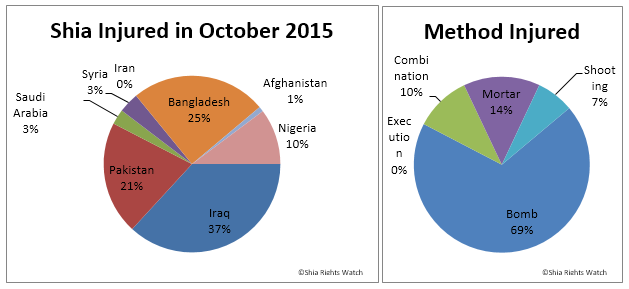
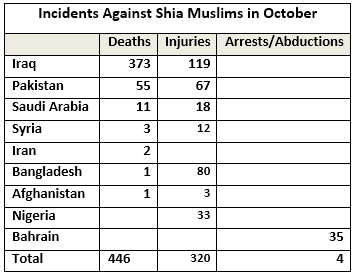
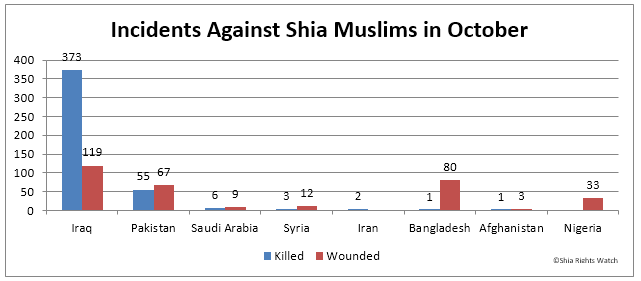
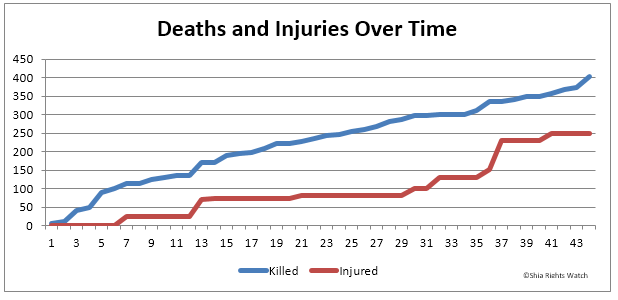
There was a significant increase in Shia deaths as well as injuries this month compared to the statistics from September. To our surprise there were no recorded arrests or detentions that targeted Shia for their religious beliefs, but four Shia have gone missing in Bahrain.  There were nearly 450 Shia deaths, and over 300 injuries this month. The figures average out to more than 14 Shia deaths per day, and more than 10 injuries per day. This month coincides with the first month of the Islamic calendar, Muharram, when Shia mourn the death of Imam Hussein during this month. On the tenth day of Muharram, otherwise known as Ashura, Shia remember the Battle of Karbala, and mourn the death of Imam Hussein as well as his followers. As a result, Shia are targeted on Ashura and the days leading up to it. Almost all of the countries listed in this report are repeat offenders, but the attacks in Bangladesh, Denmark, and Iran are new to the list.

Overview

This report will analyze the data compiled on Shia deaths, injuries, and arrests that occurred between October 1st and October 31st. The data for this report was gathered from a variety of different sources. The most well-known incidents of anti-Shiism were retrieved and reported to Shia Rights Watch by eyewitnesses. Each incident is thoroughly evaluated for both authenticity and relevance. For an incident to be included in this report it has to show clear intent to target Shia Muslims on the basis of religious beliefs. The subsequent sections will present and analyze the data gathered by Shia Rights Watch for October.Shia Rights Watch_October 1

Where have Shia Muslims been targeted?

In October, Shia Muslims were victims in 13 countries: Iraq, Pakistan, Saudi Arabia, Syria, Iran, Bangladesh, Afghanistan, Nigeria, Bahrain, Egypt, Denmark, India, and Indonesia. There were a total of 446 Shia deaths, 320 injuries, and 4 abductions this month.

Iraq

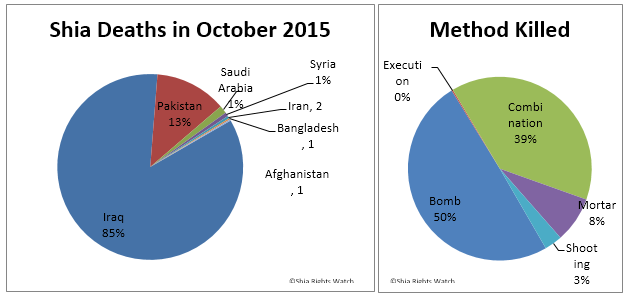
Iraq, Baghdad more specifically, is still the most dangerous place to be Shia as it continues to top the deaths and injuries for the tenth time in a row. Iraq was the target of Ashura attacks like other countries in the report this month, but also had almost daily attacks. 44% of all the attacks in Iraq were bombings, 46% were a combination of methods, and 35 Shia died from mortar attack. The Shia deaths in Iraq have more than doubled from September, and the amount of Shia injured from attacks has only decreased slightly. This could be attributed to one of our news sources in Baghdad ceasing their updates on October 2, 2015.

Pakistan

Pakistan was making great strides in tackling anti-Shiism in recent months, but was hit multiple times as Ashura became closer. There were still the usual terrorist shootings against Shia throughout the month, but the major attacks occurred in Quetta, Balochistan, and Jacobabad. These three bombings took the lives of 42 Shia and injured 63 Shia. Shia Rights Watch condemns the brutal acts committed by the terrorists, and urges the Pakistani government to continue the positive work it has done so far.

Saudi Arabia

An ISIS gunman fired upon a Shia mosque, and killed 5 Shia while injuring 9 more. He had planned to explode himself but was stopped before he could detonate his explosive belt. Beside members of terrorist groups, the Saudi regime is also guilty of anti-Shiism since they raided homes in Awwamiya with troops using rocket propelled grenades and gasoline bombs.

Shia Rights Watch_October 2

Iran

Two Iranian Shia were shot dead in Iran during Ashura commemoration. It took place in Dezful which is a province with a Sunni population which could explain the anti-Shia act. It is surprising that an attack like this could occur in a country that is generally commonly thought to be the homeland for Shia Muslims.

Bangladesh

ISIS in Bangladesh planted 3 bombs in the old town area of Dhaka, when 20,000 Shia would be gathered there for Ashura. One Shia died, and 80 Shia were injured as a result of the attack.

Syria

Nubl and Zahra saw a missile attack as well as a bombing this month which combined for tow Shia deaths and more than a dozen Shia injuries. There are also reports of ISIS executing a Shia boy with a tank. This is the first time a tank has been utilized to execute a Shia this year, and is an example of how mundane the activity of killing is for ISIS that they have to be creative in their murderous rampage. The numbers recorded from Syria are the bare minimum, because it is difficult to get information in or out of the war torn country. It is especially difficult in Shia towns that are surrounded by ISIS or Al Nusra Front.

Shia Rights Watch_October 3

Nigeria

Thugs attacked Shia worshippers on their way to Ashura with knives, cutlasses, and iron rods. 32 people were injured and the attackers went on to demolish Shia mosques and Shia homes in Gangre. Nigeria is not always included in every report, but events such as this show that it is going strong there even if it is not always reported. Shia Rights Watch condemns the actions of these terrorists.

Denmark

During Ashura Shia procession in Copenhagen, a armed man fired into the crowd, no one was reported dead or injured as a result. This is the first time that Denmark is included on the monthly anti-Shiism report.

 Bahrain

Throughout the month, there were multiple reports of security forces taking down Ashura banners by force, and clashing with protestors. There were also reports of the regime using terrorist militias to target human rights activists and religious figures. Four Shia from the Darwish family, Mohammad, Qasim, Ibrahim, Ismail, were abducted by a quasi-military group this month, and have not been heard from since.

Several injured as result of clash between protesters and government forces following troop attempt to bring down Ashura banners; forces used bullets, gas to disperse protestors.

Increased torture and assault on prisoners of conscience in conjunction with day of Ashura, including slapping of faces, being forced to stand for long periods of time, having cold water were also reported.

Shia Rights Watch_October 4

Afghanistan

                ISIS targeted a Shia Ashura gathering in Kabul which resulted in the death of one person and the wounding of 3 others.  Shia of Afghanistan have very low profile  due to fear associated with being Shia Muslims, yet they  have been target of anti-Shiism for long time and in Muharram such human rights violations increases in this country as it does in other countries.

Egypt

Salafi groups in Cairo threaten to kill Shia Muslims for celebrating Ashura, and called for the closing of Shia mosques on the sacred day. Egyptian authorities also warn of arrest for commemorating Ashura. It is alarming that the Egyptian government is not to too far off in their message from the terrorist groups in Egypt, and Shia Rights Watch condemns these messages.

Indonesia

The Mayor of Bogor denounced Shia as heretics and decided to ban Shia from celebrating the Muslim holy day of Ashura. The ban did not apply to Sunnis and the hate speech violates Indonesia’s Constitution. It is disappointing to see a government official making anti-Shia statements, and there needs to be a leader who is willing to stand up for Shia in Indonesia.

India

Hundreds of Shia traveled to Jahangir Chowk from Shaheed Gunk for Muharram, and were met with tear gas deployed by paramilitary forces. Muharram processions were banned in Srinagar since the Kashmir dispute in the late 80s, and Shia Rights Watch urges the Indian authorities to make peace with their Muslim neighbors.

Shia Rights Watch_October 5

Conclusion

                Anti-Shiism is spreading and on the rise in many countries. It is up to the international community and everyday individuals to oust the prejudice and misinformation when the governments of these countries cannot bring themselves to do so. Shia Rights Watch condemns the acts committed against Shia Muslims around the world, and urges the authorities to take action and protect this minority in their home lands.

UN Complaint