On May 17, Aya Hachem, a 19-year old student, was shot in the chest and killed on a trip to the grocery store. The Hachem family were refugees from Lebanon living in the United Kingdom.
Shia Rights Watch expresses its sincerest condolences for the family of Aya Hachem and voices concern over withdrawal of support for the family upon the realization that they are members of the Shia faith.
The case of Aya and the responses incited by her Shia faith sheds light on sentiments of anti-Shiism and the ever-existing discrimination against Shia Muslims.
Outraged by the targeting of the Hijabi female in the Holy month of Ramadan, the international community rose in commemoration. Within hours, sympathetic messages flooded social media, and numerous fundraisers were set up in her memory.
Despite the initial unity of supporters, it wasn’t long until the identification of the Hachem family as Shia Muslims led to the withdrawal of donations.
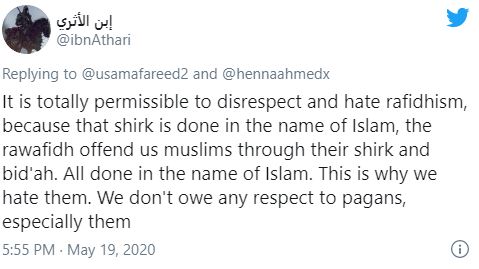
A thread of tweets among Muslim Twitter users shed light on the discriminatory sentiments that cloud fundraising.
On May 19, Twitter user @humbleackh1 tweeted, “I didn’t know she was a Shia… no way do I want to be in a situation where all this cause could go against me on the Day of Judgement.”
Twitter user @Hannanqazi_ raised 30000 Euros to build a mosque in Niger for Aya. Qazi stated, “The fact that the family aren’t in the best of financial situations and have only granted me to utilize £5000 to build the masjid in Niger for sister Aya. As the rest of the money will go towards the funeral costs and whatever additional costs the father may need to cover….”
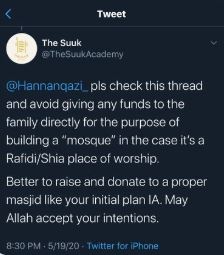
The tweet was responded with cautions against “building a mosque in the case it’s a Rafidi/ Shia place of worship” and calls to “donate to a proper masjid.”
While many have denounced anti-Shia sentiments and expressed support for the Hachem family, the events that unfolded after the family was identified as Shia Muslims points to a prosperous culture of discrimination, a culture not foreign to members of the Shia faith.
On a global scale, Shia Muslims are targeted in bombings and shootings organized to limit Shia existence. Shia Muslims endure cultural and systemic violence that downgrades them as second-class citizens and leaves them in search of justice.
The lack of aid and support within humanitarian efforts for Shia Muslims is also not new. Many Shia Muslims report facing discrimination in obtaining funding, not just across the Middle East, but also from providers based in the West.
The story of Aya Hachem is yet another reminder that Anti-Shiism cannot be ignored. No longer can the international community turn a blind eye to violence against Shia Muslims.
“Microaggressions, erasure, deadly attacks, dismissiveness, and glaringly anti–Shia utterances are a burden we have carried on our backs for as long as we can remember. And the reality is that with every death, with every attack, and with every act of hatred against the Hazara Shias, against the Zakaria Al-Jabers, and the Aya Hachems of the world, we as Shia Muslims are reminded of one thing: beneath a layer of an ostensibly collective endurance of Islamophobia, our Shia identity leads us to a duality of internal empowerment and outward isolation – we live in a world where it often feels like we have no one but ourselves to lean on.” Wrote Danya Jafri, the Ahlul Bayt chair of Columbia University, in an article on May 20.
On this occasion, Shia Rights Watch pledges its support for Aya Hachem, and all Shia lives lost amidst a world of indifference.
No longer can we afford to remain silent against anti-Shiism.
Shia Rights Watch expresses its condolences for the lives lost in the maternity ward attack in Kabul, Afghanistan.
The attack on Tuesday was unparalleled and demanded actions reciprocal in strength.
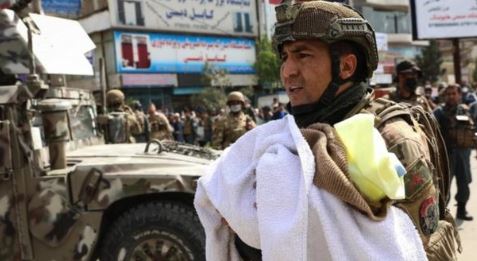
On May 12th, a militant attack on the Dashte-Barchi hospital in Kabul left 40 deceased and at least 16 others injured; 140 people are said to have been in the hospital at the time of the attack. Dashte-Barchi is located in a quarter of Kabul dense in Shia Muslims. Locals report consecutive blasts then gunfire beginning at 10 am. Panic ensued right after. Survivors say that attackers, dressed as police officers, shot at everyone.
One woman gave birth amidst the commotion.
Among those killed were newborn children, many of which were conceived after years of medical infertility treatment.
One prevailing story has been that of Zahra Muhammadi and her daughter-in-law, Zainab, who had traveled from Bamiyan to Dashte Barchi in hopes of finding reliable medical attention. Zainab’s son, Omid, was shot within hours of his birth.
“Today we’ll take [Omids] dead body to Bamiyan,” stated Zahra Muhammadi.
The hospital attack was one of two attacks on Tuesday. In Nangarhar, ISIS claimed responsibility for a suicide bombing that led to the death of more than 32. The New York Times approximates 100 people killed as a result of the two attacks.
Following the attack, Afghan President Ashraf Ghani stated, “In order to provide security for public places and to thwart attacks and threats from the Taliban and other terrorist groups, I’m ordering Afghan security forces to switch from an active defense mode to an offensive one and to resume their operations against the enemies.”
Attacks in the Shia sectors of Kabul are not new. Shia Muslims in Kabul live in constant fear of being targeted by radical extremism. In 2019, a significant percentage of those killed in terror attacks were Shia Muslims, deliberately targeted for their faith.
The attack on Dashte-Barchi was unprecedented in violence. The attack was a clear display of the extent of violence extremists in Afghanistan are willing to use to threaten the Shia existence in Kabul.
Shia Rights Watch notes that any action taken must recognize sentiments of anti-Shiism that fuel extremist activities across Afghanistan. Measures signed into effect must discretely include protection for Shia Muslims and call for national efforts to reduce anti-Shiism in the country.
Shia Rights Watch continues to monitor human rights violations against Shia Muslims in the month of April. In total, an approximate 40 incidents of violence took the lives of 77 Shia Muslims and injured 41 others in the nations of Afghanistan, Bahrain, Saudi Arabia, and Iraq.
It is important to note the reported incidents provided limited but necessary insight into conditions of this religious minority.
Afghanistan
Ten incidents of violence left more than 70 Shia Muslims dead and 25 others wounded across Afghanistan. Attacks took the forms of roadside bombs targeting travelers, explosions in areas dense with Shia Individuals, and armed attacks by assailants. In a heinous incident of violence on April 26, armed assailants led a mass execution, killing seven members of a family, one of whom was a child.
Shia Muslims in Afghanistan are disproportionately targeted by extremist groups. As the largest minority group in the nation, Shia Muslims live in the nation with the awareness that their beliefs and practices put them at increased risks of terrorist attacks.
Bahrain
In the month of April, Shia in Bahrain were subject to human rights violations in the forms of baseless detainment, torture, and denial of treatment.
On April 6th, detainee Sheikh Zuhair Ashour was denied treatment for deteriorating health in Jaws Prison. Later on the 15th, sources report the denial of treatment to Ahmed Issa Ghanem – prison authorities refused to provide him with medication he was prescribed.
In addition to denial of treatment, prisoners report heinous torture. Late in the month, the family of Ali al-Ghanmi, a military detainee, reported al-Ghanmi being tortured by a Bahraini officer and a Pakistani mercenary.
In total, six arrests were reported to Shia Rights Watch. One of those was Ahmed Yousef Abdel Aziz, after being summoned in al-Malikiyah.
In the month of April, two Bahraini citizens, hajj Abdul Aziz Muhammad Ali Sahwan and Hajj Abdul Nabi Abdullah Abdul Nabi, died as the result of their prolonged stay in Iran, enforced by the government’s refusal to extradite Shia pilgrims.
Saudi Arabia
While other nations provide services to citizens to combat COVID-19, military forces in Saudi Arabia raid Shia towns. On the 11th of April, military forces raided the town of Awamiya, firing live ammunition in the air and towards the infrastructure. While no injuries or deaths were reported, the raid achieved its goal of intimidating the residents of Awamiya.
The town of Awamiya is one of the most Shia populated areas of the country and home to the most violent reproaches in the hands of the Saudi military.
Violence does not end with the loss of life. On the 17th of April, authorities bulldozed the graves in Awamiya, damaging historical infrastructure and monuments to those deceased.
Iraq
In the month of April, approximately 20 incidents, resulting in the death and injury of over 25 individuals across Iraq. It must be noted that the incidents noted here are those reported to Shia Rights Watch by citizens and residents. Many cases of violence are not reported due to fear of retaliation and in some cases lack of communication resources.
Diyala was a hot spot for violence in the month of April. Explosive devices, car bombs, mortar shells, and gunfire were predominant forms of violence. In a number of incidents, ISIS assailants claimed responsibility for lives lost exemplifying the organization’s activeness in the country despite efforts of the government.
The United States Commission on International Religious Freedom (USCIRF) recently released its annual religious freedom report. The report documents concerns about religious freedom in Countries of Particular Concern and Special Watch List Countries.
Among the endangered religious minorities were Shia Muslims, who exist across the world as residents and citizens.
“This report and others revealed an ongoing social and institutional bias against religious minorities such as Shi’a”
Nigeria is made up of a population of 203 million individuals, 53.5% of which is Muslim. Shia Muslims are one of the largest minority religious populations in the country. While the national constitution does not assert an official religion, twelve of the northern States use “Sharia” criminal and family law. The Sharia Law within these states is singular in interpretation. Perceptions of intolerance to beliefs or practices that counter religion as promoted by the State.
USCIRF exemplified repression by the Nigerian government through the treatment of the Islamic Movement of Nigeria and its leader, Sheikh Ibrahim Zakzaky. Zakzaky’s detainment continues despite orders for his release in 2016. The group has been banned in the country on claims of violence and “annoying to society.” None-the-less the groups persist in protesting, expressing nonviolence, and citing the right to freedom of religion, assembly, and speech.
In October, a number of IMN members were acquitted of charges brought on by the government.
“While the Nigerian government has most certainly overreached, sometimes targeting innocent Shi’a, the government is justified in its suspicion of the IMN”
Pakistan
“While terrorism decreased in recent years, Pakistan remains a base for extremist groups, such as the Pakistani Taliban and Lashkar-eJhangvi.”
Pakistan remains a hotbed for extremism and violence against religious minorities. Quetta, home to Shia Hazara, has been the site of targeted bombings by the Pakistani Taliban and the Islamic State.
In correspondence with Shia rituals and commemorations, local and provincial governments have increased security for the group, adopting measures that reduce the risk of targeted violence against the group.
Saudi Arabia
“Shi’a Muslims in Saudi Arabia continue to face discrimination in education, employment, and the judiciary and lack access to senior government and military positions. The building of Shi’a mosques is restricted outside majority-Shi’a Muslim areas in the Eastern Province, and Saudi authorities often prohibit the use of the Shi’a Muslim call to prayer in these areas. Authorities arrest and imprison Shi’a Muslims for holding religious gatherings in private homes without permits and reading religious materials in husseiniyas (prayer halls). Saudi Arabia also restricts the establishment of Shi’a Muslim cemeteries”
Despite being nationals with a density of 20% of the population, Shia live as second-class citizens in Saudi Arabia. The Eastern Province is the area of the country most populated with the minority. On numerous occasions have residents reported barricades and extreme military action.
Saudi Arabia is governed by a strict, singular interpretation of Islam.
“The judicial system is largely governed by a Saudi interpretation of Shari’a as informed by Hanbali jurisprudence”
In April of 2019 alone, 32 Shia Muslims were executed on charges including, “ “provoking sectarian strife,” “spreading chaos,” and “disturbing security.” Among the beheaded was Shia cleric Sheikh Mohammad al-Atiya on charges of “spread[ing] the Shi’a confession.”
Among those executed were individuals such as Abdulkareem al-Hawaj, a Shia student arrested at the age of 16 for participating in protests.
The report noted a history of 15 years worth of documentation on intolerant content in educational textbooks.
Syria
A country still ripe with extremist activity, ISIS activity proved dangerous for religious minorities in the country.
“During its time in power, ISIS perpetrated massive atrocities across the areas under its control, including kidnapping and executing thousands of Christians, Yazidis, Shi’a Muslims, and fellow Sunni Muslims who opposed its authority.”
Despite a reduction in ISIS control, attacks by militants remain a threat to minorities such that of Shia Muslims.
Special Watch List Country Recommendations
Afghanistan
Despite peace talks between the Taliban and the United States government, ongoing extremist activity remains threatening to minority groups, especially Shia Muslims. Hazara Afghans, a largely Shia ethnic minority in the country has been subject to targeted violence. The Taliban have denounced Shia Muslims, labeling them as infidels.
“Recent attacks included an August 17, 2019, suicide bombing of a wedding reception of a Shi’a Hazara couple in Kabul, killing 63 people and wounding 182; the July 6, 2019, bombing of a Shi’a mosque in Ghazni, killing two people and wounding 20; a March 31, 2019, attack against a Shi’a shrine and cemetery in Kabul during Nowruz celebrations, killing six people and wounding 20; and a March 7, 2019, attack on a memorial service—held for a Hazara leader, Abdul Ali Mazari, who was killed by the Taliban in 1995—in a Shi’a Hazara neighborhood in Kabul, killing 11 people and wounding 95.”
The majority of attacks are by non-state actors. Analysts stipulate an increase in violence to be a function of opposition to the peace agreement. Attacks target the most vulnerable and most victimized population.
“Terrorist attacks against the Shi’a community, targeting its leadership, neighborhoods, festivals, and houses of worship, have intensified in recent years, with this trend continuing in 2019.”
In recognition of Shia Muslim’s unique standing in the country, some steps have been taken to increase security measures and to protect areas rich in Shia Muslim presence.
“In part due to these efforts, there has been a decline in terrorist attacks against Shi’a religious festivals. However, the government’s lack of control over the entirety of the country’s territory, ongoing problems with corruption, and security forces’ lack of capacity in the areas the government does control hampered the overall effectiveness of these efforts.”
Algeria
Discrimination against religious minorities prospers in the country of Algeria.
“The Algerian government further discriminates against minority communities that do not conform to mainstream Sunni Islam, such as Shi’a”
The government rules with a strict penal code which promotes a singular interpretation of Islam and punishes any practice of religion not supported by the government.
The Algerian government hires and trains preachers. Fines and imprisonment are used to punish “anyone who preaches in a mosque or other public place without being appointed or authorized, or anyone who preaches “against the noble mission of the mosque” to “undermine social cohesion” or who advocates for such preaching.”
Azerbaijan
The government of Azerbaijan exerts control and oversight on religious practice and activity. Religious communities are legally required to register with the government; those that don’t are criminalized. Content, production, import, export, distribution, and sale of all religious literature require State approval. Freedom of speech and religious expression are areas of concern and limitations in practice have created fear amidst practitioners.
A number of prisoners of consciousness remain in detention despite international advocacy.
“The government continued to exert undue control and oversight over all religious communities and their activities. Government officials continued to manage and limit religious practices through the 2009 Law on Freedom of Religion and related articles of the administrative and criminal codes.”
Bahrain
“While they are generally free to worship, Shi’a Bahrainis have long faced difficulties in an array of areas, including employment, political representation, freedom of expression, promotion within the military, and mosque construction.”
Shia religious leaders face interrogation on sermons. Laws restricting the freedom of speech are used to promote self-censorship as many fear persecution.
Revocation of citizenship remains one of the country’s most troublesome instruments against Shia Muslims. In a single incident in April 2019, 138 Shia Muslims were revoked of citizenship in a trial with lacking due process.
While a number of citizenships have been reinstated as the result of international pressure, systemic measures that allow for such violations remain in place.
Already restricted, prisoners within detention centers are at heightened risk of human rights violations. “Prisoners in Isa Town Prison and Jaw Prison were allegedly prohibited from commemorating Ashura in groups, and prison authorities—who appealed to security concerns regarding large prisoner gatherings—restricted the times in which they were allowed to conduct their commemorations. Shi’a prisoners also were denied access to religious books. “
Indonesia
Religious conditions in Indonesia have deteriorated compared to previous years as religious intolerance prospers across the country.
“Violations of religious freedom tend to have the greatest impact on Ahmadiyya and Shi’a Muslims, Christians, believers outside the six officially recognized faiths, and nonbelievers.”
The lack of tolerance across Indonesia is especially concerning as the government requires a listing of religious associations on identification cards.
Blasphemy charges are used to quell the expression and practice of any religious interpretations deviant from that enforced by the State.
Local activists report increased radicalized sentiments within educational institutions. Such sentiments are supported through existing institutions that degrade groups other than those formally accepted by the government, one such group being the Indonesian Council of Ulema.
“The quasi-governmental Indonesian Council of Ulema (MUI) has issued fatwas (religious edicts) declaring these groups “deviant” and heretical to Islam.”
Malaysia
Religious freedom in the country of Malaysia trends negatively as State-supported intolerance grows.
“All Muslim students are mandated to take religious classes. In Form 5 (for ages 16–17), religious textbooks condemn non-Sunni sects of Islam. The state-issued sermons each Friday often warn Muslims against these “deviant” sects and the so-called threats they present to Islam.”
The Malay ethnicity is paired with a singular interpretation of Islam which has a history of Muslim minorities as “deviant”
“In 2019, Shi’a Muslims continued to face state hostility and detentions, sparking fears of an escalating crackdown.”
In August 2019, an amendment was made to Section 52 of the Syariah Criminal Offences Enactment 1995, prohibiting the sharing of religious doctrines or beliefs that are not in accordance with the state-sponsored version of the faith with penalties. The new amendment is an extension to bills that officially identify Islam as Sunni Islam and criminalizes alternative interpretations.
Minority groups such that of Shia Muslims report marginalization and face violence un-attended to by local justice systems.
Amidst developments of the Coronavirus or COVID-19, increased scrutability has been placed on measures taken at the national and local levels.
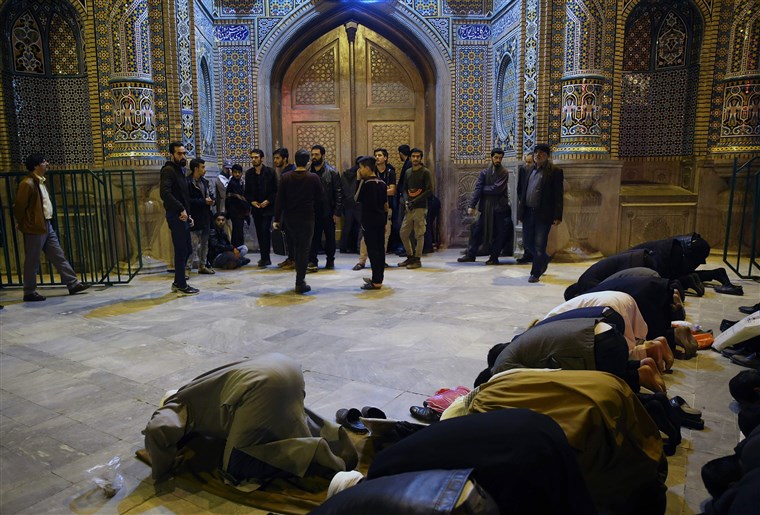
The most recent and troublesome prevention measures was that of the mismanaged closure of major Shia Shrines in Qum and Mashhad. A topic of great importance to the Shia communities, the sudden and unannounced closure of the Shrines, led to significant protests amidst Iran’s faithful. Critics note that officials did not even announce closure with justification or time of possible opening. They criticized the negligible communication between administration and Shrine-goers. Moreover, the closure of religious spaces and a lack of measures taken to close non-essential markets heightened sentiments.
Shia Rights Watch acknowledges the importance of disease prevention. It expresses support for those who strive to carry out the World Health Organization’s suggestions to limit exposure and death from COVID-19 daily. The organization further notes that the closure of Shrines in Iran, which has thus far thrived on faith, was naive and counterproductive.
The sudden closure has led to the spiral downturn of the relationship between the government and the people. Of the people gathering outside the Shrine, numerous protestors and vocals were met with violence. Men, women, and children were attacked by security forces as they used force to disperse crowds and thwart unrest. Following the attacks, authorities announced protestors were political dissidents and critics they have longed aimed to marginalize. The ill-treatment of protesters has proved to be counterproductive as it has led to a further outcry against policy-makers.
In addition to being mismanaged, Iran’s abrupt closure of religious sites was unreflective of the unique position of these institutions within religious and non-religious sects of society.
The management of Shrines in other countries, such that of Iraq, stands counter to Iran. Iraq is home to numerous major religious Shrines, including but not limited to Ali, the first Shia Imams, Hussain, the grandson of Prophet Mohammad, and his brother Abbas, the al-Askari and Al-Kadhimiya. The Shrines are one of the most influential voices to educate and treat people in addition to medical centers. Shrine management early on made definite conviction that the Shrines are valued refuge-sites and would under no condition be entirely closed. Instead, across social media and news outlets, management communicated active sanitization measurements within 24-hour durations in which a subsect of the Shrine is closed. A clear plan that acknowledged the social perceptions of the Shrines while also addressing disease prevention was announced and carried out.
While it is understood that progress is continual and that the measures in Iraq are far from conclusive, the management of Iraqi shrines is a clear counter to that of Shrines in Mashhad and Qum.
The Position of Shrines in Society
Shrines exist across religious and cultural spectrums. While each Shrine is associated with unique ideological significance, all Shrines serve as central spaces that address socio-psychological needs.
Shrines stand independent of mosques. While mosques are seen as spaces to practice a single method of worship, Shrines allow for individual expression of emotion and spirituality. Mosques are primarily attended by Muslims, while Shrines are visited by Muslims and members of other faiths.
Shrines are a catalyst for integration and harmony. They are spaces in which age, race, ethnicity, and socio-political positions fade. They are stable, trusted, and transcendent public spaces for people of all backgrounds.
Shrines serve as symbols of tranquility and peace of mind. In times of tension, these locations serve as locations of meditation and reflection from those who seek to ‘escape’ daily pressures.
Shrines have served vital social and cultural roles, and the recent closures failed to empower prevention measures using these roles. The sudden closures overlooked the potential of these settings to progress prevention measures and the possible negative social implications, including but not limited to behavioral fatigue, which already threatens Iran’s efforts to limit the spread of disease.
Sources of Empowerment
Shia Rights Watch presents ways Shrines could have been used to empower nations against COVID-19 below. Note the below suggestions are interventions that can be taken previous to complete closure of allreligious sites, regardless of their location.
Shrines are perceived to be trusted influences. Iran faces allegations of delayed action. Moreover, the continued movement between cities is a display of deteriorated trust in the government. Shrines as institutions could have been used as voices that educated prevention measures to the people. They could have been mediums by which policy-makers could have enlisted volunteers and extended resources.
Moreover, both Shrines in Mashhad and Qum are dedicated to martyred individuals. Thus, their history could have held potential in presenting the disease as a palpable threat.
Shrine-goers are members of a faith community. Research shows that within cohesive identity groups, prosocial action has higher rates of compliance relative to activities that benefit individuals. The residents of the tombs housed in the Shrines are valued for the lives they lived and their devotions to the greater good. The presentation of prevention measures as actions to protect other Shrine-goers could increase the compliance rate to behaviors such as hand-washing and social distancing.
Shrine-goers are prosocial volunteers. Historically, communities in proximity to the Shrines show great respect and devotion to these holy institutions and the people that visit them. Policy-makers could have enlisted devotees in efforts to reduce contamination and limit the spread of disease.
Shia Rights Watch values prevention measures that limit the spread of COVID-19. We further that implications of actions taken can be managed and foreseen with insight into the values of the community in which they are carried out.
Although Iranian authorities claimed the goal of the closure of Shrines in the country to be an act of social distancing, the aftereffect of the measure was counterproductive and even destructive to social wellbeing. Shia Rights Watch expresses its support for efforts that progress the health measure while also emphasizing insight into their long and short term social implications.
Tension over COVID-19 or the Coronavirus disease looms internationally as nations combat the expansion of the disease. Amidst the chaos, reports of discrimination are also prevalent. Ethnicities native to countries with the highest prevalence of the disease report being the target of violence as well as racial slurs.
In the Gulf region, discrimination against Shia Muslims is a primary concern. Already a marginalized group, Shia in Bahrain and Saudi Arabia fear being scapegoated for the decline in national health and the expansion of the disease in the country.
While they make up a majority, the Shia of Bahrain live with limited rights. Their religious identity is undermined, and expression is criminalized. They are regarded as second-class citizens in their home nations.
Today, sentiments of anti-Shiism are endangering the lives of all Bahrainis regardless of their religious identity.
Shia Rights Watch raises concerns for bias within anti-coronavirus efforts, which may lead to insufficient countering of the disease. The prejudice which places blame for the propagation of the illness on Shia Muslims is unsupported by medical authorities.
Moreover, sentiments of anti-Shiism degrade national morale and undermine a unified national effort against the disease.
Many within the nation continuously ridicule Shia and calling them traitors to their Bahraini nationality, regardless of their health status.
Today, Bahrain is home to 156 confirmed cases of the coronavirus.
In late February, Dr. Manaf al-Qahtani, an infectious disease consultant and member of the team for countering the disease, rejected accusations that placed Shia Muslims as central transmitters in the spread of Coronavirus to Bahrain.
He furthered:
“Neither the virus nor the disease has any relation to a specific race or a particular sect. It is a widespread virus that anyone may catch. We wish no one would nickname the virus by linking it to a specific party or doctrine. The World Health Organization made sure not to name it “China or Wuhan” virus, referring to the city of Wuhan from which the deadly virus originated.”
Within his statement, al-Qahtani pointed to the anti-Shia sentiment that fuels Bahrain’s lacking system for addressing the spread of the disease.
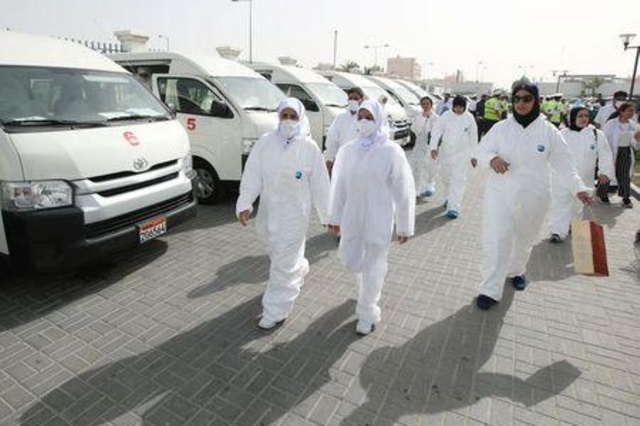
Thus far, Bahrain has instituted remote medical vans that test residents, especially those who traveled abroad and had returned previous to the travel bans, which now limits entry into the country.
While the travel ban serves to limit the spread of the contagion to the island-nation, it also complicates international efforts.
Currently, there are approximately 2100 Bahraini citizens stranded in Iran. The travelers were tourists across the country and visitors of religious shrines in the city of Mashhad. These individuals remain in Iran as all flights out of Iran are canceled. Some note the inability to pay for hotels and even lacking “clean clothes” after unexpected prolonging of their trip via canceled flights. Reports exist which place families with elderly and children in the Mashhad airport for days.
Despite calls for extradition, much like that of Canadian and American citizens from Wuhan, China, the Bahraini government has failed to make any efforts to address the needs of its citizens abroad.
Grievances highlighting a complete lack of regard for Shia Bahraini nationals exist. Not only has Bahrain failed to activate flights for those stranded, but Bahraini authorities have also disregarded foreign interventions and refused to cooperate.
The Bahraini Shia are not the only travelers from the Gulf regions in Iran. Both Saudi Arabia and Kuwait have nationals in Iran. Counter to Bahrain, however, both of these countries extradited their nationals and set up hotels with complete medical resources to reduce possible transmission. Kuwait even expensed hotels in Iran to house travelers that remain in Iran. Yet, Bahraini authorities refuse to make any efforts to protect its citizens from the coronavirus.
On Tuesday, March 10, the Foreign Ministry of Iran announced that with the intervention of the nation of Oman, the first group of Bahraini citizens would be traveling home. Extradition came after efforts were made by Kuwaiti citizens to gather funds for those stranded. Shia Rights Watch notes that the delay in extradition increased the risk of exposure for travelers and counters efforts to reduce the spread of the disease.
Despite recent efforts to bring back Bahraini citizens from Iran, Shia Rights Watch expresses a concern as to how they will be treated within their own nation.
Travelers who returned to Bahrain previous to the closure of the countries borders report being humiliated at the Bahrain International Airport, where some remain to this day. They are reportedly held in designated areas that functionally failed to meet international disease prevention guidelines.
Shia Rights Watch calls on the reframing of the coronavirus epidemic in Bahrain such that prevention is highlighted. Moreover, the organization warns against the implications of naming any single group as propagators of the disease.
Combating the coronavirus is an international effort. All groups must work together to prevent the spread of the disease without the fear of degradation or marginalization.
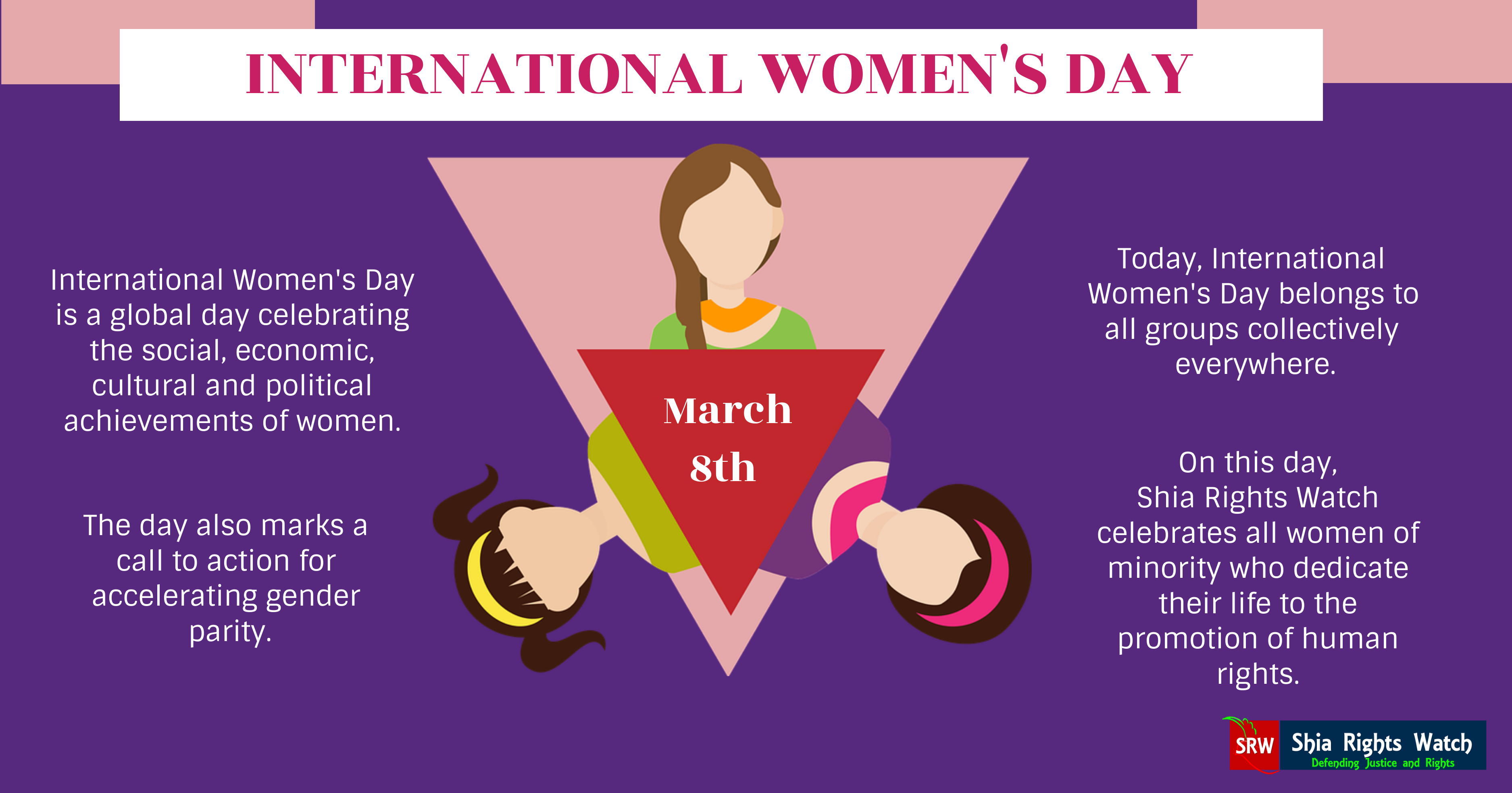
March 8 is International Women’s Day. On this day, Shia Rights Watch celebrates women all over the world who have dedicated their lives to the promotion of human rights.
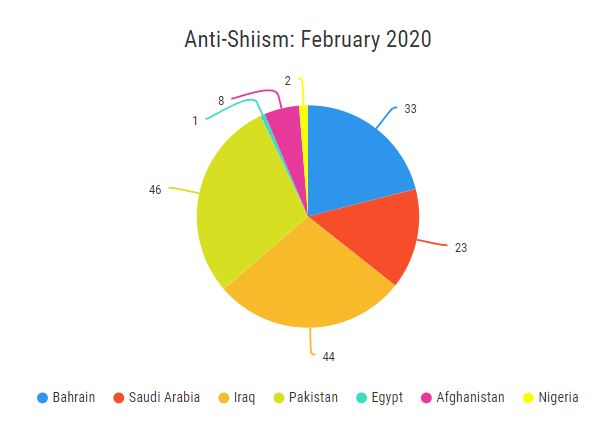
February stood witness to 151 incidents of anti-Shiism. Bahrain, Saudi Arabia, Iraq, Pakistan, Nigeria, Egypt, and Afghanistan were all nations in which violence against Shia Muslims occurred.
Bahrain
The treatment of Shia Muslims in Bahrain is worrisome. Shia Muslims in the country, while they make up the majority of the nation, face hardships and restrictions in the hands of the dominant minority, which in the past ten years have made the expression of Shiism more difficult. With a change of laws and regulations which challenge rituals inherent to Shiism, Bahrain has effectively criminalized the practice of Shiism.
Leaders of the communities are summoned and questioned about their sermons and religious interpretations. In early February, Mulla Abdul Zahra Al- Samahiji was called in for questioning. He was then detained for reasons undisclosed by officials.
As a result of the adoption of new laws, there is a high density of detainees in Bahrain’s prisons. Those in detainment suffer significantly from the refusal of authorities to meet their most basic rights and the use of violence to extract confessions.
Maltreatment many times follows the detainees well after their imprisonment terms.
Sayed Kadhem Sayed Abbas Al-Sehlawi passed away in February as the result of negligence in the duration of his detainment. Al-Sehlawi had reported severe pain in his stomach and back. It was two months before authorities transferred him to a hospital. After his release, Al-Sehlawi continued to be treated, but the extent of the damage was too high.
Medina Ali and Hajer Mansoor, both once detainees, spoke out about the conditions in which they were held while in prison. They stated they were kept in their cells sometimes 24 hours at a time with limited food and water. They were forbidden, like the rest of the inmates, from any religious rituals or even conversation with the other prisoners.
The two prisoners recounted physical violence, as well. Ali notes that the head of the prison punched her in the back, leaving days-old pain. Mansoor was hospitalized on numerous occasions as a result of the torture endured. In 2018, Mansoor had discovered a lump in her breast, yet was denied access to medical attention for weeks.
Mansoor’s son-in-law Sayed Ahmed was also detained in 2017- he is yet to be released.
Saudi Arabia
Arrests and raids were the top forms of direct violence against Shia Muslims in the Kingdom of Saudi Arabia. Residents of Awamiyah report raids in their town. Forces blooded neighborhoods, damaging property. In an attack in late February, eight were arrested, charged, and sentenced for a total of 58 years in detention.
Among those in detention are numerous minors and detainees being charged with crimes committed before they reached legal age. Muhammad Issa al-Faraj is one of 11 awaiting execution. Al-Faraj’s charges are from his participation in protests before his 10th birthday.
Nigeria
Approximately 100 members of the Islamic Movement of Nigeria were acquitted in mid-February. Both members and the leadership were absolved of blames in the events that lead to the Zaria massacre in which hundreds of Shia Muslims were killed.
This was the latest terminal trial in a case in which the Zaria government had sued 200 members of the IMN.
None-the-less, violence against the Shia of Nigeria continues. In a violent confrontation with protestors, a minor was killed by the hands of Nigerian forces. Police had used live ammunition to disperse those protesting the lack of justice in the case of Shiekh Ibrahim Zakzaky.
The case of Sheikh Zakzaky and his wife remains ongoing and little development.
Pakistan
A bomb in Quetta killed eight and wounded 22 others. The detonation took place near the Quetta Press Club and lead to extensive property damage. The weapon is said to have aimed to harm protestors of an international conference at the site.
Quetta is dense in Hazara Shia Muslims.
Egypt
On February 23, the Egyptian Court of Administrative Judiciary ruled the closure of all Shia websites and TV channels.
Censorship in Egypt is prominent. In 2018, the ratification fo the Anti-Cyber and Information Technology Law allowed officials to censor websites that are considered to threaten national security or economy. The law further allowed for the release of data and the penalization of visitors to the sites.
The majority of the websites taken down under the law have been new websites or sources of criticism to State systems.
Sources report the new judgment to be the function of fear of foreign political influence in the country.
Shiism in Egypt has a long and prosperous history. The most recent censorship of Shia media is a form of religious repression. Shia Muslims in Egypt have long expressed loyalty for their country and have denounced any political associations.
Iraq
Iraq was home to 13 incidents of violence, which led to the death of 12 and the injury of 32 others. The events occurred in various areas of Baghdad. Some days, parallel explosions happened across the city. Shia Rights Watch notes that many incidents of violence against Shia Muslims in rural areas of Iraq are not reported in fear of retaliatory violence.
ISIS claimed at least one of the explosions in the month. The others are unclaimed and underinvestigated.
Shia Rights Watch continues its commitment to studying trends of anti-Shiism in the year 2020.
The first month of the new year targeted violence against Shia Muslims remained prevalent and in need of international attention.
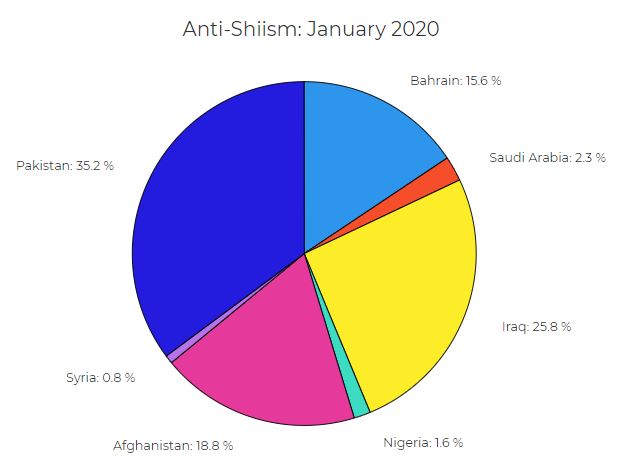
In January 2020, a total of 121 incidents of anti-Shiism were reported in the nations of Bahrain, Saudi Arabia, Iraq, Syria, Afghanistan, Pakistan, and Nigeria.
Bahrain
Detainment of Clergymen
Mulla AbdulZahraa Al-Samahiji, Sheikh Mohammed Al-Rayash, Mulla Qassim Zainuldin, Sheikh Abdulmohsen Al-Jamri, and Sheikh Ali Rahma were all clerics arrested in January. Sheikh Ali bin Ahmed Al-Jidhafsi, Sheikh Isa Al-Momen, Sheikh Hamza Al-Dairi, and Sheikh Jassim Al-Haddad were summoned for interrogation by security forces.
Those summoned noted a lack of clear reason for their appearance. Upon questioning, the clerics were asked to justify their sermons and their delivery of Quranic interpretations. End-of-the session prayers such that for mercy towards martyrs and the safety of the displaced as the result of conflict were also inquired.
The clerics were detained for over three hours before their interrogations. Shia Rights Watch notes that summonings and short term arrests are tactics used to induce fear in clerics and communicate an awareness of community events.
Release under Alternative Punishment Law
In January, Bahraini authorities released detainees Mohammad Faraj and Elias al-Mulla were released under the Alternative Punishment Law.
Mohammad Faraj was diagnosed with Multiple Sclerosis (MS), a deteriorative condition in which damage to the central nervous system disrupts communication between the brain and the body. Symptoms of MS, among others, are vision loss, pain, impaired coordination.
Elias al-Mulla, now 28, was arrested for participation in pro-democracy activism. Al-Mulla was sentenced to 15 years in prison on coerced confessions obtained through prolonged torture. He was diagnosed with stage 3-colon cancer while in detainment. Sources within the Al-Mulla family note the authorities failed to address his initial symptoms early on. They furthered that upon calls for help, he was met with physical violence.
Al-Mulla and Faraj are just two of the many individuals who were diagnosed with cancer while in detainment. Hameed Khatam passed away from stomach cancer late in January. Khatam was diagnosed while in detainment, charged with “insulting the king” on social media. He was denied treatment and upon his release, his cancer had progressed to stage 4.
The Alternative Punishment Law in Bahrain has become a beacon of hope for some in Bahrain. At the same time, many Bahrainees express concern for implications of the Law and the broad basis for release and assignment to alternative punishment. Moreover, Shia of the country note that this law is not an application of justice, but a shift in response to limited resources in the country.
Death Penalty
The death penalty was a topic of concern for the Shia communities in Bahrain in January. Mohammad Ramadhan and Hussain Moosa were among a number of detainees facing execution. The death penalty is especially worrisome, given the coercion of confessions from detainees. Sources withing detainment centers and their loved ones report the use of torture and threats in forcing detainees to signed false confessions. Moreover, detainees are not allowed sufficient due process during their trials. Death sentences in Bahrain are an outright questioning of dignity and human rights.
Saudi Arabia
The Eastern Province of Saudi Arabia is still home to the highest prevalence of violence in the hands of government authorities. Early in January, Mohammad Hussain al-Ammar was arrested after a raid. Raids remain the most prominent form of direct violence in the nation. Homes are entered illegally, and individuals are taken with force. Rarely are their families offered any information on charges or whereabouts of their loved ones.
The lack of communication by authorities stands true for the arbitrary summonings. Shiekh Ali Rahma was among those summoned for questioning without the presence of sufficient documentation or justification.
Upon injury and death, families of victims report a refusal by authorities to give access to the bodies of deceased inmates. Residents speculate the refusal to grant access to bodies is a means of concealing evidence of torture.
None-the-less, Shia of Saudi Arabia rally against injustice. In late January, residents of Qatif gathered in the thousands to mourn the death of young men killed by authorities.
Iraq
Iraq was home to the highest body counts among countries with incidents of Anti-Shiism. With over 30 total acts of violence against Shia Muslims, 20 individuals were killed, and 16 others were injured.
Incidents of violence in Iraq are individual assasinations. The detonation of explosions is the leading form of violence leading to injury; 7 different bomb detonations were reported to Shia Rights Watch.
Syria
In an incident in late January, two gunmen targeted the Sayeda Ruqaya shrine in Damascus, killing one and causing property damage. The shrine is a religious site that hosts the tomb of Ruqaya, the three-year-old daughter of Hussain, the grandson of Prophet Mohammad, who was martyred in Karbala, Iraq. Ruqaya is said to have died en-route as the caravan of Hussain’s family was paraded in Arabia after his death.
The gunmen remain unidentified.
The incident is not the first of its kind. Sources within Syria report targeted attacks against Shia religious sites, many positing that the attacks are eased by lacking security resources amidst turmoil in the country.
Afghanistan
Early in the month, a roadside bomb in Mazaresharif killed one and injured three others. Located in northern Afghanistan, Mazaresharif is the countries fourth-largest city. The term “Mazaresharif” translates to “Tomb of the Prince” and is in reference to a mosque in the city center believed by locals to house the body Ali, a notable Shia Imam. The mosque is also called the Blue Mosque in recognition of blue tiles that decorate the building.
In August of 1998, the city was home to the most violent massacre of civilians by the Taliban in the countries twenty-year war. Within days, Taliban forces sought out and killed male Shia Hazara, Tajik, and Uzbeks while kidnapping and raping their female counterparts. The exact number of victims from the massacre remains unknown.
Nigeria
On the 23rd of the month, Nigerian forces used tear gas and firearms on demonstrators who took to the streets, calling for the release of Shiekh Ibraheem Zakzaky. One person was killed, and another was severely injured.
In 2019, the Nigerian government outlawed the Islamic Movement of Nigeria, which was lead by Sheikh Zakzaky. Zakzaky himself remains in detainment.
Pakistan
In a detonation targeting the Shia of Pakistan, 35 were injured and 10 were killed. A suicide bomber detonated his explosives vest targeting a religious school in Quetta.
Quetta is home to Pakistan’s densest population of Hazara Shia Muslims. The Hazara are ethnic Shia who exist as diaspora fleeing Anti-Shiism in Afghanistan.
In this report, Shia Rights Watch quantifies violence against Shia Muslims and presents the dynamics of anti-Shiism in various nations of the world. This report reflects year-round investigations arranged by native activists and international researchers on actions taken to endanger populations based on their Shia identity.
Pushing for Protection: Advocating for the Shia as a document aims to educate human rights activists and lawmakers on the most recent trends of anti-Shiism and to suggest research-based interventions to combat violence and promote conflict resolution.
Anti-Shiism is a term used to denote actions that directly or indirectly, actively, or through complacency, promote hatred, violence, or prejudice motivated with the aim of detriment towards the Shia Muslim identity.
While violence in the forms mentioned above has existed for centuries, anti-Shiism has only recently been recognized by the international community.
It is important to note that this report represents only a fraction of insight into modern-day anti-Shiism. This report neither reflects all of the work Shia Rights Watch does in terms of which countries we investigate for human rights violations, nor does it showcase every single Shia human rights violation. Many forms of anti-Shiism are unquantifiable. Moreover, many incidents of violence are not reported due to fear of persecution or as a result of restricted communication resources.
Shia Rights Watch emphasizes that acts of violence included in this report are ones who were explicitly motivated by the religious identity of victims. Only the death of civilians is contained in this report. Reports of death as a function of political motivations are not included.
More information in regards to specific incidents of violence can be found on ShiaRightsWatch.org, including but not limited to, monthly analyses that detail anti-Shiism.
2019
Between January 1, 2018, and December 31, 2019, the international Shia community experienced 3,537 incidents of violence. Violence against Shia Muslims was varied and diverse in form. Imprisonment, denaturalization, injury, loss of life, life-sentences, kidnapping, denial of services, arrests, and property damage are just some forms of anti-Shiism recorded by Shia Rights Watch.
Updated Numbers
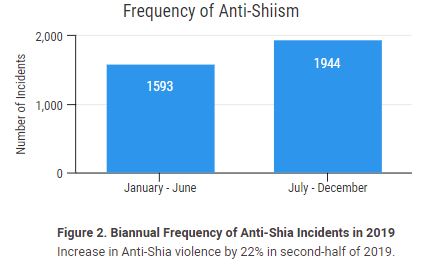
Of the incidents reported to Shia Rights Watch, 1944 were concentrated between July 1 and December 31.
Incidents of anti-Shiism increased by 22% in the second half of the year. The spike in numbers is mainly a function of incidents of mass violence in Afghanistan. Historically, due to the rituals that emphasize congregation and communality in the holy month of Muharram, Shia Muslims are at increased risk for targeted violence.
Shia Rights Watch notes the change in the reported frequency of violence in the first half of the year relative to the Biannual report. This change is a function of delayed reporting of survivors of violence due to fear and lacking communication resources, as well as an increased death count traced to incidents of violence previously reported. These numbers include victims who were initially injured and were deceased after the publishing of the Biannual report. Shia Rights Watch updates its reporting with respect to lives lost as a result of Shia rights violations.
Annual Trends
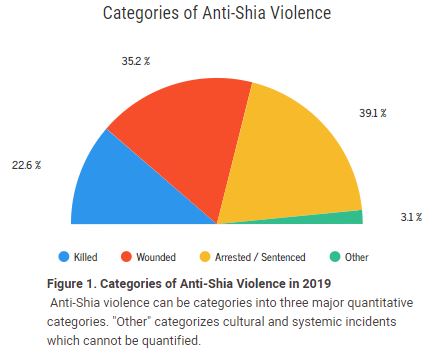
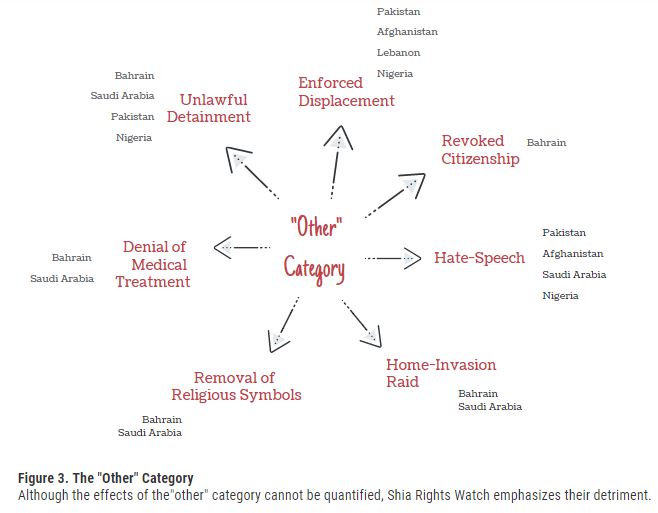
The primary forms of direct acts of anti-Shiism are killings, wounding, arrests, and sentencing. Of the 3,537 incidents of recorded anti-Shiism, approximately 109 are reports of cultural and systemic violence.
Shia Rights Watch has categorized such violence as “others” and notes that each cultural and systemic incident of violence affects countless Shia Muslims and has international implications.
“Other” in classification include, but is not limited to the following:
Denial of medical treatment
Unlawful detainment
Enforced displacement
Hate- Speech
Closing of Shia religious centers
Removal of religious symbols
Home-invasion / Raid
While Shia Rights Watch attempts to quantify forms of violence in an “other” category, the organization emphasizes that the detriments caused by such violence cannot be truly measured as they have both short term and long term, physical, and psychological effects.
Political Associations of Shiism
As an approximate population of 120 million, Shia Muslims live as residents and natives of various nations across the globe. They have diverse political ideologies and exist as multiple ethnicities.
In the past decade, however, Shia Islam has been vastly generalized into a single political identity under the influence of Iran. Shia Muslims in Saudi Arabia, Iraq, Pakistan, among other nations, are perceived to be promoters of values of the Islamic Republic of Iran. This perception is fueled by political propaganda and the nation’s history of Shiism.
Iran is not the first nor the last majority – Shia nation. Historically Shia Muslims have risen to power in many global regions (i.e., Fatimid Dynasty of 909) and have displayed the religious ability to stand independent of politics. Shia Islam, in itself, is not an affiliation but an ideology, free of any political tie. Based on Shia doctrine, mosque and politics are independent, and the only role religion plays to act as a check and balance of government jurisdiction and in protection and representation of the people.
The association of Shia Islam and Iran is destroying communities at large. Shia in various countries refuse association with Iran- many have not even been exposed to Iranian influence. Shia populations stand loyal to their nations and have shown the same citizenry to their resident countries as any other population. This publicized affiliation only strengthens international Iranian influence. It leaves nations fractionated and weak in response to extremist organizations, costing the lives of thousands, if not millions of men, women, and children. The association of religion to politics is not only counterproductive but also destructive.
In 2019, the nation of France joined the list of countries that fell victim to false associations of Shiism with Iran. In March, French Interior Minister Christophe Castaner closed down four Shia centers under the guise of them being backed by Iran. Giving in to ignorance, Castaner victimized French Shia Muslims.
Shia Muslims have long expressed independence from any political entity, and the minister’s failure to recognize Shia Muslims as an independent religious group was met with condemnation.
France is not the first nor the last nation to politicize its Shia residents and citizens. And while the actions of Minister Castaner was public and immediately recognized, the association of Shia Islam with a single political identity exists as unrecognized and unconscious discrimination.
Shia Rights Watch emphasizes that the association of Shiism with a singular political identity is dangerous. Shia Islam must be recognized as a multi-cultural, multi-ethnic decentralized identity and unrequited associations must be altered as a means of reducing anti-Shia violence.
Efforts to Address Anti-Shiism
In 2019, aims to address violence against Shia Muslims were taken in Sri Lanka, Pakistan, and the United States of America. While these measures were met with gratitude upon their occurrence, Shia Rights Watch highlights these pioneering promotions of religious freedom in this report.
Sri Lanka
In correspondence with the holy month of Muharram, the Sri Lankan Colombo Hultsdorf Magistrate courts ordered restraints against two nationalist groups, ‘Sinhala Jathika Balamuluwa’ and ‘Ravana Balaya,’ upon discovery of plans to disrupt Shia gatherings in the Bambalapitiya area of Colombo. Colombo authorities increased security around the Shia religious center and its surrounding neighborhoods.
Colombo Sri Lanka is home to approximately 25,000 Shia Muslims.
Pakistan
Authorities in Karachi, Hyderabad, Peshawar, Islamabad, Mirpurkhas, Shaheed Benazirabad, Sukkar, Larkana, and Nawabshah increased security by 69,545 to protect Shia mourners for the holy day of Ashura in which Shia Muslims commemorate the martyrdom of Hussain, the grandson of Prophet Mohammad.
The Sindh province declared the 9th and 10th of September, days with the highest processional attendees, as public holidays and cut off mobile services that could empower explosives. On rare occurrence of medical emergencies, six operation theatres, 16 ambulances, and 422 medical personnel were placed on high alert in Lady Reading Hospital.
Across Pakistan, mourning processions and gatherings were anticipated, and routine traffic was rerouted to reduce the feasibility of attacks.
The new measures not only protected Shia Muslims, but they also prevented violence that led to the loss of life and damage to property of non-Shia individuals.
United States of America
New York University students discussed minority identities and physical appearances in an event titled, “Making the Marginalized Mainstream: Being the Minority within a Minority.”
Participants noted feeling marginalized by their “own community” based on their Shia beliefs and even more discrimination based on skin color. Nawal Ali, a panelist at the event, noted the hidden power of being a minority, “Even though I might have felt I wasn’t part of the mainstream, being different is your superpower,” Ali said. “I don’t know if mainstream should be our goal, but by being unapologetic, we might be a window to Islam for somebody else, educating them.”
The above measures are explicit examples of decisive action that can be taken to promote minority rights. Shia Rights Watch encourages standards, legal and at a grassroots level, to reduce and prevent human rights violations. More information in regards to each of the above measures can be found at ShiaRightsWatch.org.
Counter Productive Policy
Poorly designed policy not only does not meet intended goals, but it can cause detriment to constituents. In this section, Shia Rights Watch highlights policy interventions undertaken in 2019 that counter to their aims of promoting human rights.
India’s Citizenship Amendment
Indian lawmakers approved an amendment to the nation’s Citizenship Law allowing illegal migrants who have lived in India for five years to apply for citizenship. The bill specifically eased naturalization for Hindu, Sikh, Buddhist, Jain, Parsi, and Christian individuals from Pakistan, Bangladesh, and Afghanistan, while ignoring the multitude of other minority religions and identities in these nations.
The adopted changes eased immigration for thousands of migrants but, for the first time in Indian history, created a provision for religious identity to serve as a basis for granting citizenship.
The bill caused an outcry in the Muslim community as it explicitly discriminated against Muslims.
As it pertains to Shia Muslims, the bill has dangerous implications. The law limits Shia Muslims fleeing prosecution, especially as it sets precedents in the region to explicitly limit migration based on religious identity. Already a targeted group, the new bill excludes Shia groups such as the Hazara from Pakistan, Bangladesh, and Afghanistan- all countries included in the statement. Exclusions of the Shia from the law is a fierce display of biased policy as these groups have been established as endangered minorities in their native nations. As for Shia native to India, many may be expelled to countries in which their lives are targeted by active anti-Shiism.
The Indian government claimed the law serves to present India as a haven for groups discriminated against in neighboring nations. Counter to their declared goals; the amendment marginalized other religious groups and signals the acceptability of intolerance and prejudice.
Residence by Religion in Lebanon
Lebanon has long established itself as a multireligious nation. Yet in an incident on June 26, in the town of Hadath, southeast of Beirut, a Shia Muslim couple was denied their right to rent a property. The property owner told the couple that a law established by Hadath’s officials prohibited Muslims from renting or buying Christian property. Only Christians are allowed to buy or rent property in Hadath. It is important to note that Hadath is on the edge of an area known as Dahiyeh, Beirut’s densely populated Shia area, and those who seek to reside in Hadath are Shia.
The Mayor of Hadath, George Aoun promoted sectarianism in a statement saying,
“Every village should preserve itself. Every Shiite village should preserve its Shiite nature, every Christian village should preserve its Christian nature and every Sunni village should preserve its Sunni nature. We want to preserve our village or what remains of it.”
This incident was the only one publicly announced. Still, it has become more and more common in other Lebanese cities in east and south Lebanon to limit residence to specific religious sects. Local lawmakers are adopting legal measures that would make it harder for non-Christians to buy and operate the property in their jurisdiction.
Mayor Aoun and his like claim to protect their communities. However, they are instigating identity-based restrictions that breed intolerance in Lebanon.
Limited Hazara of Pakistan
The Hazara are an ethnic group of Shia Muslims that originate from the historic town of Hazarajat, Afghanistan. They have long been the target of anti-Shia violence, so much so that Shia Rights Watch estimates that only a fraction of their population has survived ethnic cleansing over the years.
Quetta, Pakistan, is home to a substantial population of Hazara diaspora. In July, security forces were deployed to Hazara districts of Quetta as a means of reducing targeted violence. The community, however, notes that as a result of increased checkpoints and security inspections, they have been marginalized from the greater society.
While the increased checkpoints aimed to reduce potential violence, they inadvertently marginalize the Hazara residents and deter business by limiting passage in and out of the area.
Shia Rights Watch acknowledges the need for top-down interventions to protect religious minorities. Top-down policies, however, can also have negative implications if they are not representative of their constituents and their needs.
Country Based
Anti-Shiism is present in various forms and is unique to its target Shia population. Shia Rights Watch gathers information concerning violations against Shia Muslims in all nations of their residence. The incidents included in this report are only a sample of violence that threatens Shia Muslims. Thus this report must be used as a window into Anti-Shiism. Moreover, points and trends noted in this report serve as first stepping stones into interventions that can reduce and eliminate violence against Shia Muslims.
In the following section, trends of violence specific to each nation will be presented.
Afghanistan
Afghanistan is home to approximately 8 million Shia Muslims. Primarily, the Shia population native to Afghanistan consists of Twelvers or those who believe in the successorship of 12 infallible leaders following the martyrdom of Prophet Mohammed.
Shia populations in Afghanistan historically exist as ethnic communities, the most prominent of which is the Hazara group. With the rise of terrorist organizations like al-Qaeda and the Taliban, Shia communities disbanded ethnically. In response to increased violence, both direct and cultural, some Afghan Shia practiced in private in fear of being targeted.
Despite efforts to conceal their identities, the nature of Shia rituals makes pockets of Shia communities identifiable. Attacks are mainly designed to target the maximum number of Shia civilians. Targeting is indiscriminate to the age or gender of victims.
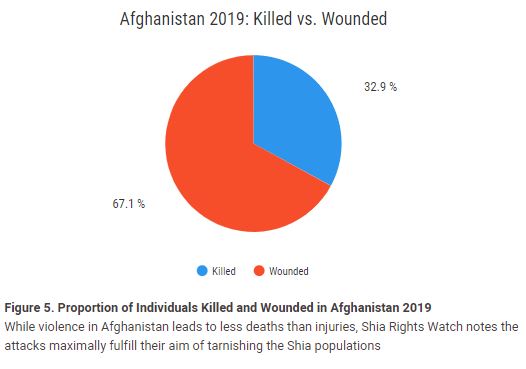
In total, 744 Shia men, women, and children were killed and wounded in 2019. Improvised explosive devices were the most common medium of violence.
Perpetrators of anti-Shiism are mainly violent aggressors from existing terror organizations, including but not limited to the Taliban and ISIS-affiliated groups. The nature of the attacks exemplifies radical extremism fueled by the dehumanization of those perceived to be deviants from the secular extremist ideologies promoted by these organizations.
Attacks against Shia Muslims occur in mosques, celebratory and commemoratory congregations, and cultural or educational centers.
Shia Muslims and non-Shia sympathizers are killed in bombings. Others are injured and communities, Shia and non-Shia live to endure the infrastructural and psychological damage caused by terror attacks. Terror attacks cause more injury than they do loss of life. While this may point to the inaccuracy of bombings, Shia Rights Watch, notes that these attacks maximally fulfill their potential to marginalize Shia Muslims by presenting them as high-risk group associations.
Two-wave attacks are frequent in the hands of terror organizations. Not only do extremists want to eradicate Shia Muslims, but they also wish to eliminate anyone who empathizes with victims of anti-Shiism. After an initial explosion that targets Shia congregations, a second attack targets those who provide aid or support to Shia Muslims.
The attacks against civilians have resulted in extreme fear and paranoia, preventing Afghan Shia from attending religious and cultural programs. Such violence not only threatens the lives of the people but also harms their overall participation in society.
Bahrain
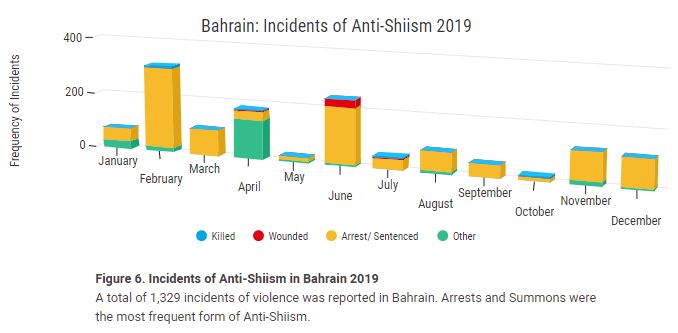
In 2019, 1329 incidents of violence were reported in the Kingdom of Bahrain, 500 of which were the function of raids.
Arrested and summonings are the most prominent form of anti-Shiism in Bahrain. Injuries have been the result of violence in raids and failure to maintain minimum health and sanitation requirements for prisoners.
Prison Conditions
Medical negligence is a prominent form of violence in the hands of authorities at detention centers, such as that of Jaus. Prisoners with existing conditions are prevented from follow up medical attention, and families report that living conditions are worsened by torture and solitary confinement. Some prisoners report having spent as much as 23 hours a day in solitary.
In the final months of the year, scabies ran rampant among detainees. Scabies, a contagious skin rash caused by mites, is an easily treatable condition, yet authorities within detention centers have failed to attend to prisoners.
Increased Limitations on Social Media
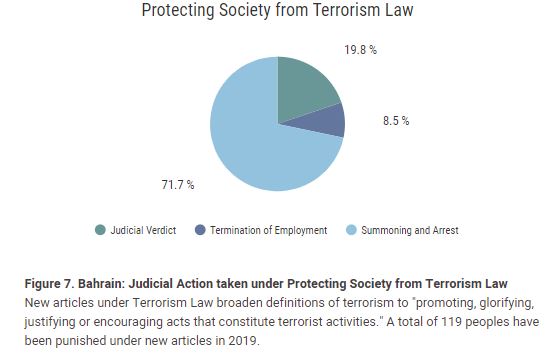
In 2019, the Bahraini lawmakers made definitions of terrorism broader than ever before, thus allowing more critics of the government to be placed behind bars on actions that the United Nations would classify as free speech.
Adoption of the new legal measures makes even retweeting and following criticizing social media accounts acts of sedition. Criminalization of freedom of expression in the media occurs through 21 articles under the Protecting Society from Terrorism Law with penalties ranging from fines to imprisonment for promoting, glorifying, justifying, or encouraging acts that constitute terrorist activities, which themselves are defined arbitrarily by presiding judges.
As a result of the newly adopted articles, 119 violations have been recorded including 76 incidents of summoning and arrests, 21 judicial verdicts against social media journalism and 9 cases of termination of employment, or threats thereof; 51 of the summonings were of preachers and eulogy reciters active during the first ten days of Muharram alone.
Alternative Punishment Law
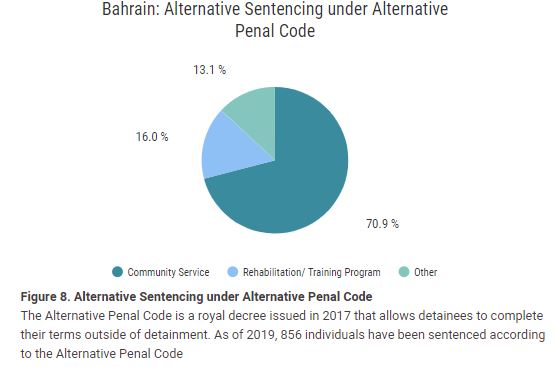
While rights-based violations exist and continue to threaten the livelihood of Shia Muslims in Bahrain, increased use of the Alternative Penal Code adopted in 2017 has served as a beacon of hope for some families.
The Alternative Penal Code is a royal decree issued in 2017 that allows detainees to complete their term outside of traditional detainment centers.
Under this law, prisoners who: served over half of their sentence, paid financial dues and are in good conduct can complete their punishment in the forms of community service, house arrest, confinement within a particular place, refraining from entering a particular place or places, limitations in communicating with particular persons or entities, submitting to electronic surveillance, attending rehabilitation and training programs, and remedying the damage that resulted from the crime.
Moreover, “any convicted person sentenced to imprisonment of not more than one year or physical coercion may request the Execution Judge to substitute the imprisonment sentence or physical coercion by one or more of the alternative sanctions set forth in Article 2 of this Law. The execution judge shall decide upon such a request after hearing the statements of the Public Prosecution.”
Thus far, 856 individuals have been sentenced according to the Alternative Penal Code.
While the law provides hope for many detainees, it remains under heavy criticism from the Shia community in Bahrain. The new alternatives allow for increased long and short term limitations in the financial and psychological well being of pro-democracy activists. Moreover, the laws disintegrate Shia communities and present dangers of possible indoctrination of these individuals against their communities in fear of return to prison. While the government has eluded to the new penal code as a public good, the alternatives have unilateral benefits and created minimal grounds for social and human rights.
For instance, Article 3 of the Law in which community service can be made as an alternative punishment, allows for unpaid employment in roles similar to occupation or profession previous to detainment. Shia Rights Watch notes this alternative aims to counter the increasing failure of social structures as the result of protests which left national service positions lacking workers. Moreover, the organization notes that placing Shia Muslims within posts of occupation without any compensation, financial or resources, opens the way for the public and private sector to violate their employees through disproportionate workload and a malevolent psychological environment.
Given the lack of measures that would ensure equal rights in the workplace and the existing hostility against activists, monitoring the after-effects of the alternative penal code must occur.
Similar concerns stand for other alternatives such as the rehabilitation and training programs that stand as the second most prominent alternative punishments. Under Article 8 of the Penal Code, “attending rehabilitation and training programs shall take effect through compelling a convicted person to undergo one or more of the medical, psychological, social, educational, occupational or industrial rehabilitation and training programs to reform his behavior.”
Noting a history of prominent Saudi Arabian influence in the Kingdom of Bahrain, Shia Rights Watch also fears the inclusion of religious indoctrination within training programs.
Indoctrination can be detrimental to the Shia identity, especially as the law calls for refraining from “communicating with particular persons or entities” and “submitting to electronic surveillance,” all of which can lead to the marginalization of previously convicted Shia persons from their larger Shia community.
Nigeria
Shia Islam is the largest growing religious minority in the African continent. The nation of Nigeria is home to the region’s densest population of Shia Muslims. Activists estimate 4 million Shia Muslims in Nigeria.
Anti-Shiism in Nigeria continued in 2019. The most prominent case of anti-Shiism is that of Sheikh Zakzaky and the Islamic Movement in Nigeria (IMN).
Zakzaky and his followers in Kaduna were first recognized in December 2015 when their congregation was attacked by the Nigerian army during religious processions. The single incident led to the death of 400 Shia Muslims, the majority of whose families were refused ritual burials. Bodies were later discovered in mass graves.
Figure 9. Timeline of events related to Sheikh Zakzaky
In July of this year, the IMN was banned and outlawed by a Nigerian court on assumptions that the group acts in association with the Islamic Republic of Iran, and the association that Shia Rights Watch has warned to be dangerous and detrimental to basic human rights.
In September 2019, Agnes Callamard, the United Nations special rapporteur on extrajudicial, summary or arbitrary executions condemned violence against the Islamic Movement in Nigeria led by Sheikh Zakzaky after a 12-day investigation. Callamard noted “arbitrary deprivation of life” and the excessive use of lethal force against protesters. Moreover, she stated that evidence of alleged weaponization of the group is lacking and that the Nigerian authorities lack sufficient justification for their actions against the group. Callamard cautioned against violence and warned the violations in the hands of authorities could destabilize the African region.
None-the-less, Sheikh Zakzaky and the IMN remain a point of contention. Sources close to Zakzaky report deteriorating health after a stroke last year. A toxicology examination in June 2019 found high levels of cadmium and lead in Zakzaky’s blood. Moreover, medical examinations showing the loss of eyesight and further complication to his pre-existing cardiac condition. Protestors took to the streets calling for attention to the leader’s health.
In July, clashes between protestors and government soldiers led to the immediate death of 19, injury of 5 and the arrest of 159 Shia Muslims; 38 of those arrested were arraigned in court in the week following the clash.
Following the rising contention, the Kaduna State High Court ordered the release of Zakzaky allowing him and his wife, who is also detained and suffering from injuries incurred in previous attacks, to undergo medical treatment in India. Femi Falana, the Zakzaky counsel noted that the government of Nigeria warned the couple against seeking asylum in India and that the couple’s travels would be strictly escorted by security forces. On August 12 the couple arrived In India for treatment. Upon arrival, a statement by Zakzaky was released expressing grievances of limitations imposed by the government of Nigeria amidst his travels. He stated,
“After we arrived we realized that in this hospital, or better yet someone working in the Nigerian embassy here told us that before we came, they had carried out a meeting with the hospital staff, the workers from the Nigerian embassy and some security operatives on how to go about things once we are here.
So we saw that we were practically brought to another detention facility which is even stricter than the one we were in back in Nigeria. They came here with police armed with guns and a lot of staff from the Nigerian embassy. And we also noticed we were brought into another detention that we only came based on trust.
Even in Nigeria, they agreed where we were detained that we would be treated only by the doctors we choose and are comfortable with allowing us to treat us. But here we understand that the doctors that advised us to come here are blocked from having any say in our case. They even told us when we spoke to them, they are only allowed to advise but the hospital reserves the right to decide the course of our treatment. So I told them that, we came here based on the trust we have in our doctors, we cannot just see any doctor that we don’t know, or trust to treat us. And without a recommendation from those we trust, we cannot allow a stranger to treat us, lest not what couldn’t be done with bullets be carried out in a different way.
Due to this, we think that based on everything we have seen so far indicates to us that we are not safe here. We were just brought to another detention.”
Fueled by mistrust in Nigerian influence in their treatment, the couple returned to Nigeria within days without completing necessary treatments. Upon arrival, they were taken to undisclosed locations. Since their return little has been disclosed of the state of Sheikh Zakaky and his wife. The couple remains in custody with no developments in their case.
The Islamic Movement of Nigeria community, however, remains under the assault of national forces. On processions in commemoration of Ashura, the tenth day of the holy month of Muharram and the anniversary of the death of Imam Hussain, government forces attacked mourners killing 12 individuals and injuring dozens of others. The congregation of the group was also violated in December as hundreds gathered in memory of lives lost in 2015 in state-authorized violence that killed hundreds of Shia Muslims.
While the IMN and Sheikh Zakzaky have gained international media attention, Shia Rights Watch wishes to highlight the nature of non-associated Shia Muslims in Nigeria. Given the treatment of Zakzaky and his community, it can be assumed that Shiism in Nigeria is not openly accepted. Shia Rights Watch notes that inquiry is needed into the existence of cultural and systemic discrimination against identified Shia Muslims in Nigeria. The organization recognizes the fears and lack of security which may limit the expression of the Shia identity, and also highlights the need for understanding the conditions of life for Shia Muslims who do not associate themselves with the IMN.
Pakistan
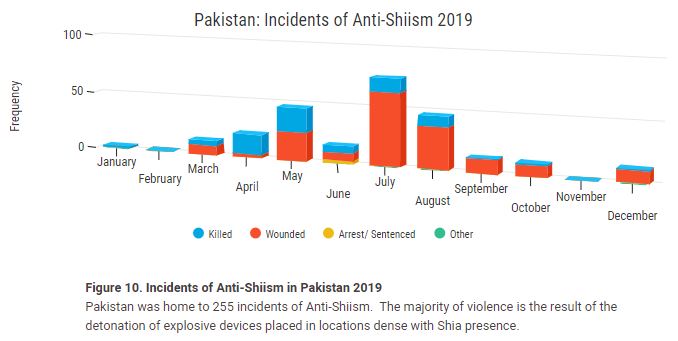
Pakistan stood witness to 255 incidents of anti-Shiism in the year 2019.
In the first half of the year alone, 160 Shia Muslims were killed or injured. The majority of violence is the result of the detonation of explosive devices placed in locations dense with Shia presence.
The most prominent forms of violence in the nation were death or injury as the result of a mass killing of Shia communities, namely the Hazara, and the targeted killings of prominent Shia individuals.
Mass Killings
Quetta has been the target of the nation’s highest frequency of bombings. The site of a large population of Hazara Shia Muslims, the city of Quetta is largely targeted by terror organizations. Suicide bombers and car bombs are often detonated in market places or places of the congregation to maximize loss of life.
In April, the terror group Lashkar e Jhangvi initiated an attack in Quetta with explicit aims to “target the Hazara community”. The attack led to the death of 20 and the injury of 48 others. In May, another explosion near a Shia mosque rocked Quetta killing four and injuring dozens of others. Later in August, an improvised explosive device detonated under the chair of the prayer leader inside a mosque, again in Quetta, killing four.
Two-step explosions have been used on numerous occasions to ensure the killing of Shia Muslims as well as sympathetic aid workers.
Outside Shia dominant locations, Shia Muslims also face danger. In June, Hazara Shia again were the target of extremism. Two individuals were killed in an explosion in Ziarat, Balochistan as they traveled for “sightseeing” of the region.
Assassinations
Notable Shia Muslims in positions of social power at higher risks of being targeted all over Pakistan.
In January, the vice-chairman of the Shia Council, Mohammad Ali Shah was shot in Karachi. In March, Sayyed Hussain Shah, the Superintendent of the Balochistan University was shot by an unknown assailant.
Assassinations are a prominent form of anti-Shiism in Pakistan. Prominent Shia Muslims in a position of power are targeted and killed in a shooting by unknown assailants on-route. While assailants are known to be motivated by radical ideologies of terror groups in the area, they are rarely identified and arrested. Shia Rights Watch posits that individual targeting of prominent Shia Muslims is a means of thwarting the rise of Shia Muslims to positions of power to influence society. Moreover, they aim to signal the intolerance of Shia Muslims in legislative and educational institutions in the country.
Such intolerance for Shia Muslims was also evident in the call for the removal of the Vice-Chancellor of Bacha Khan University, Saqlain Naqvi, in Charsadda in December 2019. Protestors invoked Naqvi’s Shia identity as a means of inciting support for his removal.
Identifiable Shia Muslims are also the target of extreme violence. In June, Muzamil Abbas was beheaded by two extremists in Punjab. The assailants had identified and targeted Abbas by his necklace which bore the name of Ali, a prominent Shia Imam.
Measures to Counter Violence
Within the past year, efforts to reduce anti-Shiism were taken.
In 2019, Shia Rights Watch recognized Pakistan’s preparation for Muharram processions. Authorities reported increased health and approximately 70,000 security services in areas dense in Shia population, including Karachi, Hyderabad, Peshawar, Islamabad, and Nawabshah. Moreover, authorities warned against anti-Shia propaganda and hate-inciting publications. Plans for rerouting traffic to reduce congestion as well as reduce incidents of violence were announced in advance.
Shia Rights Watch expressed gratitude for the protection of religious expression and the prevention of violence that could have led to the loss of life and damage to property of non-Shia individuals. More information on this issue can be found on ShiaRightsWatch.org.
While efforts to reduce violence signal development in the nation, some measurements have been counterproductive. For instance, in July, security forces were deployed to the Hazara districts of Quetta as a means of protection. The community, however, notes that as a result of increased checkpoints and security inspections, they have been marginalized from the greater community.
The criticisms of the new measures by Shia Rights Watch sources point to a failure of the authorities to include Shia communities in the planning of efforts to address anti-Shiism. In order to meet the needs of survivors of violence, Pakistan must include Shia Muslims in city planning and encourage community-level interventions that empower communities against violence.
Iraq
The year 2019 stood witness to 502 incidents of anti-Shiism in Iraq. This reported number is void of any incidents of violence against protesters as their motivations were not the religious identity of individuals but their political ideologies. Shia Rights Watch approximates at least 25,000 incidents of violence (injury and death) against Shia individuals protesting the political climate in Iraq. Shia Rights Watch expresses its sympathy for all lives lost in the struggle for freedom of expression and rights.
The most prominent form of anti-Shia violence in Iraq was that of assassinations, or targeted shootings, and bombings.
Assassinations in Iraq are prominent across the north and south. Unknown assailants target identified Shia Muslims, typically male, and kill them using handheld guns on transit. Kidnapping and killing were common by ISIS assailants as their territorial reign retracted. While evidence for ISIS activity exists in limitation, Shia Rights Watch posits that the same anti-Shia sentiment that fueled the success of ISIS enforces violence against Shia Muslims today.
It must be recognized that there are many incidents of violence that remain unreported. Grassroots activists state that many families do not report loss of life in fear of being recognized as Shia Muslims. Moreover, many fear that reporting anti-Shiism would instigate retaliatory tribal violence. Thus, the 502 incidents of violence in Iraq can only be taken as a sampling window into the dynamics of violence in the nation.
Shia Rights Watch sources within Iraq report numerous dismantled explosive devices in cities such as Samarra which have a heavy presence of security sources. Dismantled bombs were also found in Baghdad. Successful prevention of direct violence is a source of hope that violence prevention can be possible with increased security measures.
Saudi Arabia
Saudi Arabia was the home to a total of 187 incidents of anti-Shia violence.
Approximately 51% of deaths in Saudi Arabia were the result of executions. Executions in Saudi Arabia occur en-masse. Those executed were charged with terrorism and charged on confessions extracted after torture and tried in sham trials with severely lacking due process.
Among those executed were individuals such as AbdulKareem al-Hawaj who was arrested as a minor for participating in pro-democracy protests.
Executions have become an increasingly popular form of punishment in the Saudi Arabian judicial system; with 184 total executions, 2019 marked an all-time high in the number of executions in one year.
Raids were the second-most prominent form of violence with which Shia Muslim were killed. Frequently throughout the year, raids were carried out in areas with a majority Shia population. Late at night or at dawn, security forces flood Shia neighborhoods and instigate fear by shooting at infrastructure and cars. Homes are entered unlawfully and individuals suspected of pro-democracy activism are taken. As a result of unprecedented violence, a number of Shia Muslims have been killed in raids.
The year 2019 also stood witness to the death of a number of detainees as a result of failure to address detainee health concerns. The brutal conditions in Saudi detainment centers have lead to the death of three detainees in 2019. Dissident Saudi cleric Sheikh Saleh Abdulaziz al-Dumairi died of health complications he had developed at Tarfiya prison; Dumairi suffered from heart problems and was being kept in solitary confinement.
Nayef Ahmed Al-Omran died in detainment due to neglect by prison authorities. Hussein Ali-Abdul Aziz al-Ribh, arrested in 2017, died in Dhahban Central Prison in November following torture.
Families of victims who have lost life in raids or while in detention have been largely denied access to the body of their loved ones. Sources stipulate that bodies of individuals that die in detention are withheld with the aim of hiding evidence of torture and maltreatment.
Conclusion
Anti-Shiism remains a prevalent international issue. Imprisonment, denaturalization, injury, loss of life, life-sentences, kidnapping, denial of services, arrests and property damage are types of violence reported to Shia Rights Watch. This report only presents quantifiable incidents of anti-Shiism. Each incident extends to tens of unquantifiable cultural violence, including but not limited to marginalization, stigmatization, and scape-goating of Shia communities.
Prevention of violence is possible.
While violence against Shia Muslims continued, the year 2019 also stood witness to numerous measures that aimed to address anti-Shiism; 2019 showed that preventing violence is possible. Executive-level sanctions against violators of human rights in Sri Lanka and Pakistan were a display of actions that policy-makers and executors can take to signal intolerance towards targeting of minority groups. Events at New York University also show that a platform for discussing the dynamics of minority groups can be created.
Parallel to interventions that positively impacted pro-rights efforts were interventions that were ineffective, and in some cases even detrimental, to minority communities. Such counterproductive policies lacked the inclusion of at-risk communities and an overall understanding of the possible unintended implications policy may have.
Having experienced anti-Shiism first hand, Shia Muslims can provide unique perspectives on the needs and the potentials of this group in reducing violence.
To the Shia Communities and Activists:
Build Community Capacity and Agency
At a community level, Shia Muslims must work to develop and strengthen processes and resources that promote community cohesion and resilience. Shia Muslims can build an active, educated and aware network that promotes justice and condemns human rights violations against all religious minorities, including their own.
To do so, Shia Muslims must first acknowledge concerns of anti-Shiism in their international communities and then adopt agency to address violence-related trauma in their respective communities.
Subsequently, Shia Muslims must build bridges with their legislative representatives. By participating in dialogues and volunteering for initiatives that directly and indirectly support their community, Shia Muslims can become active citizens to both their Shia communities and their greater national society.
The top-down policy has the power to create change on a national and international scale.
To National and International Policy-Makers:
Establish Judicial Justice
In one form or another, Shia Muslims are threatened by the failure of due justice. In nations such as Saudi Arabia, Bahrain, and Nigeria, Shia activists are detained and denied a fair trial. In some cases, policies and laws are amended in a manner which criminalizes Shia rituals such as religious congregation. Shia Rights Watch urges nations to enforce judicial justice by ensuring fair trials, abolishing the death penalty (especially for minors), banning travel impositions, halting revocation of citizenships, and complying with international laws and standards.
Moreover, in nations such as Pakistan and Afghanistan, Shia individuals have reported a failure in their judicial systems to effectively prosecute agents of anti-Shiism. Shia Rights Watch calls on leaders to secure justice for religious minorities through investigation in anti-Shia incidents.
Include Shia Muslims Explicitly
In recognition of the marginalization of Shia Muslims by extremist ideologies, the explicit recognition of Shia Muslims as active, yet targeted, members of the country can legitimize the Shia identity. Examples of such action would be the allocation of resources, protection of the group in locations with dense Shia population and the establishment of entities as a communication bridge with community leaders.
The explicit recognition of the group empowers Shia Muslims to further their participation in their greater national communities. Moreover, to groups within the nation and to foreign powers, the recognition and protection of religious minorities signal intolerance towards targeted violence and cultural discriminations. Subsequently, the inclusion of Shia Muslims in policy-making allows for targeted policies that can truly address the needs of the community and thus reduce possible negative implications.



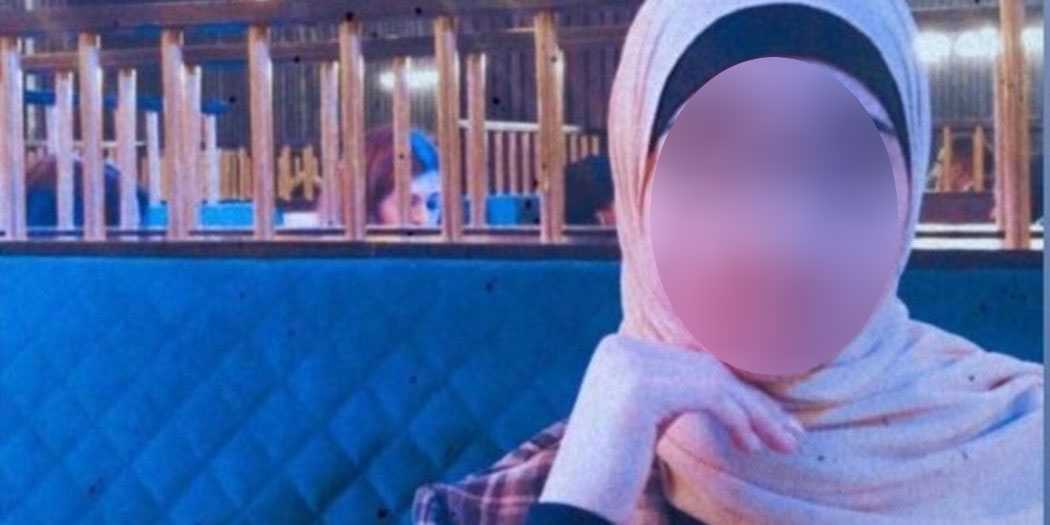
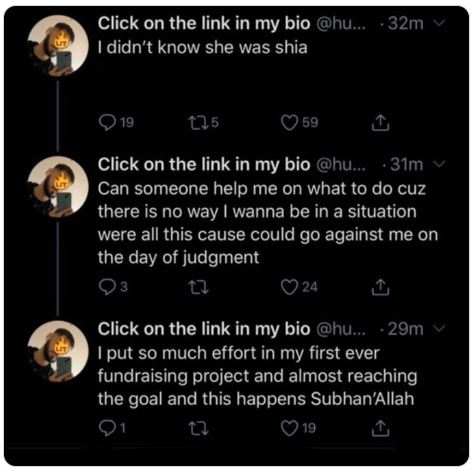 On May 17, Aya Hachem, a 19-year old student, was shot in the chest and killed on a trip to the grocery store. The Hachem family were refugees from Lebanon living in the United Kingdom.