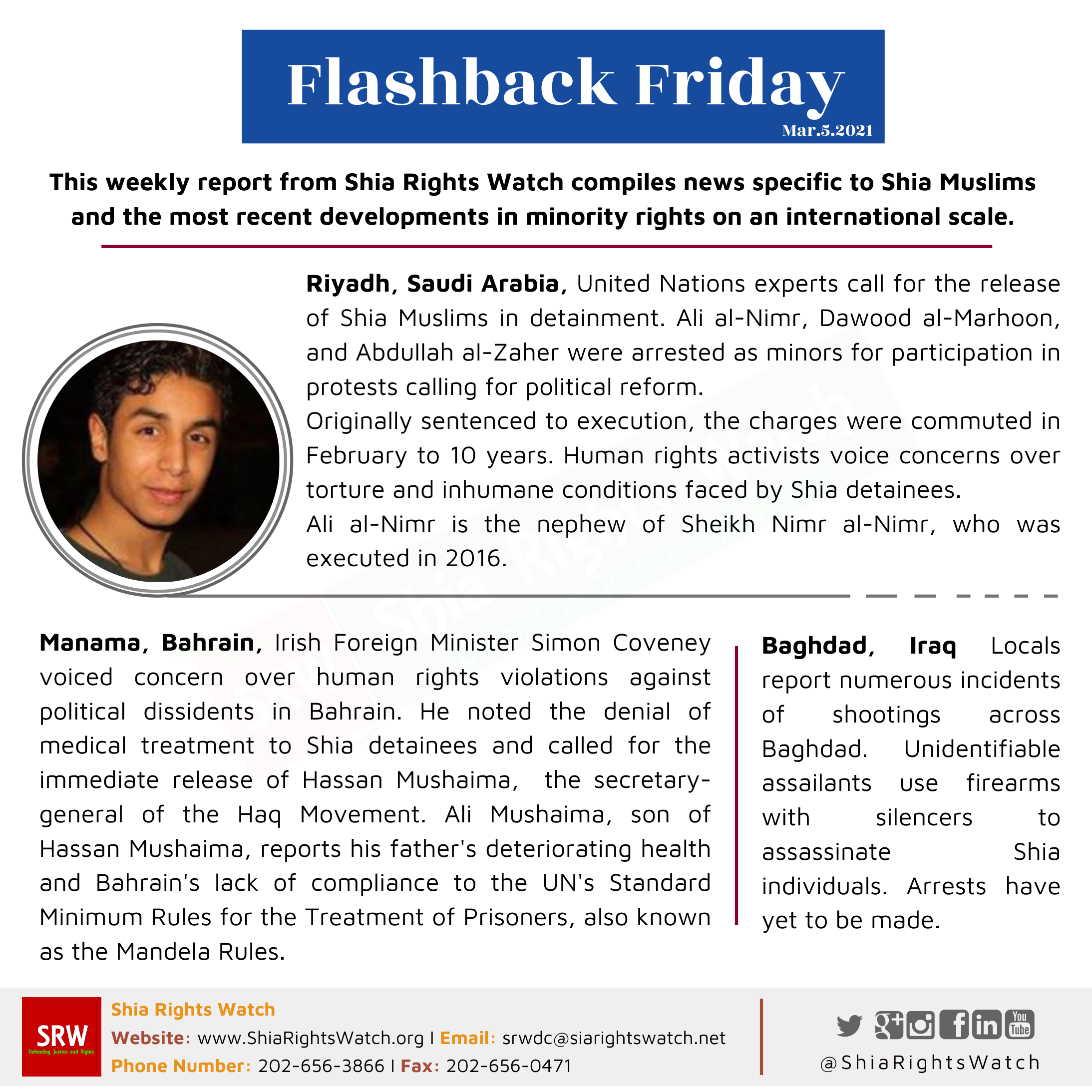
Flashback Friday March 5, 2021
Flashback Friday, February 26, 2021
Shia happenings in the week of February 26, 2021
Detained Shia Muslims Face Harsh Conditions and Threats to Basic Rights
Flashback Friday February 19, 2021
Find news about Shia Muslims in the past week in a single page.
10 Years of Calling for Reform in Bahrain
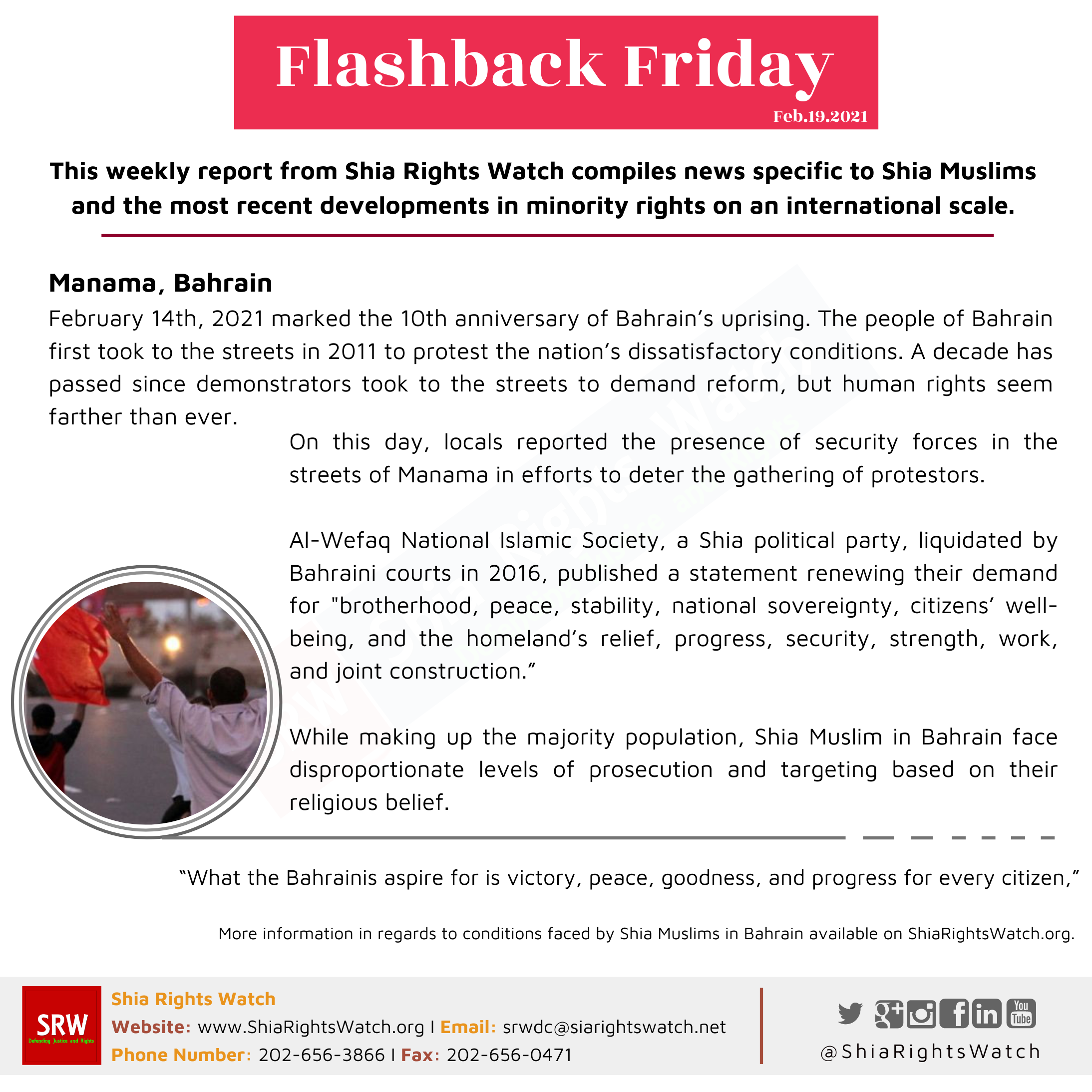
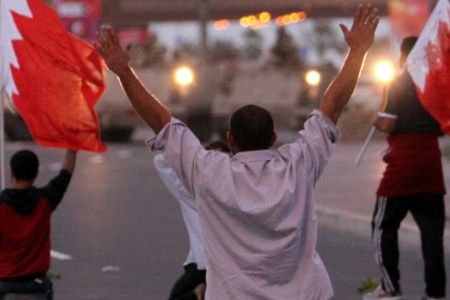
February 14th, 2021 marks the 10th anniversary of Bahrain’s uprising. The people of Bahrain first took to the streets in 2011 in protest of the nation’s dissatisfactory conditions. A decade has passed since demonstrators took to the streets to demand reform but human rights seem farther than ever.
February 14th is also the anniversary of the National Action Charter of Bahrain in 2001 and the 2002 Constitution in which King Hamad bin Isa al-Khalifa’s instituted a set of democratic reforms both documents in response to social calls for reform.
Inspired by the uprisings in Egypt and Tunisia, Bahraini youth participated in 55 marches in 25 locations across the country, in nonviolent protest to discriminate rulings in the hands of the monarchy. Despite the peaceful nature of the protests, tens of individuals were injured and a number were killed as a result of the violent response by national forces.
Since 2011, Shia Muslims of Bahrain face increased restrictions in congregation and freedom of speech. Political groups who voiced support for democracy have been disbanded and activists face long sentences and denial of due process. Officials instituted zero-tolerance policies for critique or any association with opposition groups. So much so that social media posts, likes, and retweets were used as the basis for the arrest and even removal from public sector occupations.
Bahraini Shia Muslims continue to live under extreme human rights detriment as violations toward them increase and expand without any international interventions. In 2020 alone, Shia Rights Watch reports 230 new arrests (this number does not include the tens of individuals who were arrested in 2019 and have yet to be sentenced).
Moreover, Shia Rights Watch records cases of torture within detention centers as a means of deriving false confessions. Violations include but are not limited to sexual abuse.
None-the-less, human rights and democratic reform in Bahrain have not received any support from the international community. Nations like the United States and the United Kingdom who expressed immense support for democratic efforts in Egypt and Tunisia failed to recognize the people’s movement in Bahrain. Between 2012 and 2019, the United Kingdom provided 6.5 million pounds in technical assistance. In 2019, the United States States Department undertook weapons sales worth 3.4 billion dollars.
Shia Rights Watch expresses concern for Shia Muslims in Bahrain, especially on the anniversary of February 14. Shia Rights Watch emphasizes that authorities in Bahrain must refrain from using excessive force against protesters as mass protests can be expected during February. They have to regain their citizens’ trust by equal treatment and by releasing detainees unconditionally.
Moreover, we call for independent oversight into the conditions of human rights in Bahrain by the international community and appropriate changes in economic exchange as a form of accountability.
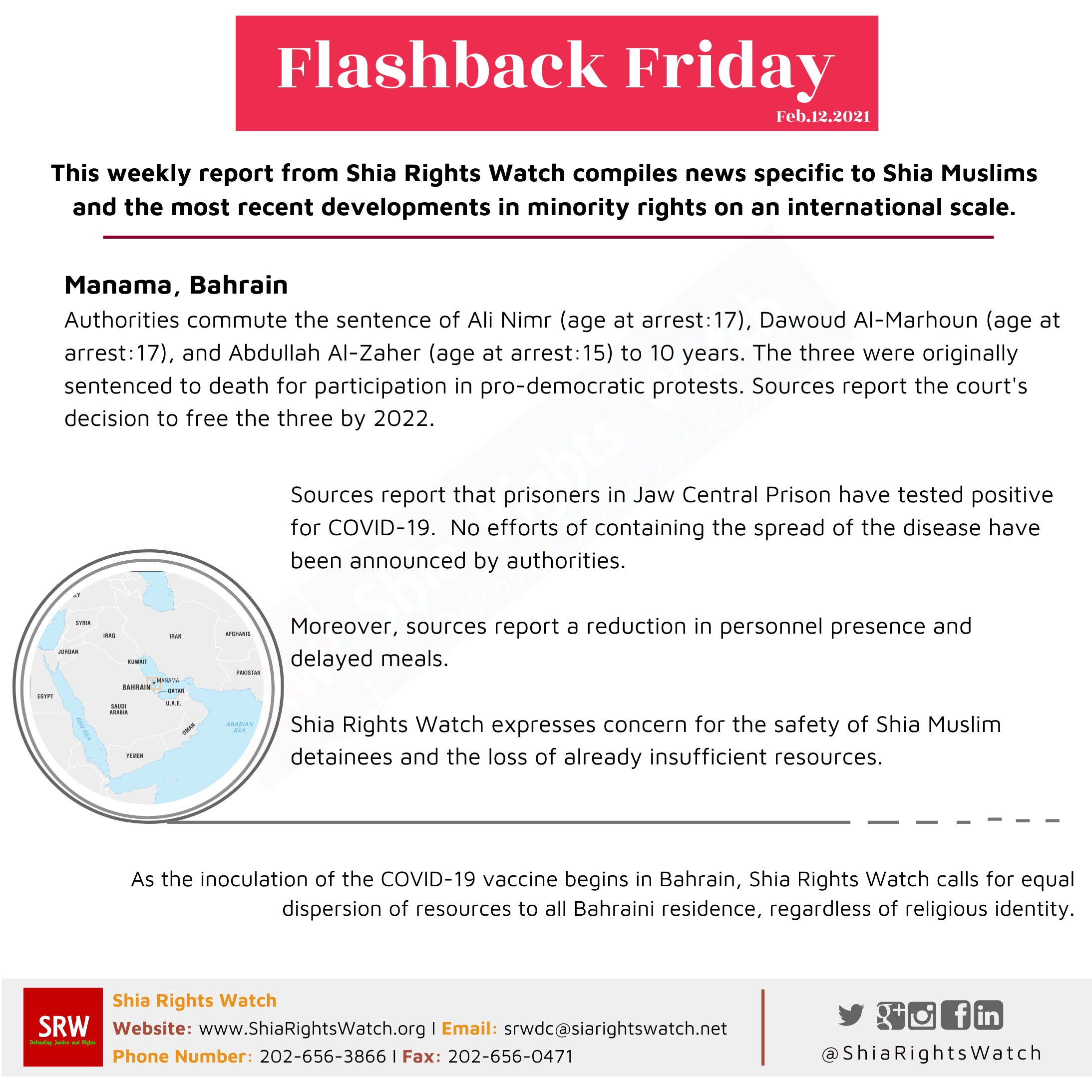
Flashback Friday February 12, 2021
Shia-related news in the week of February 12, 2021
Incidents of Anti-Shiism, January 2021
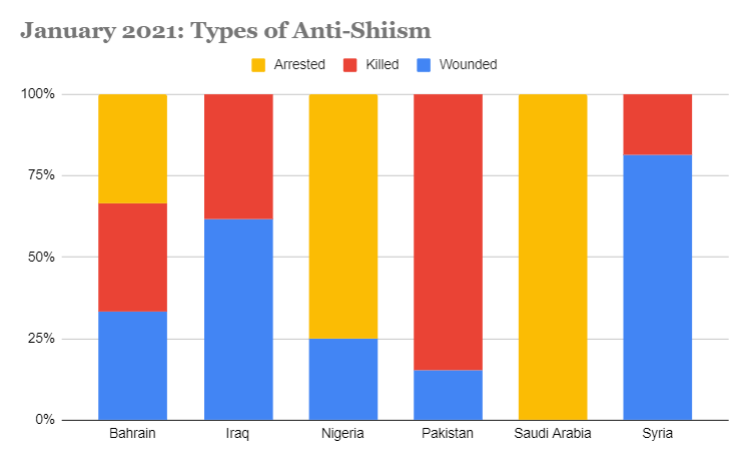
Shia Rights Watch has recorded 245 cases of anti-Shiism in the month of January. Incidents of direct violence occurred in the countries of Bahrain, Iraq, Nigeria, Pakistan, Saudi Arabia, and Syria.
Shia Rights Watch notes that the true effects of anti-Shia violence, including but not limited to generational trauma, cannot be quantified. We continue to monitor and report conditions faced by Shia Muslims all over the world in efforts to raise awareness and reduce human rights violations. 
Bahrain
The Kingdom of Bahrain stood witness to 10 incidents of anti-Shiism.
Four of those incidents have been arrests. Early in the month, the son of orator Hussain Mahdi Sahwan, Muhatir Sahwan was arrested. Authorities based his arrest on his participation in a commemorative gathering.
On the 10th of the month, authorities arrested Miqdad Al-Ajimi and Hassan Al-Ajimi in raids in Abu Quwa.
Later in the month in Manama, Ali Hussain was arrested upon his summoning to the local police station. In Ma’ameer another young man was arrested by authorities without a warrant.
On the 29th of January, attendees at the Sitra Cemetary were arrested as they visited the gravesite of their loved ones.
Despite being a majority, Shia Muslims continue to be prosecuted on the basis of their religious identity. Participation in commemorative gatherings has been used as a basis for detainment. While the congregation of Shia Muslims has long been criminalized in the Kingdom of Bahrain, recent waves of the coronavirus have been used as an excuse to further limit religious expression among Shia Muslims.
Family of those arrested report harsh conditions for prisoners. The family of Sheikh Ashour reports a lack of contact with him for months. They expressed immense concern as evidence of torture was previously seen on the cleric.
Further reports have been made by detainees in Bahrain’s detention centers, one of which is Jaws Prison, of violence and abuse.
Iraq
With 116 injuries and 58 deaths, Iraq stood witness to the highest number of Shia rights violations in the month of January.
On the 21st of January, two bombings in central Baghdad killed 32 and injured 110 others. Early in the day, a suicide bomber lured a crown around himself by feigning illness. He detonated his explosive vest as a crowd gathered. Another perpetrator targeted aid workers with a secondary detonation.
The January attack was the second double bombing in Tayaran Square since 2017.
Other attacks occurred in Diyala, Amara, Anbar, Mosul, Salah-d-Din, and Najaf in the form of individual assassinations and bombings.
Nigeria
January 16 marked the fourth anniversary of the expiration of the 45-day caveat in which the release of Shaikh Ibrahim Zakzaky was ordered by the Abuja Federal High Court. The order has yet to be carried out.
Late in the month, Malama Zeenat Ibrahim tested positive for Covid-19.
Protesters took to the street in protest to harsh conditions faced by the Zakzaky couple. Two were killed as authorities used excessive violence to meet protestors.
Late in the month, Malama Zeenat Ibrahim was temporarily released for treatment and the deceased protestors were laid to rest. Justice for those killed in peaceful protest has yet to be instituted as no action has been taken by authorities.
Pakistan
Early in the month of January, ISIS assailants attacked a coal mine in Mach and killed 11 miners after identifying them as Shia Muslim. The miner’s hands were tied behind their backs and shot close range. Sources report that several victims’ throats were also slit. Upon discovery, the bodies were blood-soaked and bruised; six were dead, and 5 others died en route to the hospital. The miners were of the minority Hazara group.
The act of anti-Shiism incited anger all over Pakistan. Demanding justice, the family of victims refused to bury their loved ones for close to a week. Bodies of the miners were placed on the road and Hazara groups gathered demanding the presence of Pakistan’s Prime Ministers Imran Khan and explicit action to protect the group against extremism.
On the 18th of the month, the detonation of an explosive device place on the side of the road in Quetta led to the injury of two people.
Shia Muslims in Pakistan, namely those of the Hazara group are frequently targeted by extremist assailants. Despite frequent attacks, little has been done by the government to protect the population.
Saudi Arabia
The sentencing of six Shia Muslims has been reported to Shia Rights Watch. Renowned eulogist, Mohammad Bujabara was among those sentenced. Bujumbura was sentenced to the detainment of 9 months. The eulogist was arrested on October 4, 2020, along with eight others for participation in Arbaeen commemorations in al-Asfar. Five others were sentenced to four months.
Syria
A bombing in Aleppo left six dead and two dozens others injured. A car bomb detonated killing civilians, three of which were children. The incident occurred in Afrin City, Aleppo on January 30.

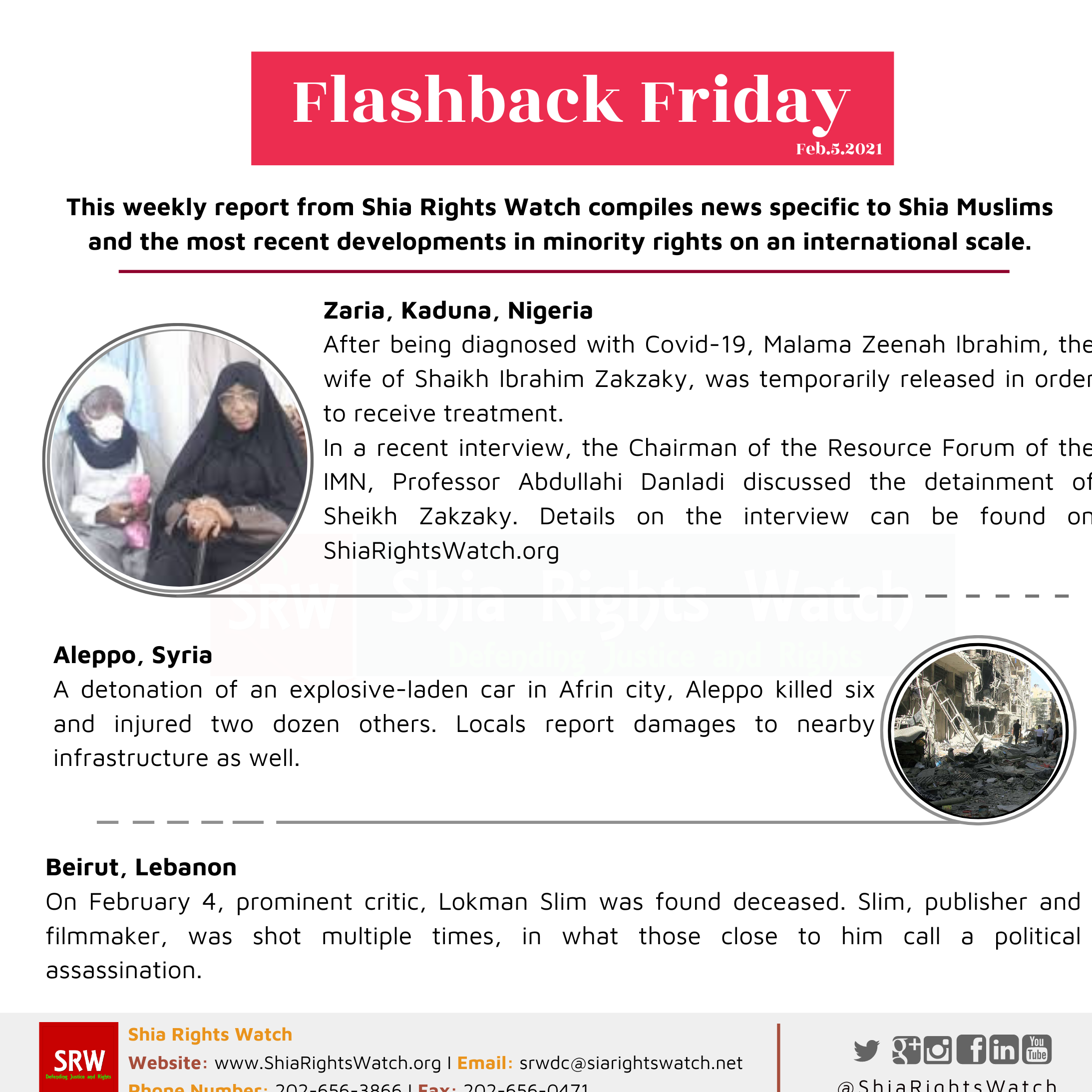
Flashback Friday – February 5, 2021
Happenings specific to Shia Muslims in the week of February 5, 2021
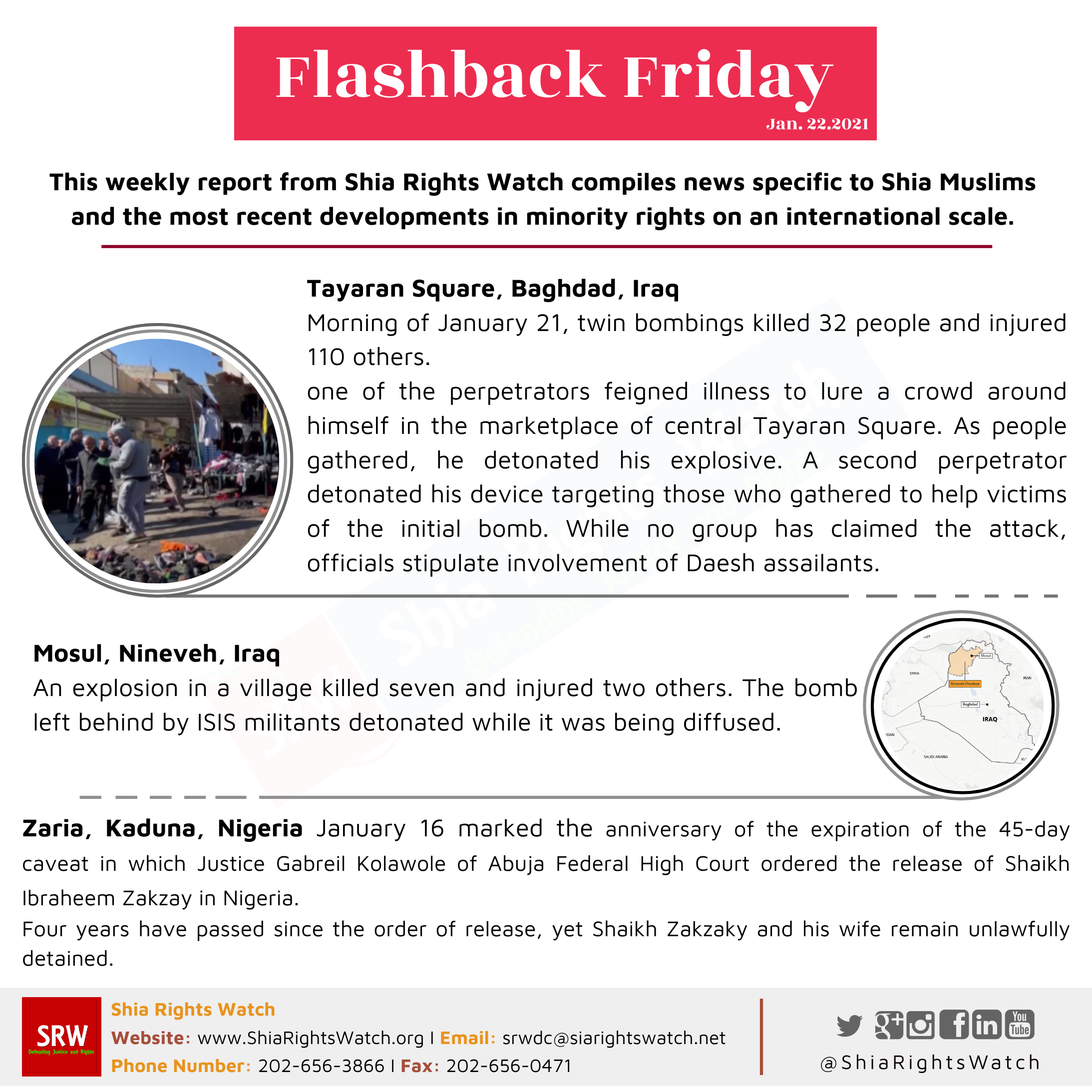
Flashback Friday – January 22, 2021
Find news about Shia Muslims in the past week in a single page.
Bombings in Tayaran Square Baghdad Kill 32
Shia Rights Watch condemns bombing in Baghdad, Iraq on January 21, 2021 and offers its condolences to the nation of Iraq.
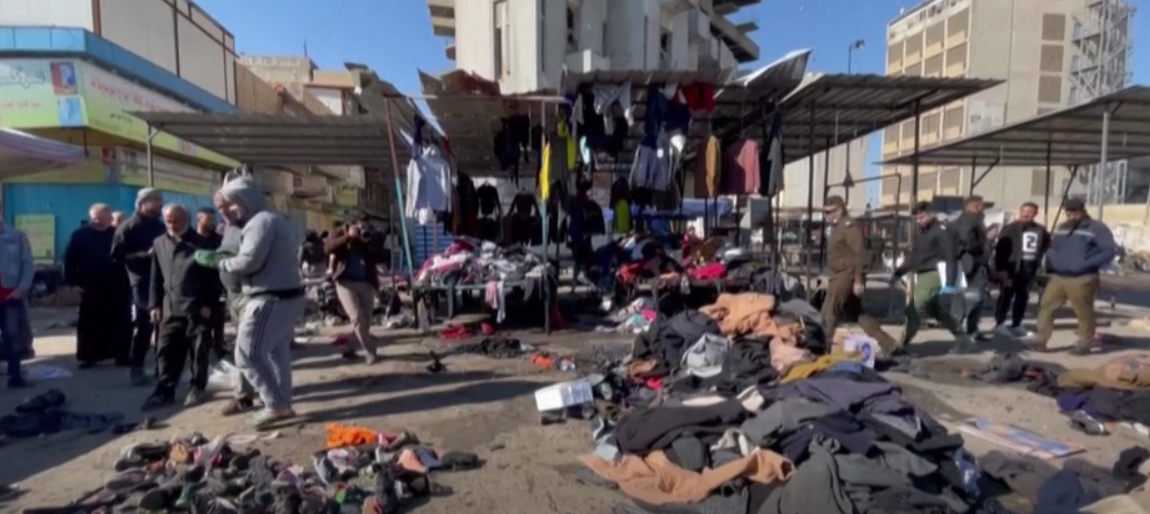
In a twin suicide bombing in central Baghdad, 32 people have been killed and 110 others have reportedly been injured on Thursday morning.
Yahya Rasool of the Ministry of Defence said one of the perpetrators feigned illness to lure a crowd around himself in the marketplace of central Tayaran Square. As people gathered, he detonated his explosive. A second perpetrator detonated his device targeting those who gathered to help victims of the initial bomb.
Wreckage and dried blood remain on the streets as onlookers walk by. Sources within Baghdad report a sense of turmoil as family members and loved ones wander the market-place in search of bodies affected by the blasts.
The death toll is expected to increase given the gruesome nature of the attack.
The attack has been condemned as a “reprehensible act of cowardice that underscores the dangers of terrorism that millions of Iraqis continue to face” by the United States embassy in Iraq.
While no one has yet to take responsibility for the attack, analysts note the nature of the attack as a hallmark of Daesh.
Tahsin al-Khafaji, spokesman for the Joint Operations Command, said, “This is a terrorist act perpetrated by a sleeper cell of the Islamic State.” Al-Khafaji further stipulated that the attack aims to express the existence of ISIS in the country.
The last double bombing that occurred in Tayaran Square, Baghdad occurred in 2018 with 35 killed and 95 others injured. The 2018 attack occurred shortly after Prime Minister Abadi’s declaration of victory over Daesh.
While the frequency of Daesh attacks across Iraq has decreased since 2017, the extremist organization is still active, and the recent attack is a reminder of that.
Thursday’s attack is a clear display of the continued need for an anti-Daesh offensive in Iraq. Since 2018, ISIS is perceived to be ‘defeated’ as their visible ties have been broken.
Authorities announce pressures inhibiting ISIS assailants organizing and obtaining access to arms. Officials further claim significant declines in manpower, financial ability, and freedom to operate for extremist groups.
Shia Rights Watch calls for a renewed examination of extremism in Iraq. Despite claims of weakened Daesh activity, the casualties in the bombings in Tayaran Square attest that sleeper cells are active danger to the security of the nation.
Holistic anti-extremism measures must be taken and efforts to reduce casualties within response teams must be adopted.
Shia Rights Watch urges for sustainable measures that inhibit the growth of extremist groups, but more importantly security measures that protect Iraqi citizens.